Job & Career
Why does lifelong learning become a mandatory part of the program for you as a creative professional?


Contents 10 sections
- What exactly is behind the term lifelong learning?
- Why is the need for continuing education rising so sharply right now?
- Which learning formats are best suited for creative professionals?
- How is e-learning changing the way you pursue continuing education?
- What are the biggest hurdles to lifelong learning?
- What does your personal learning plan look like?
- Which competencies are particularly in demand in 2025 and beyond?
- Why is lifelong learning also worthwhile financially?
- What is the best way to start now?
- You might also be interested in
The half-life of expert knowledge is shrinking rapidly. What you know today about tools, technologies or marketing strategies can already be outdated in two years. Especially for freelancers, agencies and creative professionals in the DACH region, this is a real challenge. After all, anyone who doesn't keep up loses clients to the competition, which keeps developing steadily. Lifelong learning is therefore no longer an academic concept, but your personal competitive advantage.

This article shows you why lifelong learning is existential for creative professionals, which learning formats really work, and how you can integrate continuing education into your everyday work in a practical way. You will also find out what role e-learning plays and why digital learning formats are fundamentally changing the industry right now.
What exactly is behind the term lifelong learning?
Lifelong learning describes the idea that education does not end with graduating from school or university. It includes formal continuing education such as certificate programs as well as informal learning through YouTube tutorials, podcasts or exchanges with colleagues. The European Union defined the concept as a key strategy as early as the 2000s to secure competitiveness and social participation.
For you as a creative professional, this means specifically: Every new Photoshop feature, every change in the Google algorithm, every AI trend requires adaptation. The German Federal Ministry of Education and Research also uses the term life-accompanying learning, because it better captures the ongoing nature. It is precisely not about a one-time training course, but about a permanent attitude.
The good news: You are probably already learning more than you think. If you analyze a design trend on Pinterest in the evening, watch new CSS techniques in a webinar or exchange ideas about project management methods with a colleague, then that is already lifelong learning in practice.
Why is the need for continuing education rising so sharply right now?
Three major developments are driving up the need for continuing education. First, artificial intelligence is changing practically every creative profession. According to the World Economic Forum's Future of Jobs Report, around 39 percent of existing competencies will become obsolete or fundamentally transformed by 2030. For web designers, copywriters and video producers, this means: Anyone who cannot use AI tools will soon lose assignments.
Second, digitalization is accelerating change in all industries. The Bitkom Continuing Education Study 2024 shows that 66 percent of respondents assume that AI-based training will be standard in five years. At the same time, only 62 percent of employees feel sufficiently informed about their employer's continuing education offerings. For freelancers and small agencies, this source of information is often missing entirely.
Third, the shortage of skilled workers plays a decisive role. Those who specialize and demonstrably bring up-to-date knowledge can demand higher day rates and get the more exciting projects. According to the Federal Statistical Office, the continuing education rate in academic professions was 10.5 percent in 2024. That sounds low at first, but it shows: Those who pursue continuing education belong to a minority and stand out from the market.
Which learning formats are best suited for creative professionals?
Not every learning format suits every learning type and every daily work routine. The following table gives you an overview of common formats and their strengths.
| Learning format | Time required | Cost | Particularly suitable for |
| Online video courses | Flexible, often 2 to 20 hours | Low to medium | Software skills, design techniques |
| Blended learning | Several weeks | Medium to high | Certifications, comprehensive topics |
| Microlearning | 5 to 15 minutes daily | Low | Quick updates, refreshers |
| Peer learning | Variable | Free | Exchange, new perspectives |
| Workshops and bootcamps | 1 to 5 days intensive | High | Hands-on topics, networking |
| Specialist literature and blogs | 30 to 60 minutes | Low | Deepening, background knowledge |
For creative professionals, hybrid formats in particular have proven effective. A short online course in the morning, a professional podcast on the way to the client and a monthly exchange with industry colleagues together make up a solid learning program that can be integrated into everyday life without much effort.

How is e-learning changing the way you pursue continuing education?
The global e-learning market has been growing at an impressive pace for years. Analysts currently estimate the global market volume at around 130 billion US dollars, with an annual growth rate of about 9.5 percent. Germany is one of the leading markets for digital learning in Europe. For freelancers and agencies, this is a fantastic development, because e-learning removes the typical hurdles of traditional continuing education.
You no longer need to fly to Munich for a two-day seminar and pay 800 euros in conference fees plus a hotel. Instead, you can work through a course on Adobe After Effects at 10 p.m. in your home office or watch a webinar on SEO strategies over breakfast. The flexibility is unbeatable, especially if you as a freelancer schedule your own time.
Modern learning platforms increasingly rely on AI-supported personalization. This means that the learning path adapts to your prior knowledge and your learning pace. You skip basics you already master and get exactly the deepening you need. Those who want to build a professional strategy for digital continuing education in a company will find comprehensive E-Learning consulting from a single source at specialized providers such as chemmedia. From strategy development through the right learning platform to content creation, all building blocks are considered.
Another important trend is so-called microlearning. Short learning units of five to fifteen minutes that focus on a specific topic fit perfectly into the work breaks of creative professionals. Instead of blocking a whole day for continuing education, you learn in bite-sized pieces and still keep up.
What are the biggest hurdles to lifelong learning?
Everyone knows the most common excuse: no time. And indeed, according to an IW study, lack of time is the biggest obstacle to professional continuing education in Germany. Self-employed people in particular face the dilemma that every hour they spend learning is an hour in which they earn no money. But that is precisely a fallacy. Continuing education is an investment, not an expense. Those who learn new skills can often deliver better results or offer new services within a few weeks.
Another problem is being overwhelmed by the sheer number of offerings. There are thousands of online courses, webinars, tutorials and certificates. Without a clear learning strategy, you quickly spread yourself too thin and learn a little of everything, but nothing properly. The key is to focus on the competencies that have the greatest leverage for your specific projects and career goals.
Last but not least, motivation plays a major role. Self-directed learning requires discipline. Without exam pressure or an instructor who checks homework, many find it hard to stay on track. Fixed learning routines, study groups with colleagues or setting milestones, for example one completed certificate per quarter, help here.
What does your personal learning plan look like?
A good learning plan needs neither a project manager nor a spreadsheet. Above all, it needs honesty with yourself and a realistic time budget. The following checklist helps you create your individual learning plan.
✅ Take stock of your current skills and identify the three biggest gaps for your professional development.
✅ Define one concrete learning goal per quarter, for example "master the basics of prompt engineering" or "refresh video editing skills in Premiere Pro".
✅ Reserve fixed learning times in your calendar. Even two to three hours per week add up to over 100 learning hours over the year.
✅ Choose a maximum of two to three learning sources at the same time so you don't spread yourself too thin.
✅ Document your progress. A simple notebook or a Trello board is completely sufficient.
✅ Find a learning partner or a community with whom you regularly exchange ideas.
✅ Review your learning plan every three months and adapt it to new requirements of your projects.
The decisive point is that you establish learning as a fixed part of your working life. Just like accounting, client acquisition or project management, continuing education is one of your professional duties. Just a much more pleasant one.

Which competencies are particularly in demand in 2025 and beyond?
A look at current studies clearly shows where things are heading. AI competence is at the top of the list. This is not about training machine learning models yourself, but about integrating AI tools sensibly into your own workflow. Prompt engineering, AI-supported image editing and automated content creation are skills you should acquire now.
Alongside this, classic digital competencies remain indispensable. In its current Continuing Education Study 2025, Bitkom Akademie emphasizes that almost 80 percent of employees see the necessity of continuously learning more in digital competencies and soft skills. For creative professionals, this means: In addition to technical hard skills such as design software, video editing or web development, project management, client management and strategic thinking are becoming increasingly important.
The growing importance of data analysis in the creative field is also exciting. If you as a web designer or online marketer can back up the performance of your work with numbers, you are in a significantly stronger negotiating position with clients. Tools such as Google Analytics 4, Hotjar or Matomo therefore belong on the learning list of many creative professionals.
Why is lifelong learning also worthwhile financially?
The OECD study "Education at a Glance 2025" provides clear figures: Adults with a higher educational qualification in Germany earn on average 50 percent more than people with a medium-level qualification. This pattern also continues with professional continuing education. Freelancers who regularly pursue continuing education and also communicate this often report rising day rates and a better order situation.
How lifelong learning works in practice and why curiosity is the most important driver is shown in this compact video from the channel Schulgelaber. In just under five minutes, you will learn which inner attitude you need, what you gain from it and which typical blockages keep you from learning.
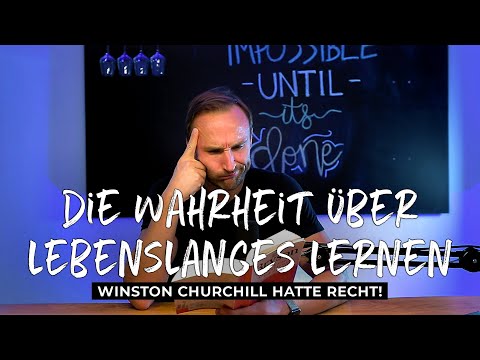
The video is only loaded from YouTube when you play it – data (including your IP address) is then transmitted to YouTube/Google. More in the privacy policy
For agencies, the same principle applies at the team level. A team that is trained regularly works more efficiently, makes fewer mistakes and delivers more innovative results. The investment in continuing education pays off through higher customer satisfaction and lower turnover. Employees who feel supported demonstrably stay longer at the company.
On top of that comes an often underestimated factor: positioning. If you can mention current certifications and training on your website, in your LinkedIn profile or in client conversations, you signal professionalism and up-to-dateness. This is a strong differentiating feature, especially in the creative industry, where many providers with similar portfolios compete for the same clients.
What is the best way to start now?
The best time to start is always now. Not next week, not after the current project, not in the new year. Open a learning platform of your choice today and take a look at a course on a topic that has interested you for a while. The first hurdle is always the highest. Once you are in the flow of learning, it becomes a habit.
Start small. A thirty-minute video course on a new design tool is a perfect start. You don't have to go and earn a master's degree right away. It is about establishing the learning habit and building it up step by step. Lifelong learning is not a sprint, but a marathon. However, one where you take away something valuable at every stop.
And if you notice that you even enjoy learning? Then you have already laid the most important foundation. After all, the most successful creatives are those who never stop being curious.
You might also be interested in
Comments
Register and comment.
Continue reading


