Job & Career
Agency Inquiries 2026: Why Good Briefings Are More Important Than Ever


Contents 9 sections
- What a briefing has to deliver today
- Where the time is actually lost
- A look at practice: How Feedbax.ai shortens the process
- The silent metric: follow-up question rate
- Making the budget transparent without selling yourself short
- Selection by substance, not by surface
- What doesn't change
- A short checklist before sending
- Conclusion
Anyone who has ever commissioned an agency knows the pattern. A few weeks of research, twelve emails sent, eight video calls, four proposals back, and in the end none of them really fits. The prices range between 8,000 and 48,000 euros. The service descriptions compare like apples and tire treads. And the agencies' follow-up question is, in nine out of ten cases: What exactly do you actually want?
The problem rarely lies with the agencies. We know this because we ourselves run the very successful agency 4eck Media in Waren (Müritz). It lies in the briefing. And that is exactly where the most has changed over the last two years.
What a briefing has to deliver today

A briefing is not a wish list. It is an offer to the agency to make an informed decision about whether the project is right for them. The clearer this offer, the more informed the answer … including ours as an agency.
Three things determine the quality of a briefing.
First, the starting situation. Not only what already exists, but also what isn't working. A website that nobody visits is something different from one that brings in leads but no longer looks good. Both need a relaunch, but not one that resembles the other.
Second, the goal. "More visibility" is not sufficient as a formulation. Visibility for what purpose, among whom, measured by what? An agency that receives a concrete goal can build a plan for it. One that has to interpret a gut feeling is guessing.
Third, the budget. The most common mistake in inquiries is the open budget range. The idea behind it sounds reasonable. You want to see what the market offers without committing. In practice, it leads to agencies either putting together the cheapest minimal offer or a luxury package in order to renegotiate in the next round. Anyone who has ten thousand euros should say so. Anyone who can go up to fifty thousand should too. From our perspective, that is not a weakness but professionalism.
Where the time is actually lost
The uncomfortable truth about agency selection: the time-consuming part is not the briefing. It is gathering the providers. Scrolling through Google for hours, clicking through references, skimming portfolios, filling out contact forms. In the end, you have a list of twelve agencies, half of which don't respond and the other half send proposals that have nothing to do with each other.
This is where new platforms come in that bundle and structure the search process. One of them is Feedbax.de, and it is worth taking a concrete look at what such a tool does in everyday use. We are explicitly presenting this platform here because, as an agency, we are listed in various agency directories (Sortlist, Agenturtipp, …), but Feedbax has a great unique selling point that makes it easier for companies searching to find the right agency and helps us agencies receive qualified briefings.

A look at practice: How Feedbax.ai shortens the process
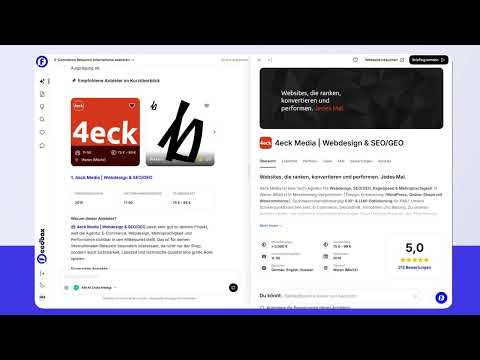
Feedbax.ai combines four steps that otherwise happen manually and usually in separate tools: creating the briefing, estimating the budget, agency matching, and comparing the providers. It gets interesting when you look at how these steps work together.
From a blank document to a finished briefing. The start doesn't begin with a form that demands forty fields, but with a short project description in everyday language. From this, the platform automatically and AI-based structures the typical briefing components, namely starting situation, goals, expected results, and general conditions. The practical benefit lies less in saving time than in not forgetting relevant information. Points like internal resources or technical requirements in particular often fall by the wayside in self-written briefings.
The video is only loaded from YouTube when you play it – data (including your IP address) is then transmitted to YouTube/Google. More in the privacy policy
Budget estimate before the inquiry. Before any agency is even contacted, the platform provides a rough budget range based on project type, scope, and market data. This is not a binding offer, and it is not meant to be. The value lies elsewhere. Anyone who knows in advance that a relaunch with shop functionality of the described scale realistically costs 35,000 to 60,000 euros starts the inquiry with a different self-assurance than someone who offers 15,000 euros on the off chance.
Matching instead of ranking. In the third step, the AI analyzes potential service providers based on their services, references, reviews, and the content of their websites, and compiles an individual shortlist from this. The difference from other classic agency directories is that the selection is aligned with the project and not with advertising budget or portfolio size. As a rule, it also explains why an agency is recommended, what strengths it has for precisely this case, and where it may be a weaker fit. This doesn't replace a personal assessment, but it shortens the preselection considerably.

Comparison and inquiry in one place. Instead of emailing individually, favorites are collected in a list and can be compared side by side. The briefing is created once and sent with one click to all selected agencies, whereby the cover letter can be adapted for each provider. The effect is less spectacular, but noticeable in everyday use. No lost emails, no different versions of a briefing, no Excel list in which in the end nobody knows who has already replied.
Use is free for clients, which makes the comparison with classic brokerage agencies interesting, where such services often end up hidden in the project costs via the price.
The silent metric: follow-up question rate
Regardless of which tool is ultimately used, there is a metric that reveals a lot about the quality of an inquiry. It is the number of follow-up questions you get per agency. Anyone who has to handle five follow-up questions per proposal has not written a clear briefing. Three to four are normal. Zero is suspicious, because it usually means the agency is simply sending out a standard offer.
A realistic target: one to two factual follow-up questions per proposal, relating to technical details or scheduling. Anything beyond that shows that the briefing has gaps.
Making the budget transparent without selling yourself short

The worry that a stated budget will inevitably be exhausted is not entirely unfounded. We agencies indeed have nothing against earning money ;-) But it can be defused with two simple formulations.
Instead of "Our budget is 40,000 euros," it's better to say: "We are working with a budget between
25,000 and 40,000 euros and will decide depending on the concept." This sets a framework and still leaves room for variants. A reputable agency doesn't use this range to land at the upper end, but to propose an honest value for money
… also to possibly come in slightly below the competitors' prices.
Anyone who doesn't want to name a clear figure can also cite a reference project. "A friendly company invested 18,000 euros last year for a similar relaunch. We want to know whether that is realistic for our project too." That is precise enough for a reliable answer and open enough for an honest assessment.
Selection by substance, not by surface
A beautiful agency website says little about project work. Designers can of course make their own website appealing, because that's exactly what they do professionally. A modern agency site is therefore no feat for a design agency, but basic equipment. It consequently says little about how the agency actually works for clients
Are there reference projects where you can call the client? What metrics did previous projects achieve, and can they be substantiated? Who on the team actually works on the project, and who only sells?
What does the process look like when something goes wrong?
Good agencies answer these questions without evasive maneuvers. Anyone who responds to such questions with platitudes will deliver platitudes in the project too. In this checklist I have already pointed out red flags at agencies.
What doesn't change
For all that tools can now take over, one part of the work remains untouched. The conversation with the person on the other side. The question of whether you're on the same wavelength. Whether the project manager shows backbone when things get tight. Whether the team can deliver what was promised in the pitch.
No platform makes this assessment. That takes a twenty-minute phone call and your own intuition. And that becomes all the more reliable the less time you've burned beforehand on administrative stuff.
A short checklist before sending
Before an inquiry goes out, it's worth taking a look at four points.
Is the goal formulated in a way that can be measured? Is the budget stated concretely in the briefing? Can agencies derive an estimate of effort from it without calling? And if you were to read the inquiry as a stranger, would you understand what it's about?
If any of these questions is answered with no, another round is worthwhile. An extra hour in the briefing easily saves a day in the responses. With the help of tools like the one from Feedbax, that hour actually becomes a matter of minutes. Feel free to try it out.
Conclusion
The tools for agency selection are better in 2026 than ever before. Briefings can be structured, budgets estimated, shortlists automated. Platforms like Feedbax.ai bundle these steps and turn the tedious research marathon into a comprehensible process that creates clarity about what the project should achieve. And anyone who has clarity in their briefings also gets precise proposals from us agencies.
Comments
Register and comment.
Continue reading


