
The potential of biodata and biosystems engineering is enormous, especially in combination with advanced technologies of artificial intelligence (AI) and digitalization. This is where Dominique Zeise comes in: In this short video tutorial, she provides insights into her career and the relevant topics that may be significant for your thesis.
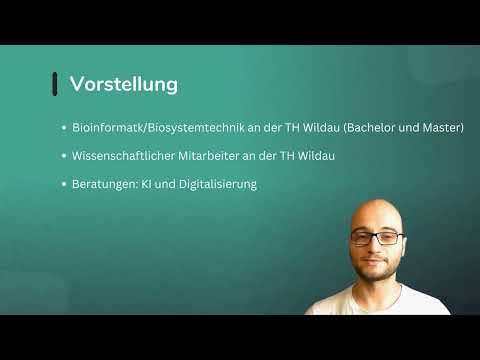
The video is only loaded from YouTube when you play it – data (including your IP address) is then transmitted to YouTube/Google. More in the privacy policy
The information from the video helps you to understand the fundamental competencies and tools that are necessary to succeed in today's fast-paced digital landscape.
Key insights
- Dominique Zeise studied bioinformatics and biosystems engineering.
- She works as a research assistant and specializes in digitalization and AI.
- Her experiences as a data engineer play a significant role in her work.
- The goal of the course is to provide you with expertise for an effective and stress-free thesis.
Step-by-step guide
First, Dominique introduces herself as part of the course. Here you get an overview of which competencies she brings to the project.

As the video progresses, you learn more about Dominique's academic background. She studied bioinformatics and biosystems engineering at the Technical University of Wildau, which provided her with a solid foundation for her work. You should consider this as the first step in your journey into bioinformatics: choosing the right education.
Dominique is currently working as a research assistant. Her focus is primarily on the areas of digitalization and artificial intelligence, which gives her deep insights into these current topics. It is essential to explore and understand the latest technologies and their applications in your field to effectively shape your thesis.
Another interesting point is Dominique's professional experience as a data engineer. She has extensively dealt with programming data pipelines and has worked on developing intelligent systems. These practical experiences are indispensable: they not only help you apply theoretical knowledge but also effectively solve complex problems.
Another important aspect is how Dominique wrote her bachelor's and master's thesis in a similar field. This illustrates how closely theory and practice are linked. By focusing on a specific area within bioinformatics, you can gain valuable insights and focus your work.
She concludes with the hope and confidence that this course can impart a lot of expertise that will help you to effectively and stress-free shape your thesis. When preparing, keep in mind to not only view the learned concepts as theoretical knowledge but to actively implement them in practice.
Summary – Effective use of AI and digitalization in bioinformatics
Dominique Zeise offers a valuable insight into her experiences and the relevance of digitalization and AI in the field of bioinformatics. Her academic and professional backgrounds give you the foundation to successfully approach your thesis. The combination of theoretical knowledge and practical applications is key to a successful career in this exciting field.
FAQ
What did Dominique study?Dominique studied bioinformatics and biosystems engineering at the Technical University of Wildau.
In which areas is Dominique active?She works as a research assistant, focusing on digitalization and artificial intelligence.
What was Dominique's role as a data engineer?She mainly worked on programming data pipelines and developing intelligent systems.
How important is Dominique's experience for the thesis?Her expertise and practical experiences are valuable for effectively shaping the thesis.
What is the goal of the course?The goal is to impart knowledge to help you approach your thesis stress-free.
