
The structure of a thesis can often seem complicated and challenging. A clear structure is crucial for the success of your work. In this guide, you will learn step by step how to organize your thesis – from the title page to the appendix. By understanding the various sections and their contents, you can ensure that you include all necessary elements and formulate your argumentation clearly and understandably.
The video is only loaded from YouTube when you play it – data (including your IP address) is then transmitted to YouTube/Google. More in the privacy policy
Key findings
- The structure of a thesis always includes an introduction, main body, and conclusion.
- Before and after these main parts, other important elements, such as title page and bibliography, should be included.
- Always adhere to your university's formatting guidelines, as these may vary.
Step-by-step guide
Title page and assignment statement
When writing your thesis, everything starts with the title page. Here, the title of your work, your name, your student ID number, the submission date, and information about your supervisor should be listed. Don't forget to include the institute and university logo if required. Make sure to check your university's formatting guidelines to ensure that you meet all requirements.
After the title page, the assignment statement in its original form follows. This should normally be an A4 page signed by your professor. Make sure that you cannot just scan the document and insert it as an image; it must actually be included in its original form in the thesis to ensure authenticity.

Next comes the summary or abstract. Often, it is necessary to create both an English and a German version, possibly both. Check your university's guidelines to ensure which specifications apply.
Then follows the table of contents, which lists the various chapters of your work along with the corresponding page numbers. This greatly facilitates navigation for the readers.
Directories and abbreviations
It is important to insert further directories after the table of contents, such as the list of figures and tables. Here, you list all figures and tables used in the thesis, with numbering, title or subtitle, and page number.
If you use abbreviations in your work that are not generally known, you should create a list of abbreviations. There, you list the scientific terms and explain them.
A symbol list may also be necessary, especially in scientific and mathematical works. Here, the symbols used from the formulas are listed, including their names and units.
Don't forget that Roman numerals should be used for the page numbers in the preliminary section. Page numbers usually start with the summary on page 3.
Introduction
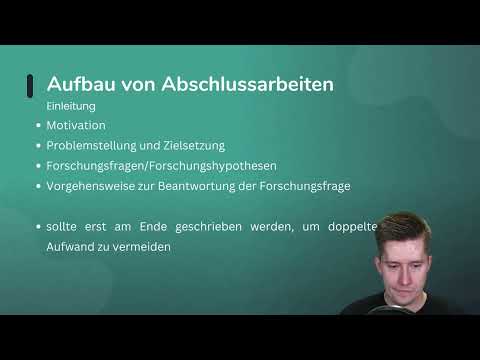
The next section of your thesis is the introduction. It starts with chapter 1 and should include several important points. First, it is important to explain the motivation for your research topic. Why is this topic relevant? What are the background and the specific problem statement?

An example could be the development of lighter batteries for electric cars, as they are becoming heavier due to the weight of the batteries. Formulate appropriate research questions or hypotheses for this.
Also explain how you intend to answer these questions. Keep your introduction flexible since it might be beneficial to write it last, after most of the work is completed. This way, you can ensure that all aspects of your investigation are accurately reflected.
Main body
The main body of your thesis is the most extensive. It should start with the state of research. Inform about which relevant works already exist and what gaps your research might aim to fill.

Following this is the section on research methodology. Here you describe the methods you have chosen to answer your research question and explain why they are appropriate.
If your work involves experiments, explain the experimental setup and document the conduct of the experiments. This is crucial for presenting comprehensible results.
After presenting the methodology, the results of your investigation should be presented. This section should be clearly and concisely structured.
Next comes the discussion. Here you reflect on whether and how the research question was answered. Compare your results with existing findings and situate them within the state of research.
Conclusion and outlook
The conclusion includes a summary and an outlook. Here you give an overview of your research question and summarize the main findings. The outlook should show which research gaps have been filled by your work and what open questions remain.
After the conclusion follows the bibliography. Here you list all sources that you cited in your work. Ensure that only the sources actually used are listed, to maintain the credibility of your work.

The appendix is the final part of your thesis. It contains material that contributes to understanding the work but is not integrated into the main text, such as extensive tables or transcripts of interviews.
Additionally, an affidavit may be necessary in which you confirm that you wrote the work independently. Clarify the requirements regarding this with your university.
It is also important to inform yourself in advance about any page number requirements, as usually only the text part is counted, not the directories or the appendix.
Summary - Structure of Theses: A Structured Guide
This guide provides you with a detailed overview of the structure of theses. You have learned what elements are necessary to create a clear and understandable structure. Make sure to always follow your university's guidelines and develop a well-thought-out argumentation.
FAQ
How do I start writing a thesis?Start with the title page and a clear outline according to your university’s specifications.
What belongs in the main body of the thesis?The main body should contain the state of research, methods, results, and discussion.
When should I write the introduction?It is recommended to write the introduction at the end when the thesis is mostly finished.
What is most important in the bibliography?Only include the sources you actually used to ensure credibility.
How should I handle the appendix?The appendix should contain material that is essential for understanding but too extensive for the main text.

