
The presentation of data is an art in itself. The choice of the appropriate diagram can be the crucial key to communicating your results clearly and understandably. Whether you are preparing a thesis, a report, or a presentation, the suitable visualization method significantly contributes to conveying your content. In the following sections, you will learn about various types of diagrams and find out when to use them best.
The video is only loaded from YouTube when you play it – data (including your IP address) is then transmitted to YouTube/Google. More in the privacy policy
Key Insights
Bar and column charts are ideal for comparing discrete data. Histograms are useful for depicting frequency distributions of continuous data. Line charts are excellent for showing trends over time. Pie and donut charts visualize parts of a whole. Box plots are helpful for representing distributions and outliers, while bubble charts illustrate complex relationships between multiple variables.
Step-by-Step Guide
1. Using Bar and Column Charts
Bar and column charts are perfect for discrete, categorical data. In a bar chart, the data is displayed horizontally, while in a column chart, it is displayed vertically. This allows for a clear comparison between different categories.

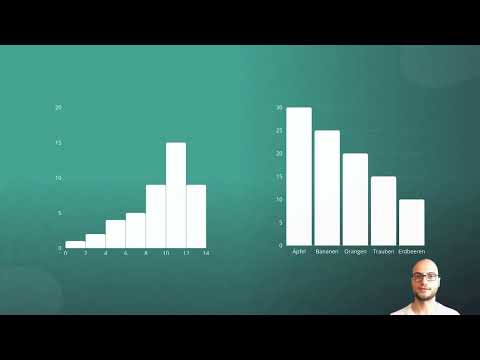
For example, if you collect data on favorite fruits from 100 surveyed individuals, you can visualize the results in a bar chart to quickly see which fruit was chosen most often. The height of the bars indicates how many people voted for each category, providing a readily interpretable visualization.
2. Applying Histograms
Histograms are specialized in visualizing quantitative data and its distribution over specific intervals, known as "bins." You create them to analyze how many data points fall within a certain range.
For instance, you could record the grades of students divided into intervals like "0 to 2," "3 to 5," and so on. This allows you to quickly identify the frequency of the grade distribution and possibly identify outliers.
3. Using Line Charts for Trends
Line charts are useful for showing trends over time. They connect data points through lines, giving you a direct overview of fluctuations and developments.
For example, if you visualize the sales figures of a product over the last twelve months, you can instantly spot sales that were particularly high or low and identify seasonal trends.

4. Using Box Plots for Distributions
Box plots provide a compact representation of statistical data. They display the median, quartiles, and outliers at a glance and are ideal for comparing distributions across different groups.
Box plots are particularly helpful when you want to represent differences in age groups or other quantitative data. They give you valuable information about the distribution and reveal whether there are outliers.

5. Using Pie and Donut Charts for Shares
Pie charts are perfectly suited to visualize shares of a whole. Each segment of a pie chart represents a part of the total result and allows for quick insights into the distribution.
If you want to represent the market shares of different companies, a pie chart can clearly visualize the shares. If you want to compare multiple periods, donut charts offer an elegant solution to display different points in time in one diagram.
6. Using Scatter Plots for Relationships between Variables
Scatter plots, or dot plots, are optimal for analyzing the relationship between two continuous variables. They show whether there is a positive, negative, or no correlation between the variables.
An example would be examining the relationship between the time students spend on their thesis and the grades achieved.
7. Using Bubble Charts for Complex Data Visualizations
If you want to look at multiple variables at once, bubble charts are the right choice. They allow you to represent not only the relationship between two variables but also to add a third dimension through the size of the points.
Imagine you are investigating the relationship between study effort, exam grades, and the number of lectures attended. By varying the bubble size, you can represent all three dimensions simultaneously.

8. Creating Diagrams
The creation of these diagrams can be done using simple software like Excel or Google Sheets. For more complex data analyses, you should consider advanced tools like Python and R to subsequently visualize your data optimally.
9. Choosing Diagrams Based on Purpose
Before deciding on a visualization, think about what you want to represent and what message you want to convey. The right diagram is key to a successful presentation of your results.
Summary - The Best Choice of Diagram Types for Your Data
The choice of the right diagram is crucial for clear and understandable communication of your data. Use the described diagram types according to their strengths to get the most out of your data visualization.
FAQ
How do I choose the best chart?Consider what type of data you have and what you want to convey.
What is the difference between column and bar charts?Column charts are vertical, bar charts are horizontal; both show discrete data.
When do I use histograms?Histograms are optimal for representing frequency distributions of continuous data.
Are pie charts always the best choice for shares?Pie charts are suitable, but visibility can suffer if segments are similarly sized.
How do I visualize multiple variables?Bubble charts are an effective method for representing complex relationships between multiple variables.

