Million points of light, infinite expanses: Discover the fascination of the universe and become a "star photographer." Stefan Seip, himself fascinated by the sun, moon, and stars, will advance you in astro and sky photography by light years in 16 lessons. Face the special challenges of this specialized discipline and return from twilight and darkness with sharp, noise-minimized, artifact-free images. Nightly recurrences such as constellations and the fine details of the moon's surface will be captured professionally after training, as well as the rarer celestial events – whether it's shooting stars or solar and lunar eclipses – get your subjects from the firmament by correctly using the camera, telescope, and binoculars with the right settings and calibrations.
For photographic sky conquerors: 16 illustrated lessons in PDF format
Photograph different motifs: Sun, moon, stars, shooting stars, solar and lunar eclipses
The right equipment, the right settings: including long exposure, tracking control
By Stefan Seip, photographer and author specializing in astrophotography and celestial photography
Your journey really begins beyond the horizon: Acquire both astronomical and photographic knowledge and create fascinating images.
content
Details of the content
Astro- and sky photography
Part 01 - Mood shots at dusk
Photography means "taking pictures with light", i.e. creating images with the help of light. This is common knowledge, which is why many cameras disappear into their pockets at the moment when the light loses intensity at the end of the day and dusk falls. This overlooks the fact that good photos can also be taken at low light levels, as every camera can use long exposure times to add up the available light for as long as necessary to produce a correctly exposed photo. In some cases, this can be several seconds or even minutes. In this respect, a camera is far superior to our eyes, which is why it is still worth hunting for subjects even when we can no longer see much due to the darkness.
Part 02 - Line trace images of stars
Everyone knows that the sun rises in the east, reaches its highest point in the south around midday and sets again in the west in the evening. In the past, people assumed that the sun actually revolved around us. Well, today we know better: it is the earth that rotates once on its axis in around 24 hours. So, in a sense, we are on the "Earth carousel" and view the sky from there. This makes it possible to take line-trace images of stars.
Technically speaking, it is not a great challenge to take photographs of the constellations. However, the prerequisites must be or become in place. You can find out what you need to consider in this tutorial.
Part 04 - Photos of shooting stars
"Anyone who sees a shooting star whizzing across the night sky for just a fraction of a second should make a wish, because that wish will come true," as the saying goes. It gets even more exciting when it comes to taking photos of shooting stars. This tutorial explains what you need to bear in mind.
Part 05 - Photographing the moon
Astrophotographers have an ambivalent relationship with the moon: on the one hand, it is a rewarding subject, but on the other hand, its bright light can be distracting on some nights when observing faint objects. This tutorial will focus on the positive aspects of the moon: Its brightness and (relative) size in the sky eliminate many of the difficulties that an astrophotographer usually has to contend with. And there is no other celestial body in space of which observers on Earth can recognize and photograph so many details on the surface.
Part 06 - Be careful with photos of the sun
As soon as you point an optical device at the sun, there is a fundamental risk that the intensity of the radiation will destroy the device or irreparably damage your eyesight! It is therefore essential that you take all the precautions contained in this tutorial to heart BEFORE you take your own photos of the sun.
Part 07 - Photographing lunar eclipses
When the moon passes through the shadow of the earth, a lunar eclipse occurs. This can only take place if the sun, earth and moon are exactly in line with each other. There are three types of lunar eclipses: penumbral, partial and total lunar eclipses. This tutorial explains what you should bear in mind if you want to capture lunar eclipses photographically.
If the sun, moon and earth are exactly in line with each other, the shadow of the moon falls on the earth and a solar eclipse occurs. In principle, a solar eclipse is only possible when there is a new moon. This tutorial explains how to take fantastic pictures of solar eclipses.
If a camera is fixed to a normal photo tripod, celestial objects will only be in focus if the exposure time does not exceed a maximum value, which depends on the focal length, the region of the sky being photographed, the pixel size of the image sensor used and the personal requirements for a "sharp" image. This tutorial explains how to use an astronomical mount correctly.
Part 10 - Long exposures with tracked camera
In episode number 9 of the "Astrophotography and Sky Photography" series, the "Handling of an astronomical mount" was explained. Thanks to its motorized tracking, such a mount enables us to work with longer exposure times without the stars becoming streaks. This tutorial will deal with how long exposures are realized with the astronomical mount. It is assumed that the mount has been set up, aligned, balanced and put into a working condition, as described in episode number 9.
Part 11 - Using the telescope as a lens
Astrophotographers are insatiable when it comes to the urge for long focal lengths. The reason for this is easy to find: Many objects in the night sky appear very small or even tiny to us due to their great distance. If you want to capture them in great detail and full format, there is no getting around long focal lengths with correspondingly small image angles.
Part 12 - Tracking control during a long exposure
Low-light celestial objects in the night sky require a long exposure time. Even if, in the age of digital photography, several shorter exposures are taken instead of a single, very long exposure, which are then added together by image processing software, the automatic tracking of an astronomical mount is not precise enough to produce reliably sharp photos when using long focal lengths. It is then necessary to check the movement of the mount during the exposures and - if necessary - take corrective action. This process is called tracking control or "guiding", the activity is called "guiding".
Part 13 - Which telescopes are suitable for astrophotography
Anyone interested in astronomy in general and astrophotography in particular will sooner or later feel the need for their own telescope. Although visual observations can be made with the naked eye or binoculars, and even impressive astrophotos can be taken without a telescope (see parts 1 to 4 of this tutorial series), it is only a telescope that provides access to countless smaller and/or fainter celestial objects.
Part 14 - Recording planets with the webcam
To take planetary photos, you need a camera system that is capable of capturing as many images as possible in the shortest possible time, whereby the size of the image sensor plays an absolutely subordinate role. Large sensors are even a disadvantage because you are only dealing with a tiny slice of planet and a large environment, which essentially consists of a black sky, only unnecessarily increases the amount of data to be stored and makes it more difficult to process the images later.
Part 15 - Calibration: Capturing bright field and dark images
Digitally captured astrophotos contain not only the unprocessed data provided by the photographed celestial object, but also artifacts, i.e. unwanted phenomena. Calibration" refers to the process of removing these artifacts from the raw images.
Part 16 - Getting to grips with electronic image noise
The "spectre" of digital photography is "noise". The topic fills a number of forums on the Internet, where there are endless discussions about which digital camera "noises" more and which less.
On the one hand, the discussion about noise is "whining on a high level" when you look at the results that a modern digital camera delivers even at high and highest ISO values. Chemical films with such a high sensitivity show a pronounced grain structure in the images, which is far more pronounced and disturbing than the noise of digital cameras.



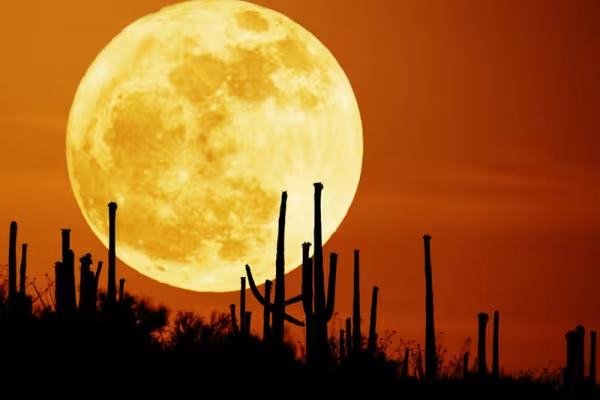 Astrophotography and celestial photography: learn what's important!
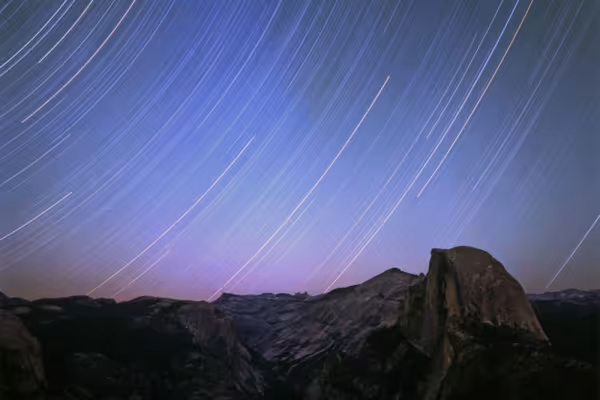 Learn how to capture the stars and their movements in line-track shots.
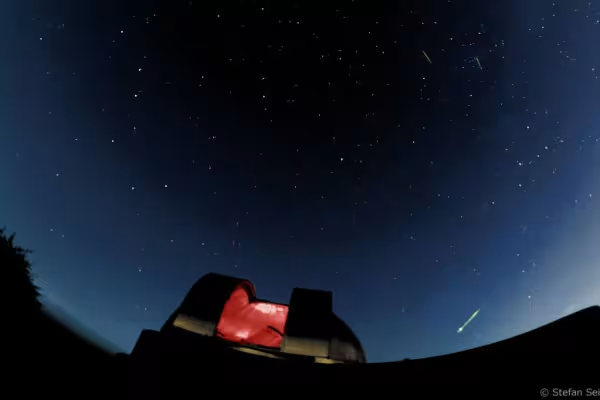 A fleeting moment: with the right preparation, you can also catch shooting stars.
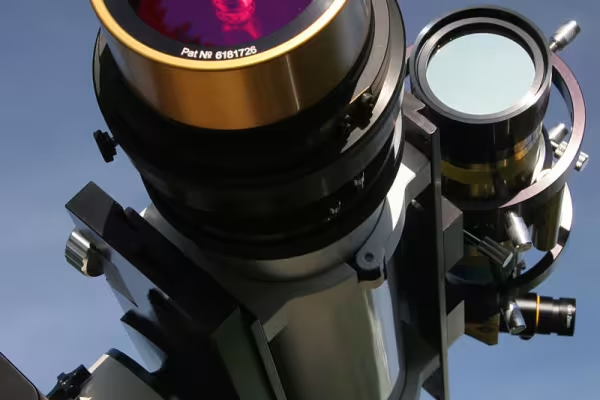 Learn which equipment is suitable for astrophotography, ...
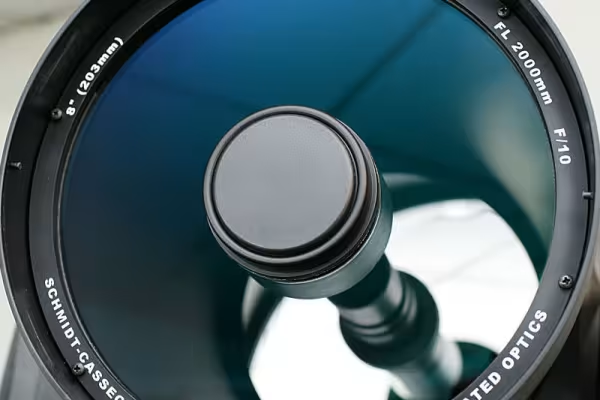 ... how to assemble them and finally use them correctly.
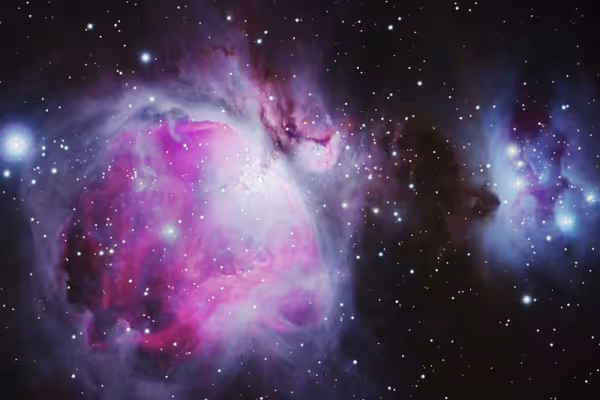 Create images that are as noise-free as possible despite the darkness and remove artifacts.
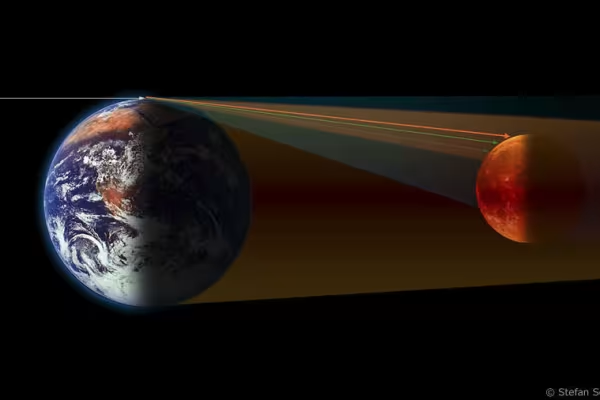 The training provides you with information on astronomical processes that you should know.


Comment now „Astrophotography and celestial photography: technique, subjects & practice“