
Plagiarism is a serious problem that can threaten not only academic careers but also the integrity of your work. In this guide, you will learn what plagiarism is, the different types of plagiarism, and how to avoid it. Additionally, the difference between direct and indirect quotations will be explained, so you can work confidently from the start.
The video is only loaded from YouTube when you play it – data (including your IP address) is then transmitted to YouTube/Google. More in the privacy policy
Key insights
- Plagiarism is a copyright violation and can have serious consequences.
- Proper citation is essential to avoid plagiarism.
- There are different types of plagiarism that you should be aware of to protect yourself legally.
Step-by-Step Guide
Below you will find a comprehensive step-by-step guide to ensure that you quote correctly in your work and avoid plagiarism.
1. Understanding the Definition of Plagiarism
First, it is important to have a clear understanding of what plagiarism is. It is the theft of intellectual property, where someone else's work, ideas, or texts are presented as one's own. This can have serious consequences in both academic and professional contexts.
2. Taking Responsibility for Citation
To avoid plagiarism, it is crucial for you to cite correctly. This means that you should always make sure to clearly label your quotes and indicate the original sources. Mislabeling quotes can already lead to plagiarism.

3. Differences Between Direct and Indirect Quotations
A direct quote is always marked by quotation marks and requires an exact source reference. It is important to reproduce the text verbatim without making changes.
An indirect quote, on the other hand, summarizes the content in your own words. You do not use quotation marks but must still include a source reference. It is crucial that you capture the main points of the original text without simply rearranging the words.
4. Correctly Labeling Sources
The next step is to ensure that you correctly label all sources used. Make sure to indicate the source directly for both direct and indirect quotes so that your own thoughts are clearly separated from cited content.
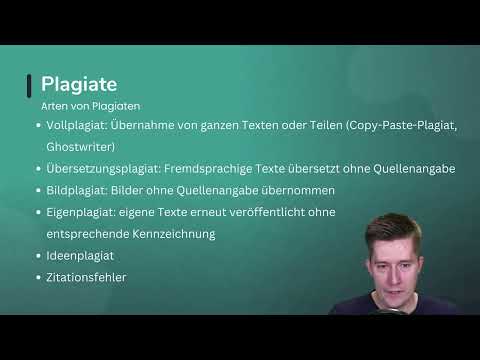
5. Getting to Know the Different Types of Plagiarism
To successfully avoid plagiarism, you should be aware of the different types of plagiarism:
- Complete plagiarism: This involves taking entire texts or parts of texts without citing the source. Even a single sentence can be considered plagiarism.

- Translation plagiarism: When you translate foreign language texts, you must label this with the appropriate source reference.
- Image plagiarism: Using images or illustrations without source reference is also plagiarism, just like recreating images.
- Self-plagiarism: Publishing your own texts or ideas multiple times without acknowledging it can also be problematic.
- Idea plagiarism: Adopting someone else's ideas without source reference is also considered plagiarism.
6. Avoiding Citation Errors
Be careful to avoid citation errors. This includes correctly distinguishing between direct and indirect quotes. If you are not careful here, it can quickly lead to plagiarism.
7. Using Artificial Intelligence (AI) Critically
If you use AI in your work, please be critical and question the generated content. Often, these texts cannot be cited correctly, which increases the risk of plagiarism. Educate yourself about the risks before incorporating AI-based tools into your literature research.

Summary – Avoiding Plagiarism: A Guide to Safe Quoting
In this guide, you have received a comprehensive overview of the significance of plagiarism and the necessity of correct citation. Make sure to always provide the correct sources to navigate your academic career smoothly.
FAQ
What is plagiarism?Plagiarism is the theft of intellectual property and the presentation of someone else's work or ideas as one's own.
How do I avoid plagiarism?By correctly citing all sources used and distinguishing between direct and indirect quotations.
What types of plagiarism are there?There are complete plagiarism, translation plagiarism, image plagiarism, self-plagiarism, and idea plagiarism.
What are citation errors?Citation errors occur when you mislabel already planned quotes, which can lead to plagiarism.
Can I use AI-generated content?Yes, but you must be careful and critically assess the content to avoid plagiarism.

