
A well-thought-out schedule is not only helpful but essential when it comes to writing your thesis on time and without stress. In this guide, I will show you how to plan the various phases – from topic selection to literature research and writing the paper – sensibly. This way, you not only keep track but also minimize stress.
The video is only loaded from YouTube when you play it – data (including your IP address) is then transmitted to YouTube/Google. More in the privacy policy
Main insights
A schedule not only gives you guidance but also helps to detect and compensate for delays early. Start planning in good time and value buffer times to manage unforeseen difficulties.
Step-by-step guide
1. The right time to create the schedule
Before you start your work, it is essential to create a schedule. This is not just done once and then forgotten. Rather, you should regularly review and adjust the plan throughout your entire work process. Even before the official registration of your thesis, it makes sense to engage with the topic and research initial literature. Do not waste time with unnecessary waiting; the preparations are crucial for the success of your project.

2. Preparations and first steps
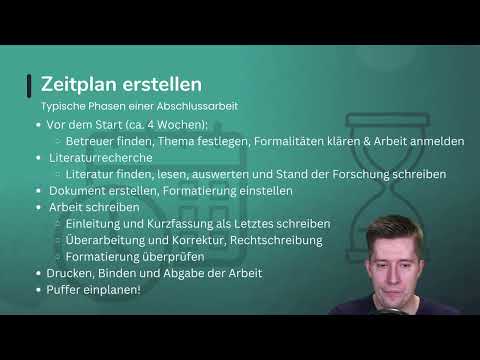
Planning begins before you officially register your thesis. In the first four weeks, you should find a supervisor and finalize the topic of your work. This process can bring many challenges that do not solely depend on you. Therefore, plan enough time to also consider the availability of your supervisor.

3. Literature research - A time-consuming step
Another central point is literature research. You should expect to spend at least two weeks finding, reading, and evaluating the relevant literature. This phase is crucial for documenting the state of research. Do not hesitate to search for literature regularly during the writing process, as new insights could be crucial for your work.
4. Document creation and formatting
As soon as you begin your research, you should also set up the document. Plan a whole day for this to ensure that the formatting is correct. Once this foundation is laid, you will save yourself a lot of effort at the end when you have to quickly adjust everything. Use templates that can make your work easier.
5. Writing the paper
Now comes the exciting part: writing. This largely depends on your preparation and the literature you have gathered so far, ideally planning 1 - 2 weeks for this step. It is advisable to write the introduction and the summary only at the end when the main part is completed. This way, you save time and effort from having to reformulate repeatedly.
6. Revision and proofreading
The revision is at least as important as the writing itself. Plan enough time to go through your work again, and consider having it proofread by others. In doing so, you should make sure to ask both non-experts and experts for their feedback to gain different perspectives.
7. Final preparations for submission
The final phase of your work is crucial. Plan the printing and binding work as well as the submission in good time. Find out the opening hours of the examination office and ensure that you allocate enough time to get everything done on time. If you have not yet scheduled appointments, it is the famous “fishing in the fog,” as the examination office could be closed on another day.
8. The importance of buffer times
Be aware that schedules are often not followed precisely. So, build buffers into your planning, especially for larger work points. This prevents the work from falling behind schedule. A schedule is only sensible if it remains flexible.
Summary - Schedule for the thesis - This is how you create it correctly
Finally, it is important to emphasize that a schedule is not set in stone. It serves as a guide and support for writing your thesis purposefully. Do not stick too rigidly to plans but adjust them as needed to your current circumstances. With good planning and sufficient lead time, you can minimize stress and concentrate on writing your work.
FAQ
How much time should I plan for literature research?At least two weeks, as this step is often time-consuming.
When should I start writing my paper?As soon as you have gathered all the necessary information and literature.
How important is the formatting of my work?Very important to make a professional impression.
How can I avoid delays in the schedule?Approach planning proactively and build in sufficient buffer times.
How can I ensure that I can submit on time?Find out in advance about deadlines and opening hours of the examination office.

