
The selection of appropriate literature sources is crucial for the quality and credibility of your academic work. From identifying trustworthy articles and books to accurately assessing internet sources: the criteria are diverse. This guide helps you recognize the essential aspects and make an informed decision for your literature research.
The video is only loaded from YouTube when you play it – data (including your IP address) is then transmitted to YouTube/Google. More in the privacy policy
Key Insights
- The peer review process ensures the quality of academic papers.
- Different types of literature sources (monographs, journal articles, internet sources) have different advantages and disadvantages.
- Poor sources, such as Wikipedia and unpublished works, are generally unsuitable for academic papers.
Step-by-Step Guide
Understanding the Peer Review Process
A fundamental understanding of the peer review process is essential. The peer review process serves as a quality assurance for academic papers. When scientists submit their research findings, these are forwarded to other professionals who critically evaluate the work. This review takes place anonymously to ensure neutrality. The reviewers identify the strengths and weaknesses of the work and provide valuable feedback that the author can use for improvements. This process helps ensure that only high-quality works are published.
Identifying Trustworthy Sources
When searching for literature sources, focus on those that have undergone a peer review process. The journals you use for your research usually provide information about their review process on their website. Be sure to inform yourself about this to ensure that the sources you choose are trustworthy.

Types of Literature Sources
There are various types of literature sources that you can use in your academic work:
- Monographs: These are comprehensive works that deal with a specific topic or research area. They can be authored by a single author or multiple authors. Monographs are ideal for gaining deeper insights into specific topics.
- Edited volumes: These consist of several chapters or essays written by different authors. Each contribution in an edited volume addresses a specific topic related to an overarching theme. This type of source is useful for gathering different perspectives on a topic.
- Journal articles (Papers): They are the primary form of communication in academia and are published in academic journals. Journal articles typically present the latest research findings and must also undergo the peer review process.
- Internet sources: These can provide a wide range of information, but their quality is often difficult to assess. You should always check the origin and the author of the website and ensure that it contains trustworthy content. Government websites are often a reliable source.
- Other sources: This includes statistics, patents, or legal texts that may be relevant depending on the discipline. Statistics are often useful initial data for introductions, but the authors and reliability should also be checked here.
Recognizing Poor Sources
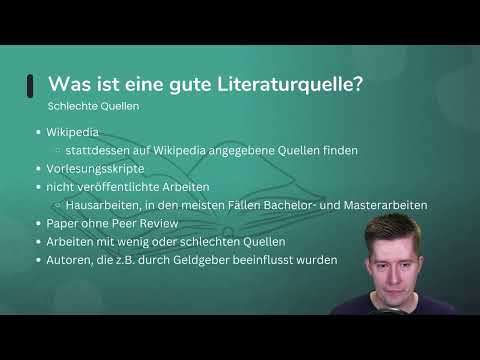
Avoiding poor sources is just as important as selecting good sources. Some examples of low-quality sources include:
- Wikipedia: Although Wikipedia can be a valuable platform for a first overview, it is not suitable as a citable source due to its open editing capabilities.
- Lecture notes: These documents are often not peer-reviewed and may contain errors. They should be considered as an introduction to a topic but should not serve as a primary source for academic papers.
- Unpublished works: Assignments or MSc papers are typically not intended for publication and therefore cannot be cited as literature sources.
- Papers without peer review: Ensure that the works you cite have indeed undergone the peer review process. It can be helpful to look for markings indicating that a paper has not yet been reviewed.
- Works with minimal bibliographies: A literature reference list should include several high-quality sources. Works with only a few or poor citations can be a sign that the quality of the work is insufficient.
Checking Funding Sources
It is important to verify whether the authors whose works you want to cite have worked independently. Often you will find sections at the end of academic papers discussing possible funding that could influence their independence. Be cautious with studies funded by interested parties, such as companies.

Summary – A Guide to Evaluating Literature Sources in Academic Papers
Awareness of the type and quality of the literature sources used plays a central role in the credibility of your academic work. Make sure to cite only trustworthy sources to ensure and protect the integrity of your research.
FAQ
What is the peer review process?The peer review process is a quality assurance method in which scientists have their work anonymously reviewed by colleagues.
Why is Wikipedia not a reliable source?Wikipedia can be edited by anyone and does not undergo peer review, which can lead to errors.
What types of literature sources are there?The main types include monographs, edited volumes, journal articles, internet sources, and statistics.
Are lecture notes suitable for academic papers?Lecture notes are generally not peer-reviewed and should therefore be used with caution.
How do I recognize good internet sources?Pay attention to the authority of the website, information about the sources, and the date the page was accessed.

