
The search for the right literature can feel like a maze, especially when it comes to finding suitable sources for your thesis. You don't want to just save time, but also ensure that you are using scientifically sound information. In this guide, you will learn how to approach this systematically and effectively to achieve the best results.
The video is only loaded from YouTube when you play it – data (including your IP address) is then transmitted to YouTube/Google. More in the privacy policy
Key insights
- Supervisors are valuable contacts for literature references.
- Search engines and databases are essential for research.
- Use the snowballing method to find newer sources.
Step-by-Step Guide
Step 1: Consult your supervisor
Start your literature research by asking your supervisor for advice. Since supervisors are often experts in the field of your work, they can recommend targeted literature. Ask explicitly which sources they consider helpful. This is not only an efficient starting point, but can also save you time and effort in your further search.
Step 2: Use relevant search engines and databases
Once you have some pointers from your supervisor, turn to relevant search engines and databases such as Google Scholar, IEEE, or SpringerLink. These platforms are ideal for searching scientific articles. Alternatively, you may also consider ResearchGate, which acts as a sort of social network for researchers. Here, you can browse profiles of researchers and their publications, and sometimes download the PDF files directly.

Step 3: A good start with Wikipedia
Although you should not cite Wikipedia pages, Wikipedia can be a useful resource to get acquainted with a topic. Read the article on your research topic and look at the sources listed in the footnotes. These can help you find specific, citable literature.
Step 4: Literature from lecture scripts
Lecture scripts are often unpublished and not suitable as scientific sources. However, you can use them as a starting point and check and research the sources they mention.

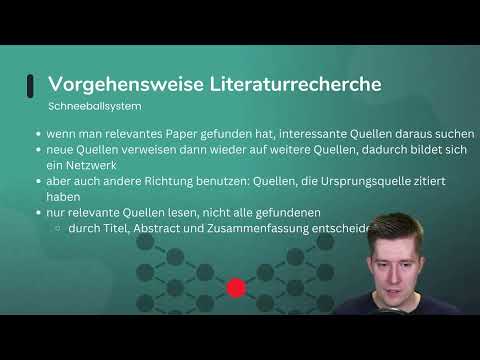
Step 5: Applying the snowballing method
If you have found a relevant paper, use the snowballing method: Look at the sources cited in this paper and research those as well. This can help you create a network of relevant articles that may be useful for your work.

Step 6: Finding newer sources
Take it a step further and see which newer papers have cited the initial paper you found. Some search engines offer this analysis function that helps you find more current research based on your original source.
Step 7: Efficiently evaluate relevant sources
Not every source is useful for your work. Start with the title of the source. Is the title promising? Then read the abstract for a quick assessment. If the abstract also sounds interesting, take a look at the summary. With these three steps, you can efficiently decide whether it is worth continuing to read.
Step 8: Read sources intentionally
Once you have deemed a source relevant, don’t just read it straight through. Focus on the sections that are important for your research question. You don't have to read every source in its entirety before deciding if it is useful.
Summary – How to find the right literature for your thesis
Literature research can seem overwhelming, but with a clear plan and the right strategies, you will quickly find what you need. Start with the recommendations from your supervisor, use modern search tools, and handle sources carefully. Remember to work efficiently by filtering out the materials that are truly relevant for your work and learning to read strategically.
FAQ
How can I ask my supervisor for literature references?Ask specifically which sources they consider relevant and which ones they have used themselves.
What are good search engines for scientific literature?Google Scholar, IEEE, SpringerLink, and ResearchGate are recommended platforms.
Can I cite Wikipedia as a source?No, Wikipedia should not be cited; however, it can be helpful as an introduction to a topic.
How does the snowballing method work in literature research?Start with a relevant paper and research the sources cited in it to create a network of literature.
How do I determine if a source is relevant for my work?Evaluate the title and the abstract; only read further if you believe the source could be useful.

