Imagine you hire a graphic designer for a landing page and only say: "Make it modern." The result will probably not match your expectations. This is exactly where the basic problem of many design prompts lies. An AI doesn't need a technically perfect description, but a clear idea of what should be created visually. In this guide, you will learn which details are important for this and how to organize them sensibly in a prompt.
The video is only loaded from YouTube when you play it – data (including your IP address) is then transmitted to YouTube/Google. More in the privacy policy
Key Takeaways
- Design prompts describe what should be created visually, not which information must be conveyed correctly.
- A prompt should always specify what is being built and who it is intended for.
- Style, mood, and references give the AI its visual direction.
- You state priorities explicitly so that the AI knows what takes precedence in case of doubt.
- Contradictory statements such as "minimalist and extremely detailed" lead to unusable results.
- Clarity is more important than completeness. A short, well-structured prompt beats a long, contradictory one.
Step 1: Define what you want to create
The first building block is the artifact, meaning the result itself. State clearly whether you need a landing page, an app interface, an icon, an illustration, a social media post, or a PowerPoint slide. The more specific this information is, the more targeted the suggestions will be. A sentence like "Create a landing page for my restaurant" already provides a usable direction.

Step 2: Describe the target audience
The second step deals with the question: Who is the design intended for? You don't have to write a complete target audience analysis. For a design, a few characteristics are usually enough, such as "female, under 30, hobby horses". You only need a detailed persona with income, place of residence, and media usage if you also want to use it in a presentation later. For visual work, the essence is enough.
Step 3: Clarify context and intended use
The purpose of use is equally important. Ask yourself what the design is actually needed for. Is it a social media post for a paid ad? An image for a landing page? An element in an app? The context determines format, readability, and structure. An ad in a crowded feed has to work differently than a calm homepage. Therefore, briefly note where the design will appear later.
Step 4: Define style and mood
Style and mood are closely related, but should be thought of separately. Style describes the type of design, for example minimalist, playful, luxurious, or technical. Mood describes the feeling that should arise in the viewer, such as calm, energetic, or trustworthy. Both can be combined, for example "minimalist and calm" or "minimalist and energetic". Make sure that the combination remains coherent.
Step 5: Add references
References are a particularly effective way to convey the desired direction. You can name a well-known brand, such as "in the style of Stripe", or upload an image of your own that you like. Your company's color scheme or existing screenshots of landing pages are also helpful. Especially with style and look and feel, an image often shows more than ten adjectives. Then describe what exactly you appreciate about the reference, because not every feature of a brand should be adopted.
Step 6: Set priorities explicitly
The sixth dimension is often forgotten: priorities. Tell the AI explicitly what is most important to you. If the horse motif is particularly important to you, write that down clearly. Everything else, for example the minimalist style, may then take a back seat in case of doubt. Without this information, the AI has to decide for itself what takes precedence, and often decides differently than you would like.
Step 7: Combine all building blocks into one prompt
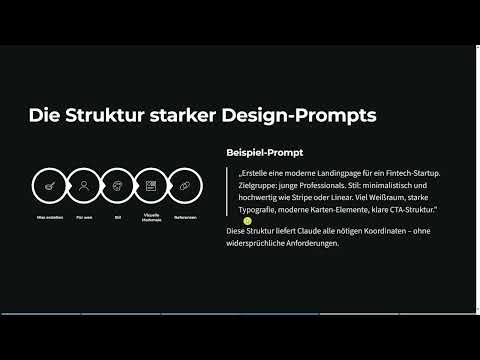
Now you put the building blocks together into one prompt. The order is: What is being created? For whom? In what style? Which visual features should appear? What references are there? An example: "Create a modern landing page for a fintech startup. The target audience is young professionals. The style should be minimalist and high-quality, inspired by Stripe or Linear." Then add visual features such as plenty of white space, strong typography, modern card elements, and a clear structure for call-to-action buttons.

The reference to Stripe is a real added value here because it anticipates many decisions at once. Stripe is a payment provider and is therefore also located in the fintech sector, which makes the direction even more coherent.
Step 8: Avoid Contradictions
The most important quality criterion is consistency. Statements such as "minimalist and extremely detailed" or "tidy and chaotic at the same time" confuse the AI. A request like "a minimalist desk that is full of documents" is conceivable, but it is a poor fit for a design tool. "Luxurious and colorful" is also problematic, because luxury usually works through restraint, for example with gold and black and white. A coherent style direction is far more effective than many conflicting requests.

Step 9: Deliberately Give the AI Freedom
Finally, you shouldn't inflate the prompt unnecessarily. A prompt with 1000 characters rarely produces anything useful, because the instructions limit or contradict each other. Give the AI the clear direction it needs, and leave it some room for the details. You will almost always get better results if you steer in a targeted way after the first draft, instead of defining every pixel from the start.

Summary – Structuring Design Prompts Correctly: Clear Direction Instead of Long Walls of Text
Good design prompts differ from normal AI requests because it is not about correctly worded information, but about a clear visual direction. You describe what should be created, who it is for, in what context it will appear, which style and mood are desired, which references you like, and what takes priority in case of doubt. Pay attention to consistency, because contradictory statements cost more result quality than missing details. Keep the prompt short, clear, and coherent.
FAQ
Does a design prompt have to be especially long?No, a clearly structured prompt with just a few sentences is usually much more effective than a long, confusing text.
How detailed does the target audience have to be described?For a design, a few key characteristics such as age, interests, or life situation are enough. You only need an in-depth analysis for presentations or strategy papers.
Can I combine style and mood?Yes, as long as the two statements complement each other. Minimalist and calm works well, whereas minimalist and extremely playful hardly works at all.
Do reference images really help?Yes, references often convey style and impression more clearly than many adjectives. However, also describe which features you want to adopt.
What happens if I consider several things important at the same time?State the priorities explicitly so that the AI knows which element takes precedence in case of doubt.

