A clip-on flash is often the first purchase that turns a flat snapshot into a cleanly lit photo. However, between original devices from the camera manufacturers, cheap alternatives, and a multitude of features, it's easy to lose track. This is exactly where this guide comes in. You'll learn how much power you actually need, when an original flash is worth it, what to look out for with third-party manufacturers, and which features really matter in everyday use. In the end, you can tailor your decision to your own photography.
The video is only loaded from YouTube when you play it – data (including your IP address) is then transmitted to YouTube/Google. More in the privacy policy
Key Takeaways
Key Takeaways
- You rarely need the most powerful model. It's better to start with a smaller device and only upgrade when you lack power.
- Original flashes usually cost between 300 and 500 euros, but they last a very long time and can often be bought used at a good price.
- Third-party manufacturers can deliver good results, but they are often built worse and wear out faster.
- The basic functions are similar on almost all flashes. Differences mainly exist in wireless functions, TTL, and additional features.
- A swiveling flash head with a reflector card is important for bounce flash.
- A securely fixed flash prevents it from falling off while you're shooting.
- An autofocus assist light only works with DSLR cameras.
Step-by-Step Guide
Step 1: Original or Third-Party?
Start with the fundamental question of how deeply you want to engage with clip-on flashes. The camera manufacturers offer matching models that integrate seamlessly into the camera's controls. If you want to take flash photography seriously, the original version is usually the more reliable choice. In terms of price, these devices often range from 300 to 500 euros, depending on the manufacturer and model. If you search patiently, you can often find used units at a good price.

Step 2: Choosing the Right Power
Many beginners automatically reach for the biggest model, but in practice you usually don't need that much power. The larger variants often only add a bit more power on top. If you're just starting out, a small to medium model is entirely sufficient. So first think about which subjects you mainly photograph, and then buy accordingly. A larger flash only makes sense if you regularly work in large rooms or in strong backlight.

Step 3: Weighing the Differences Between Models
With Canon in particular, the difference between the 580 and the 600 becomes clear. The 580 comes with an integrated wireless function that lets you synchronize multiple flashes without buying additional radio triggers. However, the added value of around 100 euros is only worthwhile if you often work with multiple flashes. The 600, on the other hand, is designed for telephoto lenses. Its zoom head can be adjusted to the focal length, up to about 200 millimeters. In return, it is less powerful in the wide-angle range. So if you shoot a lot with telephoto, you'll benefit from it. For getting started, the rule is: don't immediately buy the most expensive device, but learn the basics first.

Step 4: Critically Examining Third-Party Manufacturers
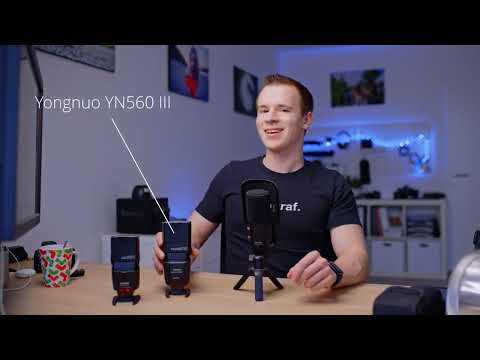
Cheap flashes from China, such as those from Yongnuo, can definitely be convincing in terms of performance and image quality. The decisive disadvantage lies in the build quality. The housings and connectors are often manufactured much more simply, and wear parts such as the battery compartment can quickly get damaged. With these devices, you should therefore expect a lifespan of one to two years. If you need several flashes, you can fall back on third-party manufacturers, but you should keep in mind that the savings can be lost again elsewhere. An original flash, on the other hand, can remain in use for many years, as the example of a ten-year-old device that still works like new shows.

Step 5: Understanding the Functions
The basic function of many clip-on flashes is quickly explained. They emit a preset power that you can manually adjust to be brighter or darker. In addition, there are extra functions such as TTL, in which the exposure is controlled automatically, and integrated radio triggers. Some third-party models have built-in radio that can trigger all flashes in range at the same time. That sounds practical, but it can be problematic. Many flashes also have a photocell that fires along when another flash is triggered. As a result, they may unexpectedly flash too. You should keep this in mind if you want to work with multiple flashes. Triggering via photocell or radio is also possible when the flash is not mounted on the camera. I'll cover the topic of off-camera flash in more detail later.

Step 6: Use the Swivel Function of the Flash Head
A flash head that you can rotate upward, sideways, or backward is indispensable for bounce flash. If you aim the flash at the ceiling or a light-colored wall, for example, the light becomes softer and more even. In addition, many models have a small reflector card in the flash head. It directs part of the light forward so that subjects at close range are also illuminated. In their basic functions, most flashes are very similar, which is why swivel capability is an important criterion when choosing.

Step 7: Securely Attach the Flash to the Hot Shoe
The flash is mounted on the camera via the hot shoe. Make sure to lock it in place afterward, because a flash that comes loose can fall off while you're shooting. The most common method is a locking wheel that you use to screw the flash tight. More expensive models often have a clamping mechanism that can be easily clipped shut. Both variants ensure a secure hold if you use them correctly.

Step 8: Check the Autofocus Assist Light
Some speedlights emit an assist light that projects a grid pattern onto the subject. This pattern makes it easier for the autofocus to lock on, even in very poor lighting conditions. However, this function can only be used with DSLR cameras. Unfortunately, the assist light does not work with mirrorless cameras. So if you own a mirrorless camera, you shouldn't overvalue this feature when making your purchase decision.

Summary – Finding the Right Speedlight
Which speedlight is right for you depends primarily on your subjects, your budget, and your requirements for build quality. Start with a model that meets your power requirements, and then check the functions you actually need. Original flashes offer longevity and reliable camera control, while third-party brands score points with their price but require a critical check of build quality. Also look for a swiveling flash head, a secure hold on the hot shoe, and the assist light if you work with a DSLR camera.
FAQ
Do I always need the most powerful speedlight?No, a smaller to mid-sized model is sufficient for most applications. The larger variants usually only offer slightly more power.
Is the extra cost for the 580 compared to the 600 worth it?That depends on how you work. The 580 is worth it if you work with multiple flashes, as it has an integrated wireless function. The 600 makes sense if you shoot a lot with telephoto lenses.
Are cheap third-party flashes bad?Not necessarily. They can deliver good results in terms of power, but they are often less well built and generally last shorter than original devices.
Can I use a speedlight with an assist light on a mirrorless camera?No, the assist light for autofocus does not work with mirrorless cameras.
What happens if several flashes have a photocell?Flashes with a photocell can fire as soon as they detect the light of another flash. As a result, they may fire unexpectedly.
Why is a swiveling flash head important?With a swiveling head, you can use bounce flash, for example off the ceiling or a wall. This makes the light softer and more even.


