
Many freelance web designers and graphic designers calculate their services based on an hourly rate and only realize during the negotiation that the client expects something completely different. This is exactly where usage rights come in. They are not an annoying appendix to the quote, but a tool with which you can flexibly adjust your prices to client needs without diluting your hourly rate. In this guide, you will learn how to use usage rights strategically, itemize them cleanly, and stay on the safe side legally.
The video is only loaded from YouTube when you play it – data (including your IP address) is then transmitted to YouTube/Google. More in the privacy policy
Key Takeaways
- Usage rights are an adjustable lever with which you can respond to the client's size, reach, and budget.
- Your hourly rate and your design fee secure your costs. Usage rights reflect the economic value of your work and give you room for price discounts.
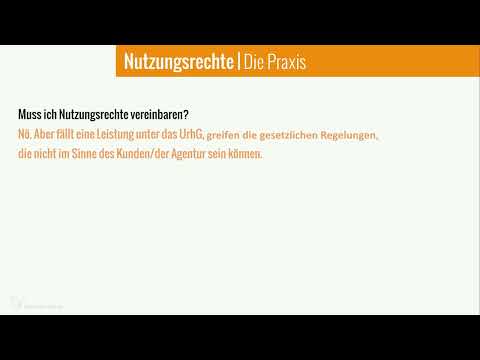
- If you do not explicitly define usage rights, you risk disputes, because the Copyright Act fills the gap with statutory provisions.
- Public tenders and larger projects require a clear definition of usage rights in the quote.
- Usage rights can be itemized and priced separately, so that you can make concessions in a targeted way.
Step-by-Step Guide
Step 1: Understand usage rights as an adjustable lever
The most important thought upfront: your hourly rate should not fluctuate depending on the client. If you offer your work more cheaply to a large corporation than to a start-up, or work for half the price for a small client, it quickly becomes unfair as soon as the clients know about each other. Usage rights offer you an elegant alternative. You keep your hourly rate stable and instead adjust the scope of the rights. A regional company pays for local, time-limited use, while an internationally operating corporation pays for worldwide and exclusive rights.

Step 2: Align the scope of use with the size of the client
A small regional company usually needs only low usage factors. A bakery on the corner will hardly use its flyer or logo across Europe. A company operating nationally or worldwide, on the other hand, often wants extensive rights and frequently even exclusive use. With every quote, ask yourself where the client is actually active, which media they use, and how long they need the work. This gives you the appropriate scope of use.
Step 3: Base the price on the economic value of the work
Usage rights reflect the economic value your work generates for the client. The broader the use, the higher the price. This makes your calculation transparent and fair. If you quote 500 euros to the small baker and 1,500 or 2,000 euros to the large bakery chain for a similar project, you can clearly justify this difference: the chain uses the work in hundreds of branches, while the baker on the corner uses it at only one location.
Step 4: Use the duration as a negotiation lever
If a client digs in their heels on price, it's worth taking a look at the duration. Often nobody asks whether the rights are needed for five or ten years right away. You can initially offer a usage right for one year, since you discuss design and campaigns annually anyway. If the project goes well and the client wants to extend the use, you only charge the difference between one year and three years. This way the entry price feels comfortable for the client, and you lose nothing if the project grows.
Step 5: Secure the design fee as a minimum price
The design fee covers your hourly rate and your effort. It is your business foundation and should always be listed in full in the quote. However, many creatives calculate so tightly that the hourly rate just covers costs without leaving any real profit. If you notice that a client does not want to pay for usage rights, you at least still have the design fee. So you don't have to negotiate your base price, only the rights. Also build a profit margin into your hourly rate so that you don't start from zero again with every discount.
Step 6: Define usage rights clearly in the quote
Especially in public tenders and larger projects, usage rights often decide who wins the contract. Authorities and large companies do not want to regularly argue with agencies about rights. If the quote says nothing about usage rights, this can cost you the project for formal reasons alone. Therefore, always state explicitly which rights you grant, for what period, in which territory, and to what extent. An authority can then, for example, receive a non-exclusive right that is unlimited in time, space, and content, without you handing over all rights wholesale.
Step 7: Keep the Copyright Act in mind
If you do not specify clear usage rights, the statutory provisions of the Copyright Act apply. These are not always in the interest of the client or your own. The law determines what was tacitly or implicitly agreed between the parties, and that may differ from your expectations. An example: A client commissions you to create an event flyer. You assume that they will only use the flyer for this one event. However, they think they get the flyer and can do whatever they want with it. Without an agreement, a dispute is inevitable. With a logo, the situation is similar: The client usually expects exclusive, comprehensive use, because it is their logo, after all. So it is better to talk about the rights early on instead of hoping for the statutory interpretation.
Step 8: Specify usage rights and price them separately
You do not necessarily have to charge for usage rights separately, but you should always specify them. This means: In the quote, you state which rights you are offering the client, and you set the price for them separately. For example, you can specify that the simple usage right for one year, regionally limited and with a low scope of use, is already included in the price. This avoids disputes over things that go without saying. If the project expands later, you can charge a surcharge afterwards for a longer term, a larger territory, or exclusive rights. So you have not closed off all doors.

Step 9: Make concessions in a targeted way and without losing profit
If a client is dissatisfied with the total price, you can accommodate them in a targeted way. You can reduce the scope of use, the territory, or the term, or remove individual items from the calculation entirely. The advantage: Your design fee and your hourly rate remain covered, because they are already fully included. If you waive the charge for usage rights, for example, you only lose the proverbial icing on the cake. This generosity can be worthwhile if it allows you to get started on a collaboration.
Step 10: Realistically assess website use for regional clients
A typical example of unnecessarily high prices is a website for a regional company with a worldwide usage rights clause. Such a clause only drives the price up, and the client gets no benefit from it. Instead, offer them a use that fits their business. If the price is still too high, you can give them a foot in the door by waiving the charge for usage rights. The client is happy about a gift, and you have still fully covered your calculation based on hourly rate and effort.

Summary – Calculating usage rights: How to negotiate prices fairly and transparently
Usage rights are far more than a legal formality. They give you the opportunity to respond to the size, budget, and needs of your clients without changing your hourly rate. Your design fee secures your minimum price, while the usage rights reflect the economic value of your work. Define the rights clearly in the quote, specify them separately, and use term, territory, and scope as flexible bargaining chips. This way you avoid disputes, remain legally protected, and give away only what you consciously release.
FAQ
Do I always have to charge for usage rights separately?No, but you should always specify them so that the client knows exactly which rights they receive, and so that you can set the price flexibly.
What happens if I do not mention usage rights in the quote?Then the statutory provisions of the Copyright Act apply, which often do not match your expectations or those of the client.
Can I sell usage rights afterwards?Yes, if you initially offer only a limited right, you can charge a surcharge for a later extension of term, territory, or scope.
Why are usage rights so important in public tenders?Authorities and large companies want clear conditions and avoid disputes with service providers, which is why missing or unclear usage rights can lead to exclusion on formal grounds alone.
How do I deal with a client who finds the price too high?You can reduce the scope of use, the territory, or the term, or remove individual items, while your design fee and your hourly rate remain covered.


