Anyone who just mounts their flash on the camera bare is giving up a good deal of creative freedom. Even small add-ons change how large the light source appears and how softly the light lands on the subject. In this guide, you will learn which accessories make sense for on-camera flashes, what to look out for in terms of quality and handling, and where the limits lie. I'll show you how it works in practice based on my own experiences, including at weddings and parties, and give you clear recommendations.
The video is only loaded from YouTube when you play it – data (including your IP address) is then transmitted to YouTube/Google. More in the privacy policy
Key Takeaways
- Attachments and light modifiers enlarge the apparent light source and make the light softer.
- The effect of small diffusers is noticeable, but not spectacular. A comparison photo helps you assess the effect yourself.
- Cheap accessories are often wobbly and do not last long in everyday use. Look for sturdy mounts.
- On-camera flashes are not studio flashes. They have less power and offer fewer options for shaping light.
- A battery pack extends runtime and shortens recharge time, but adds weight.
- Start with what you already own, and only buy accessories once you recognize a specific need.
Step 1: Why Attachments and Light Modifiers Make Sense
The bare flash is universally usable, but it delivers a very small light source. For soft, flattering light, however, you need a larger surface. This is exactly where attachments and light modifiers come in. They sit on the front of the flash and ensure that the light is diffused and directed. Similar to large studio flashes, this lets you deliberately influence the shape of the light. When buying, pay attention to how well the accessory fits your flash model, because on-camera flashes generally do not have a mount for light modifiers.

Step 2: Using Small Diffusers Like the Tuberdose
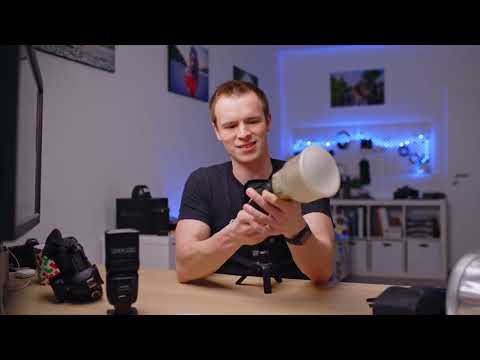
For mobile use, small diffusers that are sturdy enough for everyday use are a good fit. One example is the so-called Tuberdose, which I like to use myself. Such attachments diffuse the light a little and enlarge the light source. You should, however, have realistic expectations: the difference compared to the light source without an attachment is not huge, but it is there and is helpful in many situations.

A direct comparison makes the effect more visible. Photograph the same subject once with the bare flash and once with a diffuser. That way you can see for yourself whether the purchase is worthwhile for your work.

Step 3: The Recommendation for Sturdy Diffusers
If you are looking for an attachment that works reliably in everyday use, I clearly recommend the SMDV. It is somewhat more expensive than simple models, but significantly sturdier, at least with smaller boxes. It is easy to fold open and closed, which is convenient when switching quickly between locations.
The SMDV also offers the option of mounting it on a tripod. A light stand is also conceivable. However, the mounts differ depending on the model, so check before buying whether the attachment fits your tripod.

Step 4: Caution with Cheap Softboxes and Mounts
With accessories, the rule is: not everything that is cheap lives up to its promises. Many foldable softboxes for on-camera flashes are very small, some only about ten centimeters in diameter. They are wobbly, tend to fall apart, and are often difficult to attach to the flash. Even larger softboxes in cheap models are sometimes rickety.
There are also mounts that let you turn your on-camera flash into a kind of studio flash. Note, however, that the power of an on-camera flash is lower than that of a studio flash. Setups you have shot with studio flashes can be recreated with on-camera flashes, but you have to invest more time in the settings.

Step 5: The Combination of Reflector and Bounce
One variation that I use myself at weddings is the combination of off-camera flash and direct flash. Here you tilt the flash head slightly upward and use the ceiling as a large-surface reflector. This makes the light appear wider and softer. You also fold out the reflector at the front so that some light also falls on the subject from the front. This method is, however, more of a special case and is sometimes a bit cumbersome in practice.

Step 6: Use battery packs for longer run time
A battery pack can make working with the flash much easier. Depending on the flash model, you connect it via a power connector and thus gain more run time. In addition, the flash recharges faster when it is connected to the battery. In return, you have to carry a bit more weight around with you, and you should keep that in mind beforehand.

Keep in mind that no flash can work at full power continuously. After a number of firings, it needs a break to recharge, and even a battery pack changes little about that.
Step 7: Show restraint and choose accessories deliberately
My most important piece of advice in closing is: Don't overdo it. Start with what you already have and gather experience. Only then should you decide which accessories you are really missing. In photography especially, the so-called buying syndrome is widespread, where you constantly want to buy the next item.
With on-camera flashes, the following also applies: Many accessories are not particularly robust. They break quickly if you use them intensively. If you are on the move a lot, a sturdy model is worth more than several cheap variants. If you want to build a small studio, smaller softboxes and suitable mounts for larger softboxes are a good option. Just make sure they fit securely.

Finally, one practical tip: At parties, it can make sense to push the flash power harder, for example for strobe effects. In church, however, you should refrain from using flash. That is one of the things you should absolutely respect.

Summary – On-camera flash accessories: An overview of light modifiers, diffusers and battery packs
On-camera flashes can be noticeably improved with simple accessories. Diffusers and attachments enlarge the light source and make the light softer, even if the effect is rather moderate. Particularly sturdy models such as the SMDV are recommended for everyday use. Cheap softboxes and mounts, on the other hand, can be wobbly and should be checked carefully before purchase. A battery pack extends the run time and speeds up charging, but increases the weight. Start with what you already own and only expand your equipment when there is a specific need.
FAQ
Do I absolutely need a light modifier for soft light?No, you can also create soft light with a small diffuser or by bouncing the flash off white walls. However, a light modifier enlarges the light source much more significantly.
How big is the difference between a diffuser and a bare flash?The difference is there, but it's not huge. A comparison photo shows you best how strong the effect is with your setup.
Why is the SMDV recommended?The SMDV is a bit more expensive, but sturdier than many alternatives. It can be easily folded open and closed and can be mounted on a tripod.
Do cheap softboxes for on-camera flashes make sense?They can work, but are often rickety and fall apart easily. Check stability and attachment carefully before buying.
Can I recreate a studio setup with an on-camera flash?It's possible, but more difficult. On-camera flashes have less power than studio flashes, so you have to plan more time for setting up.
Is a battery pack worth it?Yes, if you need longer run times and shorter charging times. In return, you accept a bit more weight.
How much accessories do I need at the beginning?Start with what you already have and gather initial experience. Only buy accessories when you recognize a specific need.


