Imagine your model standing in the dark, with only a few narrow bands of light picking out the shoulders, hips and thighs. You achieve exactly this effect with a lighting setup that relies on side-placed strip lights instead of flat frontal lighting. In this guide, I will walk you step by step through converting an existing setup for lingerie and figure shoots. This is not about nudity in the image, but about light that creates shape and tension.
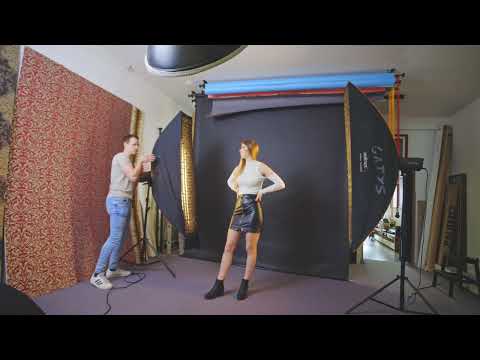
The video is only loaded from YouTube when you play it – data (including your IP address) is then transmitted to YouTube/Google. More in the privacy policy
Introduction
Many beginners light nude and lingerie shots the same way as portraits: a large softbox stands directly in front of the subject, and the result looks flat. The body loses its contours, and the image looks generic. Nude photography, on the other hand, offers you great creative freedom, because you are allowed to work deliberately with light and shadow. If you switch off the main light source and instead work with lateral grazing lights, exactly this sculpted look emerges.
You don't need a new studio for this. The setup from the previous exercises can be converted with just a few steps. A black background helps you here, because disturbing ambient light then hardly falls on the background.
Key Takeaways
- Side strip lights emphasize body contours far more strongly than frontal light.
- The main light source is removed so that no flat lighting results.
- A black background is ideal, since ambient light then hardly interferes.
- The position of the lights determines whether the background looks bright or dark.
- Turning one light source up and the other down changes the character of the image significantly.
- A small spark of light in the eye brings the subject to life, but should be used sparingly.
- Experimenting is part of the process, because every subject and every style requires its own settings.
Step 1: Switch Off the Main Light Source
Begin by dismantling whatever has been making your image flat so far. Go to your main light source and switch it off or remove it from the scene entirely. At first glance this step seems radical, but it is the most important starting point. As long as a large frontal light source is active, it overpowers the contours you want to bring out.
Afterwards, take a quick test shot. You will notice immediately how the image changes: the body shapes stand out, because only the light edges coming in from the side illuminate them.

Step 2: Check the Effect on the Subject
After switching off the main light source, it is worth taking a close look at the result. Take a shot, view it on the display, and compare how strongly the body is emphasized. On test shots you can quickly see whether the light looks too flat or already too harsh. This moment also shows you how body-emphasizing the setup is before you add more lights.

Step 3: Use Strip Lights as the Main Creative Tool
Instead of classic softboxes, you now work with strip lights. These narrow, long lights produce directional light with sharp light edges. That is exactly what makes the difference in nude and lingerie shots, because the line of light follows the curves of the body.
I consider strip lights especially well suited to this type of photography, because they allow you to create a lot of shape with just a few light edges. Place them to the side of the model so that the light hits only one edge of the body.

Step 4: Fine-Tune the Position of the Light
Now comes the fine-tuning. Move the strip light a bit further forward so that the light falls from the subject further toward the camera. You can also use the modeling light to see exactly how the light falls on the body at that moment. Many lamps allow a preview of the light shape, and that saves you numerous test shots.
Pay attention to the space in the studio. A cramped room often forces you to place the lights more compactly, and that changes the light edge. Therefore, adjust the distance until the contour is cleanly worked out.

Step 5: Control the Background via the Light Position
The lights also determine the background. Place a strip light somewhat further behind the model so that the light just passes by her. This creates a light edge along the silhouette, and depending on the distance, the background stays dark or becomes visibly brightened.
If you want the background to look completely white, aim the light directly at the background surface and increase the power. If, on the other hand, you want more drama, the background stays dark and the light focuses exclusively on the subject. You can further reduce the amount of ambient light by slightly underexposing the camera. This makes the ambient light appear darker, and your light sources dominate the image.

Step 6: Check the result and repeat
After every change, you should look at the shot again. Compare light edges, depth, and brightness in the background. Often even a small shift is enough to change the expression of the image. Take your time, because with side lighting in particular, tiny changes in distance have a strong effect.

Step 7: Place a soft spark of light in the eye
A little light in the eye brings the subject to life. Without this spark, faces in dark setups often look empty. You achieve this by moving the strip light slightly forward or backward until a small reflection becomes visible in the eye. However, make sure the face is not additionally brightened, as that would destroy the drama.

Step 8: Experiment with the light distribution
Now deliberately use just one light source or set the power of the two lights differently. Turn one lamp up higher and reduce the other. This way you can control the ratio between light and shadow. One dominant side creates tension, while two equally strong sides look more balanced. This variation is one of the most powerful tools in lighting, and it is worth trying out.

Step 9: Find your own way
At the end of this guide there is an honest realization: you can be shown many techniques, but the right style only emerges through your own experimentation. A setup that works excellently for one photographer may look too harsh or too soft for another. So take the time to vary distances, power settings, and angles, and note what suits your style.

Summary – Lingerie and Nude Photography: Lighting Setup with Side Strip Lights
You have learned how to turn a frontal standard setup into a lighting concept with side strip lights. The main light source disappears, the strip lights take over the shaping, and their position determines the background, contours, and the spark of light in the eye. With a black background, deliberate underexposure, and a conscious distribution of light power, an image with tension and depth is created. The most important step remains experimentation, because only that way will you find the lighting language that suits your photography.
FAQ
Why should I turn off the main light source?A frontal main light source covers up the body contours and makes the image flat. Without it, the side lights emphasize the shapes much more strongly.
Why are strip lights particularly suitable for nude photography?Strip lights create narrow, directional light edges that follow the curves of the body. This creates dimensionality with just a few light sources.
How do I achieve a completely white background?Aim a strip light directly at the background surface and increase the power. The light must fall specifically on the background for this.
How do I achieve a dark, dramatic background?Position the lights so that they only hit the subject, and slightly underexpose the camera. This reduces the ambient light.
How do I get a spark of light in the eye?Move the strip light slightly forward or backward until a small reflection becomes visible. Make sure not to brighten the face too much.


