
Early morning has a special atmosphere: The fog still lies over the fields, the sun is low, and every blade of grass can become the star of the show. In this tutorial, I will show you how to bring out the small details in an autumn landscape that would otherwise quickly go unnoticed. To do this, you switch to a macro lens with a 100 mm focal length, specifically look for plants with dewdrops and spider webs, and choose aperture and exposure so that subject and background together make a harmonious image.
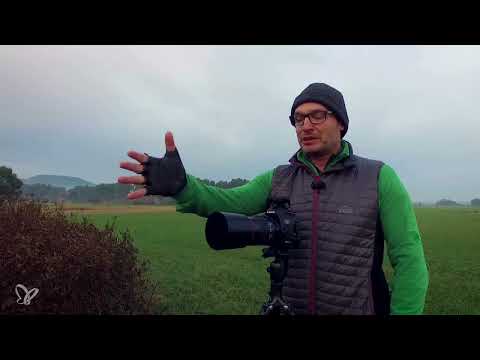
The video is only loaded from YouTube when you play it – data (including your IP address) is then transmitted to YouTube/Google. More in the privacy policy
Key Takeaways
- Details such as dewdrops, spider webs, and dried-up blossoms are what make a landscape shot truly come alive.
- A 100 mm macro lens allows you to take close-ups that are difficult to achieve with a wide-angle lens.
- With a wide-open aperture (e.g. 2.8), the background becomes soft and colorful, so the subject stands out clearly.
- In backlight, sunrays are refracted in the dewdrops. This creates sparkling effects, but requires careful exposure.
- A darker background creates contrast and brings the plant more into the center of attention.
Step-by-Step Guide
Step 1: Switch to the Macro Lens
Change the lens deliberately and as quickly as possible, especially outdoors. Every dust particle that gets onto the sensor during the change will later show up as a dark spot. It is best to put the removed lens directly into a bag or pouch so that it does not get dirty. The 100 mm focal length gives you exactly the distance you need for detail shots.

Step 2: Look for Suitable Plants
Before you start photographing, take a calm look around. Walk through the surroundings and watch out for groups of plants that look particularly interesting in the morning light. Pay attention to blades of grass, stems, inflorescences, and seed heads, but also to dried-up plant parts from autumn. It is precisely these accessories that make a subject exciting, even if the plant seems unremarkable at first glance.

Step 3: Find Plants with Spider Webs and Dewdrops
Plants with spider webs hanging from them or dewdrops sitting on them are especially valuable. These little things give the image depth and shine. Keep in mind that dewdrops form mainly in the early morning hours and evaporate over the course of the morning. So plan enough time and photograph while the drops are still there.

Step 4: Use the Backlight
As soon as the sun rises higher, you can deliberately shoot against the light. The sunrays are then refracted in the dewdrops and create small sparkling points. A spider web can literally begin to glow when tiny water droplets hang everywhere on its threads. This lighting situation is demanding, but rewards you with particularly atmospheric images.

Step 5: Capture the Close-Up with the Macro Lens
With the 100 mm macro lens, you can get close to a plant and render it sharply. With a wide-angle lens, this kind of detail shot would be much more difficult. Make sure you place the focus precisely on the spot you want to highlight, such as a single dewdrop or a fine structure on the stalk.

Step 6: Set the Aperture for Soft Backgrounds
Choose a wide-open aperture, 2.8 in the example. The lens then gives you a beautiful blur in the background. A simple rule applies here: The smaller the aperture value, the closer you are to the subject, and the longer the focal length, the blurrier the background becomes. A bright sky or a bright sun is thus transformed into a soft, delicate color gradient.

Step 7: Deliberately Design Subject and Background
Now you decide how you want to build the image. You can show the plant as a silhouette against a colorful background. This creates a mood image in which the colors determine the visual impact. Alternatively, you approach the plant even closer and concentrate on the structure. This then results in more of a nature detail image that shows surfaces, seeds, and fine hairs.

Step 8: Choosing the shutter speed to prevent camera shake
With a wide-open aperture, the depth of field is very shallow. Even a slight movement of the plant caused by wind can make the image blurry. Therefore, choose a faster shutter speed so that the movement is frozen. At sunrise it is often still dark, so you have to keep an eye on the exposure. For macro shots, this is a typical challenge that you can master with a little patience.

Step 9: Changing your position and darkening the background
If the background is too bright, change your position. This often allows you to find a darker background that makes the plant stand out more. Keep in mind: when you shoot into the sun, it places particular demands on your sensor. Set the exposure so that the subject is correctly exposed. The background then stays darker, but it is precisely this difference that creates the necessary contrast.

Step 10: Checking light gradients, structures and color contrasts
Before you press the shutter button, look at the image critically. Ask yourself which light gradients you see, which structures stand out and which color contrasts arise. Only the interplay of these image elements makes a photo interesting. A single-colored plant may look boring at first glance. In detail, however, with fine hairs, seeds and dewdrops, it gains enormous impact, especially since the soft background provides calm.

Summary – Macro photography in morning light: skillfully capturing details of the autumn landscape
In the morning light, autumn plants show their most beautiful side. By switching to a 100 mm macro lens, you bring dewdrops, spider webs and seed heads up close. With a wide-open aperture of 2.8, you create a soft background, and with a sufficiently short shutter speed, you prevent camera shake caused by wind. If you deliberately use backlighting, sparkle effects are created as well. Finally, pay attention to light gradients, structures and contrasts, and the detail will look harmonious and atmospheric.
FAQ
Why should I change the lens as quickly as possible outdoors?When changing lenses, dust can get onto the sensor. Therefore, change quickly and store the removed lens in a bag.
Which aperture is suitable for soft backgrounds in plant photos?A wide-open aperture such as 2.8 creates a soft, blurred background. The closer you are to the subject and the longer the focal length, the stronger the blur.
When is the best time to photograph dewdrops?Dewdrops form mainly in the early morning. They evaporate over the course of the morning, so you should be on location in good time.
How do I avoid the plant being blurred by movement at a wide-open aperture?Choose a faster shutter speed so that movement caused by wind is frozen. In low light, this can be a challenge.
How do I deal with backlighting?Backlighting makes dewdrops and spider webs glow. Make sure the subject is correctly exposed, because the bright background places heavy demands on the sensor.
What distinguishes a mood image from a detail image?A mood image thrives on colors and a background that surrounds the plant as a silhouette. A detail image moves close to the subject and shows surfaces and structures.


