
A river in autumn, fog over the water and a sun that is just fighting its way through the treetops: exactly such moments can be captured with the right preparation and a few tricks. Using the Brigach in Donaueschingen as an example, I show you how to build a dark, mystical mood, keep contrasts under control and carry out a long exposure in broad daylight.
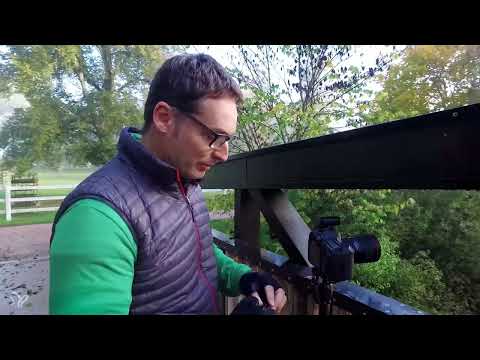
The video is only loaded from YouTube when you play it – data (including your IP address) is then transmitted to YouTube/Google. More in the privacy policy
Key Takeaways
A dark mood is created above all by fog, hard contrasts and a deliberately underexposed look, not by post-processing alone. For smooth water you need an ND filter, a stable stance and an exposure time of at least one minute. Bulb mode gives you full control over the duration. Several exposures with different times can later be combined in Lightroom into an image with depth. You create sun stars with a high aperture value, and you must check the focus again and again after the filter is on.
Step-by-Step Guide
Choosing the Location and Composition
Position yourself at the bridge so that the river flows into the frame from the right and disappears out of the frame to the left. On the right side, the sun rays between the trees can be captured best later on. This perspective gives the image direction and depth without you having to do much editing.

When composing, also pay attention to the background. Dark trees and diffuse fog form the frame for your mood, so it is worth spending a few seconds longer searching until everything looks harmonious.

Setting the Exposure for the Fog
To start, you use the automatic exposure so that you can first concentrate on composition and focus. Choose an aperture of about 8 to 11 if you want a nice depth of field. With fog, the image can quickly look bright, so check the result on the display and don't hesitate to readjust if necessary.

Take the first picture and check the histogram as well as the highlights. With fog and incoming sunlight, you are dealing with very hard contrasts. The background scenery becomes bright, while the dark river in the shadow almost disappears. It is precisely this effect that creates the atmospheric mood you are looking for.

Balancing Contrasts with an Exposure Series
If you need more detail in the dark areas, you have to expose brighter. The bright areas, such as the blown-out fog, can then be secured with a shot with a shorter exposure time. So take several photos with different exposures.

You merge these images later in Lightroom as an HDR. In doing so, you take the details in the dark areas from the bright shot and the detail in the fog from the dark shot. You don't have to rescue every detail perfectly. A slight overexposure and dark areas are part of this mood.
Deliberately Toning Down the Color
With fog, a colorful look quickly seems out of place. A more muted, gray-brown look, on the other hand, underscores the autumn mood. You save the colorful autumn colors for pictures in sunshine.

Understanding the Idea of Long Exposure
A long exposure makes flowing water smooth and calm. The surface then looks almost surreal, while the rest of the scene retains many details. During the day, however, this is a challenge, because in bright light the camera would overexpose far too quickly. So you have to darken the camera artificially.

Attaching the ND Filter Correctly
For the darkening you use an ND filter, that is, a neutral density filter that is screwed onto the front of the lens. Before you put it on, set the focus manually. With the filter, the image becomes so dark that the autofocus no longer works reliably. If you only want to set the focus manually afterwards, you will often not be able to see anything anymore.

Once the filter is on, never change the focus again. Still, check it briefly after attaching the filter, because accidentally touching the ring can ruin the result.

Use Bulb mode for the exposure time
Set the camera to Bulb mode. In this mode, you determine the exposure time yourself by holding down the shutter button or ending the shot with a timer. With the ND filter I am using here, you need an exposure time of at least one minute for the image to be reasonably correctly exposed.

Apps with exposure calculators do give you guideline values, but they are only aids for orientation. Experience helps you much more. Over time, you develop a feeling for how long a particular filter needs in a particular lighting situation.

Avoid vibrations at all costs
With long exposures, every small vibration counts. The bridge sways slightly when people or bicycles cross it. Therefore, you should avoid moving as much as possible during the shot and wait for the process to finish. Even a small movement leads to immediate blur across the entire image.

Take several shots for an exposure series
Not every long exposure succeeds on the first try. So plan enough time and rather take five, six, or seven shots until you have several usable images for later editing. An exposure of one minute and ten seconds may turn out too bright, while 50 seconds often fits better.

Also pay attention to the weather. With longer exposures, the fog often thickens, which enhances the mood even more. When wind moves the leaves, slight blur occurs that gives the image dynamism. You don't have to avoid such effects, because an image doesn't have to be perfectly sharp throughout to convey emotions.

Wait for the right moment for the sun
The sunbeams often only appear after some time. A completely overcast sky prevents the sun from breaking through. A light haze or high fog through which the light just barely shines is best suited. Find out about the weather conditions in advance if you want to specifically photograph sunbeams in fog.

As soon as the sun breaks through, the exposure time quickly decreases. In my example, 30 seconds were already enough because the brightness increased significantly. Therefore, check every shot and continuously adjust the time.

Remove the filter and reset the autofocus
After the long exposure, you unscrew the ND filter again. Then switch the autofocus back on and change back to a normal exposure mode, for example aperture priority. Don't forget this, because many photographers lose valuable time especially when switching between modes.

Pay particular attention to the focus here. If you don't reset the manual focus, you can forget the next shot right away.

Shape sun stars via the aperture value
For a star-shaped glow around the sun, you increase the aperture value. The higher the value, the more intense the sunbeams turn out. However, this can slightly reduce image sharpness due to diffraction blur. So decide for yourself whether the sun star is more important to you than the ultimate sharpness in the image.

Test several aperture values until you like the effect. Then adjust the exposure time, since the brightness changes with the higher aperture value.

Combining the long exposure and the normal exposure
An interesting option is to combine the long exposure image with the normally exposed image. In Lightroom, you can merge both shots as an HDR. This way the river stays soft, while the details in the trees are preserved. Try out different variations, because the result depends heavily on the subject.

Trying the opposite direction
If you are standing on a bridge, you usually have two directions to choose from. If you have been shooting into the sun so far, turn around and shoot with the sun at your back. This often creates completely different lighting moods that expand your repertoire of images.

Summary ??? Autumn mood by the river: long exposure and fog sunbeams
A gloomy autumn mood arises from fog, harsh contrasts, and deliberate exposure. With an ND filter, Bulb mode, and a stable stance, you capture silky water. Multiple exposures give you room to maneuver in editing, and a high aperture value brings the sun star into the picture. Take your time to wait for the moment, and don't let blurriness bother you, because it can even intensify the emotion of an image.
FAQ
How long do I need to expose for a long exposure with an ND filter?With a strong ND filter, you need at least one minute, often more; apps only provide rough guidelines and your experience is decisive.
Why should I set the focus before attaching the ND filter?With the dark filter, the autofocus often can no longer find a subject, so you set the focus manually beforehand and leave it unchanged afterwards.
Why do you use Bulb mode instead of a timer?In Bulb mode, you determine the exposure time yourself and can end the shot spontaneously at any time, which helps with changing light conditions.
How do I avoid camera shake during long exposure times?Place the camera securely, do not move during the shot, and watch out for vibrations caused by people or vehicles, for example on a swaying bridge.
When do the sunbeams come through the fog?The sun is most likely to appear with light haze or high fog without a closed cloud cover, so you should check the weather in advance.
How do I create the sun star effect?Increase the aperture value, because the higher it is, the more intense the rays become, although diffraction blur increases slightly.
How do I combine long exposure and normal exposure?Merge both shots as an HDR in Lightroom so that the water looks soft and the details in the trees are preserved.


