
Imagine a reader skimming past three paragraphs of warm-up text and losing patience. People sometimes forgive that. Language models do not. They search specifically for an answer, and if they do not find it in the first few lines, they move on to the next source. In this guide, you will learn how AI systems scan introductions, why the opening determines whether you get cited, and how you can restructure your texts with just a few tweaks.
The video is only loaded from YouTube when you play it – data (including your IP address) is then transmitted to YouTube/Google. More in the privacy policy
Key Takeaways
- AI systems check the first roughly 50 words of a text for a direct answer.
- Definition First means: you answer the core question immediately and provide the context only afterwards.
- The three-sentence formula structures the opening into definition, evidence, and promise.
- Filler phrases like "In this article, we show you …" offer AI systems no citable content.
- Automatically reworded texts must always be checked by you, especially numbers and statements.
Step-by-Step Guide
Step 1: Recognize the Warm-Up Phase
Start with an honest analysis. Open one of your articles that has not yet been cited by AI systems and read only the first few paragraphs. Typically, there are three paragraphs without any real informational content: a general introduction, a paragraph about the importance of the topic, and a paragraph announcing what awaits the reader. A sentence like "In this guide, we offer exactly that" contains neither a question, an answer, nor a definition. Mentally mark such sentences as ballast. In many texts, the actual content only begins in the fourth paragraph, and that is exactly where an AI system has usually already abandoned the search.

Step 2: Understand the 50-Word Rule
When processing a query, language models look for a suitable answer. If the system finds no direct answer in the first 50 words, it assumes that the text does not answer the question directly and looks elsewhere. The 50 words are a rule of thumb and not an official law. What matters is the principle behind it: the answer belongs at the beginning of your text, not in the middle or at the end.

Step 3: Apply Definition First
The principle is called Definition First. You answer the core question immediately, before spreading out the background. First comes the answer, then the context. Take the example of email marketing. The before version reads: "Email marketing is one of the most popular forms of marketing. Many companies have been using it successfully for years." The after version reads: "Email marketing means that you reach customers directly by email, without depending on algorithms." The definition is right there in the text and can be adopted unchanged by a system.
Step 4: Consciously Compare Before and After
At first glance, the before version looks like a perfectly normal introduction, but it contains no question, no answer, and no definition. The after version delivers what the topic is in a single sentence, adds a concrete number, and clearly states what follows in the article. This form can be adopted as a ready-made citation passage, whereas the before version offers an AI only material for a general paraphrase. In your own texts, make sure that numbers come from verifiable sources. The example number in the video serves only as an illustration.

Step 5: Build the Three-Sentence Formula
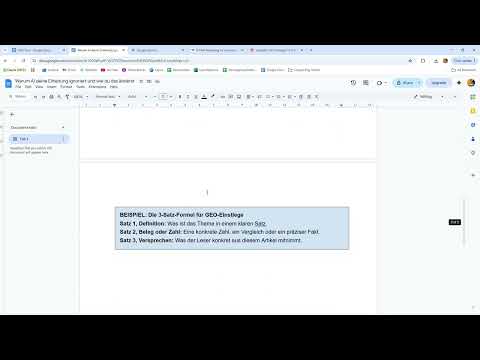
For good GEO openings, a simple structure of three sentences helps, each with a clear function. The first sentence provides the definition and answers the question of what the topic is. The second sentence provides the evidence, that is, a concrete number, a comparison, or a precise fact. The third sentence formulates the promise, that is, what readers will concretely take away from the article. Precision is crucial here. The sentence "You will learn what email marketing is" remains vague. The sentence "You will get three steps: build a list, write a welcome sequence, send regularly" immediately shows what content the article offers.

Step 6: Distinguish Definition First from the Body Text
Definition First does not mean that you have to start in a boring way. A strong headline or a surprising fact may be placed first. The principle refers to the body text, that is, the first paragraph after the headline. That is exactly where the answer belongs. If you want to work with a hook, place it in the headline or in the teaser and let the first body text paragraph begin directly with the definition.
Step 7: Revising an Overloaded Introduction with Gemini
In practice, it quickly becomes apparent how often introductions are bloated. Copy a long introduction into Gemini and ask the model to restructure it using the three-sentence formula. Phrase the prompt so that the model explicitly takes the pattern into account and adapts the introduction to the topic. The result is usually significantly shorter and already contains a definition. What is decisive, however, is the review that follows, because AI outputs are suggestions and not verified facts.
Step 8: Checking and Shortening the Result
The AI version is quicker to formulate, but not automatically correct. Check every number and every claim against your sources. In the example, it also became apparent that the introduction listed too many topics. A good opening promises only what the article actually covers. Therefore, delete lists that have no counterpart in the text, and replace sample values with verified data. It is best to make improvements for Geo yourself, because only you know the substance of your article.

Step 9: Revising Your Own Top Pages
The most effective way to get started in practice is a concrete task. Select your five most important pages or blog articles and rewrite the first three sentences of each according to the pattern. Then compare whether the key message now appears in the first paragraph and whether an unfamiliar reader can grasp it within a few seconds. The change is usually visible immediately, both when reading and when AI systems review the texts.

Summary – Geo Introduction: Writing the First Sentences So That AI Cites Them
AI systems decide within the first lines of a text whether it contains a usable answer. Those who answer the core question immediately, work according to the Definition First principle, and build the introduction with the three-sentence formula of definition, evidence, and promise create citable passages. Warm-up sentences, platitudes, and overloaded introductions should be consistently deleted for this purpose. AI tools help with rephrasing, but reviewing the content remains your job.
FAQ
How many words determine whether an AI system finds an answer in your text?The rule of thumb is that the first roughly 50 words should contain the core answer, because after that the system often switches to another source.
What does Definition First mean?You answer the core question directly in the first paragraph after the heading and provide the background only afterwards.
Do I have to give up an exciting headline?No, Definition First concerns the body text. A headline or a surprising fact may come before it.
What three sentences make up the three-sentence formula?The first sentence provides the definition, the second provides evidence such as a number or a comparison, and the third makes a concrete promise to the reader.
Can I simply have an AI rewrite an introduction?You can use it as a template, but you should always check the result for numbers, facts, and content and adapt it to your article.
Why are platitudes like "In this guide, we offer exactly that" problematic?They contain neither a question, an answer, nor a definition, and therefore offer an AI system no citable content.


