
Imagine an AI assistant is supposed to use your article as a source for an answer. Whether that succeeds depends heavily on how you structure your content. Plain running text is pleasant for humans to read, but it is often harder for language models to evaluate, because key statements are hidden between the lines. This is not because AI cannot read running text, but because tables and lists make the meaning explicit.
The video is only loaded from YouTube when you play it – data (including your IP address) is then transmitted to YouTube/Google. More in the privacy policy
In this guide, you will learn which formats language models prefer, how to turn running text into tables, lists, and FAQ blocks, and which signals tell you when a structure fits better than a paragraph.
Key Takeaways
- Tables, lists, and FAQ blocks make relationships explicit and are therefore easier to process and cite.
- Running text is suited to explanations and context, structure to comparisons and enumerations.
- Three simple triggers show you when you should restructure: comparisons, sequences, and enumerations.
- FAQ blocks are cited particularly often because they match the format in which AI systems formulate answers themselves: a concrete question and a direct answer.
- Questions from Google (People Also Ask) and Reddit provide you with the content for your FAQs.
Step-by-Step Guide
Step 1: Get to Know the Structured Formats
Before you restructure texts, you should know the building blocks. These include comparison tables, FAQ blocks, bullet points, numbered lists, and summary boxes. I group all of these forms under the term structured content. Comparisons as an image are also possible, but only if the AI can actually read out the content. That is why text in a table is usually the safer choice.

Step 2: Create a Two-Column Comparison Table
In your word processor, for example in Google Docs, create a table with exactly two columns. Label the left column "Pros" and the right one "Cons". Each row contains one point that can be clearly assigned. This way, a reader grasps the difference at a glance, and an AI does not have to filter an explanation out of a long paragraph. A table of this kind needs less explanation than running text with the same information and is therefore easier to cite.
Step 3: Formulate Comparisons as a Comparison Table
Whenever you compare two things with each other, a table is worthwhile. Typical examples are tool A versus tool B, method 1 versus method 2, or a before-and-after comparison. With three columns, however, you should make sure the table remains clear. Two or at most three columns are ideal.
Step 4: Find and Add FAQ Blocks
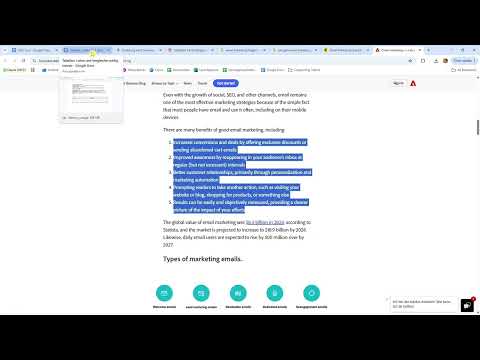
An FAQ block consists of a concrete question and a concise, directly worded answer of one to two sentences. First check whether your article already has such a section. If it is missing, add it. You can choose the presentation freely, for example as a collapsible box or as a normal heading with the answer below it. An example from the field of email marketing shows what this looks like in practice: the question is clearly in the foreground, and the answer gets straight to the point.

Step 5: Use Numbered Lists for Sequences
Numbered lists fit wherever the order plays a role. These are step-by-step instructions, phases, or rankings. Make sure you really build the list according to sequence. Then both the reader and the language model can recognize which point follows which.

Step 6: Use Bullet Points for Options and Features
In most cases, you reach for bullet points when you list options, benefits, examples, or features. One to two paragraphs of explanation, followed by a short list, work very well. It is important that the individual points are worded equivalently. Then the list looks clean and can be evaluated quickly.
Step 7: Add Summary Boxes
A summary box bundles the key statements of a section into a few points. It is particularly suitable for longer texts because it gives the reader a quick overview and provides the AI with the most important statements in compact form. Place it at the beginning or at the end of a section and keep it really short.

Step 8: Apply the Rule of Thumb
The most important rule is: running text for explanation and context, structure for comparison and enumeration. Not every paragraph has to become a table or a list. If you write everything in lists, the text becomes less readable for humans. So for each paragraph, check which function it serves, and then choose the appropriate format.
Step 9: Recognize the Three Triggers
Three signals show you when a structure is better than a paragraph. The first trigger is contrasts such as "on the one hand, on the other hand", "advantages and disadvantages" or "Tool A and Tool B". These become a two- or three-column table. The second trigger is enumerations with "first, second, third". These become a numbered list. The third trigger is examples that you place side by side as an enumeration. Bullet points are suitable for this. Once you consciously notice the signals, you will quickly spot them while writing.
Step 10: Use FAQ Blocks as a Quick Lever
If you only want to make a single structural change, add FAQ blocks. They are easy to implement and have a particularly strong effect. Include three to five of the most frequent questions about your topic. This step brings a noticeable effect with minimal effort, because it corresponds exactly to the format that AI systems use for their answers.

Step 11: Derive Questions from Reddit
Reddit is a reliable source of real questions. Search relevant subreddits for questions about your topic. An example from the email marketing subreddit is the question of how people design their marketing emails. Such threads often contain many honest answers from real people. You can adopt these questions into your FAQs. If you supplement a question with a suitable article, that additionally increases your chances of visibility.

Step 12: Use People Also Ask as a Source of Questions
The questions from "People Also Ask" on Google show you which follow-up questions users have about a topic. Although this area is somewhat less important today than it used to be, it is still worthwhile. Call up a search query, such as "What are the five most important questions in marketing?", and adopt the relevant questions as the basis for your FAQ section.

Step 13: Develop Your Own Models and Take Up Questions
The questions from Google and Reddit can also inspire you to create your own content. One example is the marketing model of the 4Ps or the 8Ps. You could extend it for services and thus develop a new model. An article about it simultaneously answers questions that people ask on Google or on Reddit. This combines originality with clear structure and makes your contribution equally valuable for readers and AI.

Summary – GEO Tables, Lists & FAQ: How to Structure Content for AI
Structured content makes meaning explicit. Tables are suited to comparisons, numbered lists to sequences, bullet points to enumerations, and FAQ blocks to concrete questions with direct answers. Running text remains indispensable for explanations and context. If you know the three triggers and take up questions from Google and Reddit, you can prepare your texts significantly better for humans and AI systems with manageable effort.
FAQ
Why are tables and lists processed more easily by AI systems?Tables and lists make the meaning of statements explicit, so that relationships do not first have to be inferred from a long text.
When should I use running text instead of a structure?Running text is suited to explanations and context. A structure fits better as soon as you compare or enumerate.
How many columns should a comparison table have?Two columns are ideal, three at most. More columns quickly make the table confusing.
What makes an FAQ block so effective?It consists of a concrete question and a direct answer, which is exactly the form in which AI systems themselves generate answers.
Where do I get suitable questions for my FAQ?Suitable sources are frequent questions from Reddit forums, the follow-up questions from "People Also Ask" on Google, and questions that your customers ask regularly.


