
Long texts hardly help you anymore with AI systems and search engines. What matters is whether your content delivers something that doesn't exist elsewhere. An AI can write generic guides in seconds, but it cannot collect its own data. That is exactly where your opportunity lies. Anyone who publishes their own figures, observations, or experiments becomes a primary source and is therefore disproportionately citable in AI answers. In this guide, I show you how to create such original sources with manageable effort, earn press mentions, and set in motion an authority cycle that reinforces itself.
The video is only loaded from YouTube when you play it – data (including your IP address) is then transmitted to YouTube/Google. More in the privacy policy
Key Takeaways
- Originality beats text volume. AI can produce any number of generic texts, but it cannot produce its own data.
- Anyone who publishes their own surveys, analyses, or experiments becomes a primary source and is therefore cited more often.
- Citable content contains a number, a comparison, or a clear finding that you can state in one sentence.
- Small mini-studies that can be carried out in one to two days are entirely sufficient.
- Press mentions and podcast appearances anchor your brand as an entity and amplify the effect.
- Generic blog posts without original input will lose their visibility in the medium term.
Step-by-Step Guide
Step 1: Understand the Logic of the Primary Source
Before you collect anything, you should have grasped the basic principle. AI systems look for statements that they cannot find elsewhere. If you produce information that exists only with you, the likelihood that it will be cited as a source increases significantly. So for every idea, ask yourself a simple question: Does the AI have access to this information somewhere else? If not, you are the source, and that is exactly what makes your content valuable.

Step 2: Collect Research Ideas with an AI Prompt
You don't have to reinvent the wheel on your own. A good tool to get started is a precise prompt. In the example, I work in the field of dog training and ask the AI for five mini-research ideas that I can carry out in one to two days. Three requirements are important: The ideas should be your own surveys, analyses, or experiments, not complex studies, and they should deliver concrete numbers wherever possible. The more clearly you formulate industry, timeframe, and goal, the more useful the answer will be. Afterwards, discard everything that you cannot carry out yourself with reasonable effort.
Step 3: Choose Suitable Data Collection Formats
Next, it's about the concrete form of your data collection. Many formats are closer than you think. You can conduct a reaction time study in which you use a stopwatch to measure how quickly your dog responds to a command. You can compare products in the supermarket or contrast value-for-money ratios. A short survey of passersby, a poll sent to your email list, or the analysis of your own website data are equally suitable. What matters is not perfection but honesty: The goal is around 50 responses from your target group, which you publish with real numbers. Two or three articles can then be derived from such a survey with ten questions.

Step 4: Plan and Conduct Experiments
Experiments are a particularly strong format because they include a comparison. You can test two strategies in parallel, for example two thumbnails for YouTube videos that you run against each other. Afterwards, you evaluate which variant performs better and draw conclusions from it. Even very small trials work. For example, you can post on LinkedIn every day for a month, document your results, and derive insights from them. Such experiments with yourself are often the fastest way to a solid statement of your own.
Step 5: Formulate Citable Findings
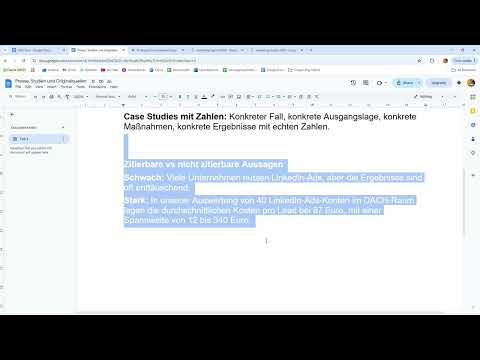
Now comes the decisive step for publication. Citable content shares one characteristic: It contains a number, a comparison, or a clear finding that can be stated in one sentence. Compare two formulations. The sentence "Many companies use LinkedIn Ads, but the results are often disappointing" is generic and can hardly be cited. The sentence "In our analysis of 40 LinkedIn Ads accounts, the average cost per lead was €87, with a range of €12 to €340," on the other hand, names the source, scope, and result at a glance. Make sure to always include your method and your sample size.

Step 6: Derive an Honest Mini-Analysis from Your Work
What if you don't have any data yet? Then start with the simplest format: an honest mini-analysis of your own work. You have already done something, otherwise you wouldn't be dealing with this topic. Use that. For example, post regularly on LinkedIn over several months, publish three YouTube videos, or document a podcast appearance. At the end, evaluate what happened and take a clear stance. A sentence like "Last year I posted on LinkedIn twelve times a month, and these are my results" is concrete, verifiable, and therefore citable. AI tools can also help you with the analysis, for instance by recognizing patterns or creating a dashboard. The data collection itself, however, must be real.
Step 7: Build Targeted Press Mentions and Podcast Appearances
Once you have your own data, it's worth stepping into the public eye. Journalists, industry magazines, trade publications, and podcasts like to cite content with reliable numbers. When your expertise is mentioned on the web, it has a strong effect on your AI authority, provided the articles can be found online. For established brands, larger interviews in newspapers are added to the mix. Being mentioned in industry media or daily newspapers anchors your brand as an entity in the knowledge graph, and this often has a stronger effect than any blog post of your own. Reports such as HubSpot's State of Marketing Report also show how well numbers work as citation anchors.

Step 8: Prepare Case Studies with Concrete Results
Client projects are another valuable resource, even if they are only small projects. Describe specifically what you did and how it helped. However, a case study without results remains of little use, so you should at least provide rough numbers. That way, the case can easily be picked up and cited by an AI. Make sure to publish client data only with their consent.
Step 9: Consistently Avoid Generic Texts
The last step is about differentiation. A blog post on dog grooming that you have an AI create with a simple prompt offers no added value, because anyone can generate it in a few minutes. Even if you work in keywords or optimize text length, it lacks your own input. Such content will hardly achieve any rankings in the foreseeable future. Therefore, before every publication, check whether the text contains your own number, your own finding, or your own observation. If both are missing, revise it or discard it.
Summary – Original Sources for AI Systems: Using Your Own Studies and Press
Your own data is the core of a self-reinforcing authority cycle. You start with a small survey or experiment, formulate a citable finding with a number and method, and spread it via press, podcasts, and trade media. Every mention strengthens your entity and makes the next publication more likely. Generic texts, by contrast, do not replace an original source, and AI systems increasingly recognize the difference.
FAQ
Do I have to conduct a large study for an original source?No, small surveys with around 50 honestly collected responses or an analysis of your own posts are sufficient, as long as the method and numbers are clearly stated.
Why are numbers in texts so important?Numbers and clear findings can be cited in a single sentence, and AI systems preferentially draw on concrete, verifiable statements.
Can I start without client projects?Yes, you can start with an honest mini-analysis of your own work, such as LinkedIn posts, YouTube videos, or small experiments.
Does AI help with analyzing my data?Yes, AI can analyze data, recognize patterns, and create dashboards. However, the data collection itself should be real.
How important are press mentions?They anchor your brand as an entity and strengthen your authority, especially when the articles can be found online.
Why are generic blog posts losing value?Anyone can create them in a few minutes. Without your own data or perspective, they offer no added value that AI systems would cite.


