
Think about your last blog post. Could an AI write it without knowing your work, your experiences, or your data? For many texts, the honest answer is unfortunately yes. This is exactly where content fails when it comes to visibility in AI systems such as ChatGPT, Perplexity, or Gemini.
The video is only loaded from YouTube when you play it – data (including your IP address) is then transmitted to YouTube/Google. More in the privacy policy
This principle is called Information Gain. It describes how much real added value a text delivers that an AI could not produce off the cuff. In this guide, you will learn how to recognize generic content, why AI systems pass it over, and how to create citation-worthy content with your own data, clear viewpoints, and your own frameworks.
Key Takeaways
The more a text contains that an AI cannot generate on its own, the higher the chance that it will be cited. This includes your own data, personal positioning, your own frameworks, expert interviews, as well as case studies and experience reports. If one of these three elements, Information Gain, perspective, or primary source, is missing, the article lacks citation value.
Step-by-Step Guide
Step 1: The Thought Test for Your Content
Start with a simple check. Take your last blog post or your latest piece of content and ask yourself whether an AI could write this text without knowing your work. If you honestly answer yes, the article probably delivers no Information Gain. This is not a judgment on your quality, but an indication that the text lacks its own core.

Step 2: Recognize Generic Patterns
Typical examples are articles such as "10 Tips for Better Content Marketing", "What Is SEO? A Guide for Beginners", or "The Best Social Media Strategies 2025". Thousands of such texts exist, summarizing general knowledge. They lack their own experiences, their own numbers, and any recognizable citation substance. When reviewing, pay particular attention to text building blocks that are always structured the same way: a short paragraph, a bullet point list, another paragraph. This pattern seems interchangeable, and this is exactly how a machine also recognizes that nothing new is being offered.

Step 3: Understand How AI Systems Select Content
AI models create answers largely from their training data. For general knowledge, they therefore do not need your article. Only when a request demands current or specialized information do they fall back on web search and real-time data. Content without originality is skipped in this process, not cited, and not displayed. If your text merely repeats known knowledge, the AI's training knowledge is entirely sufficient, and your site loses visibility.
Traffic is therefore shifting to where real knowledge resides and more work has been invested.

Step 4: Build the Three Components of Information Gain
For a text to become citation-worthy, you need three elements: Information Gain, perspective, and primary sources. Start with your own data. This includes figures from your own surveys, internal evaluations, or analyses of your client projects. Such values exist only with you, and that is exactly why they are valuable to AI systems.
The second component is your own opinion. Formulate clear viewpoints that are allowed to polarize and show attitude. A sentence you said in an interview or video is often more citable than any summary of the topic.
The third component is primary sources. These include case studies, experience reports based on real work results, and your own interpretations of market trends. Your own frameworks also belong here. If you develop a model that emerged from your practice, it exists only in your head and in your content.

Step 5: Turn General Statements into Your Own Statements
You don't have to start from scratch. Take a generic sentence from your article and reshape it. "According to studies, the success of content marketing is increasing" could become, for example: "In our analysis of 120 B2B blogs, the organic reach of generic articles dropped by 63 percent within twelve months." It is important that such figures are truly accurate and come from your own survey.
"There are different views on AI in marketing" becomes a position: "AI-generated content without an original source is a one-way street to invisibility." And a familiar approach can be given its own name, such as the IGP model made up of Information Gain, Perspective, and Primary Sources. This turns a general tip into content that only you can offer.

Step 6: Create your own data instead of just writing articles
The effort is worth it. A survey with around 50 participants can be created using a form and sent out via newsletter. The results then form the basis for several articles with real added value. Invest an afternoon in a small survey rather than publishing five generic texts. Interviews with experts are also a strong format, because they produce opinions that didn't exist anywhere before.

Step 7: Check your competition in the AI test
Finally, you can test for yourself how generically your competitors write. Search Google for a topic like "email marketing guide" and open the top three results. You will notice that the structures are very similar: introduction, definition, bullet points, tips, a conclusion. Then enter the same title into an AI like Gemini and compare the results. Often you get a structure that is almost identical to the original. This shows you which content AI systems can reproduce without any problem and where your own advantage must lie.

Summary – Information Gain: Why generic content is ignored by AI
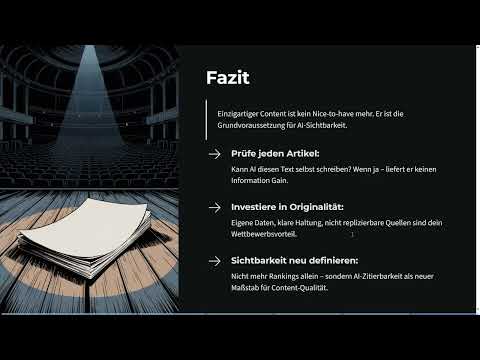
Generic content loses because AI systems can easily generate it themselves. Texts that contain original data, clear positions, original frameworks and genuine primary sources are the ones that get cited. Therefore, check every article with the question of whether an AI could write it. If so, add Information Gain before you publish. In the future, visibility will no longer be measured by rankings alone, but also by how citable your content is.
FAQ
What does Information Gain mean?Information Gain describes the real added value of a text that an AI cannot independently generate from existing knowledge, for example your own surveys or experiences.
Why doesn't an AI cite my article?If an article merely repeats general knowledge, the AI models' training data is sufficient for them. They then don't draw on your text.
Which content has a high citation value?Particularly citable are original data and studies, personal positions, original frameworks, expert interviews, case studies and experience reports from real projects.
Can I generate Information Gain even without a large study?Yes. Even a small survey among 50 participants or your own analysis of your client projects provides data that others don't have.
Is it enough to simply make an AI text longer?No. A longer text with the same structure remains generic. What matters is that it contains content that didn't exist before.
How do I recognize generic content from the competition?Look out for identical structure, interchangeable text blocks, bullet points without original examples, and missing sources or figures from original research.

