
With AI, you can check existing texts for weak points much faster than you can by hand. A clear division of roles applies here: the text remains your work, and the AI takes on the role of a structure assistant. This guide shows you how to use ChatGPT or Claude to analyze an existing article from a GEO perspective, find gaps, and improve it in a targeted way. A guide article on dog toys serves as the example.
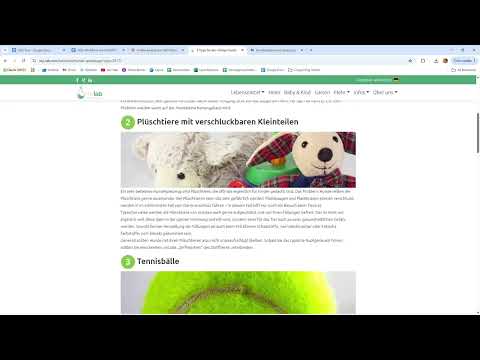
The video is only loaded from YouTube when you play it – data (including your IP address) is then transmitted to YouTube/Google. More in the privacy policy
Key Takeaways
- AI is excellent for structure, clarity, and extractability, but less suited to rewriting your text.
- The core question belongs in the first sentences, ideally within the first 50 words.
- Clear hierarchies with H2 and H3 headings, tables, and definitions improve readability for humans and machines.
- Information gain comes from your own insights, data, and experiences that go beyond basic knowledge.
- Entities such as companies and authors should be recognizable and verifiable.
Step 1: Prepare the GEO audit prompt
Start with a clearly worded prompt. Write it so that the AI knows exactly what it should evaluate from the perspective of a generative search. The video covers the criteria of clarity, structure, extractability, definitions, information gain, and citability. Insert these points directly into the prompt and additionally ask for concrete suggestions for improvement. A well-prepared prompt saves you several follow-up questions later.

Step 2: Paste the article as text
Copy your article as plain text into the input field after you have inserted the prompt. Screenshots or PDFs do work, but they usually consume more tokens and are more error-prone. With plain text, you can run more analyses in one session, and the AI has a clean point of reference.

Step 3: Query the analysis criteria in a targeted way
Now you have the article evaluated. Make sure the analysis is done criterion by criterion: Is the core question answered early enough? Are the sections clearly structured? Can information be extracted easily? Are all terms defined? Is there information gain, and is the citability high enough? Depending on the length of the article, the response can take a few minutes. If you want more perspectives, also run the same prompt in Gemini or Perplexity.

Step 4: Evaluate the clarity result
In the example, the introduction receives only a weak rating because it merely provides a summary of the contents but no answer. Read the feedback carefully and note the places where the AI sees deficiencies. Clarity in particular determines whether an AI can reliably adopt the core statement at all. Therefore, take the time for each point to understand the assessment before you change anything.

Step 5: Sharpen the core question in the introduction
The introduction should name the five most important factors covered in the article in one to two sentences. In the example, these would be harmful substances, swallowable small parts, material quality, size, and safety tests. Phrase the answer so that it is understandable without the rest of the text. A short list with bullet points is quite sensible here if the content lends itself to it.

Step 6: Improve headings and hierarchy
Many subheadings are worded too generally. In the example, the H2 sections are called things like "Tip 1" to "Tip 5," which offers no added value for an AI. Replace such titles with specific terms, for example "Recognizing and avoiding harmful substances in dog toys." Under the H2 sections, a clean hierarchy is also missing. You should set up the subtopics such as plasticizers, heavy metals, or chromium as H3 headings instead of just making them bold. This creates a clear structure that both readers and AI systems can grasp quickly.

Step 7: Increase extractability with tables and examples
A text without tables, bullet points, and subheadings is difficult to break down. In the example, it does say that plasticizers make plastic material supple, but not where they come from and what risk they pose to the dog. Add such details and summarize them in a table, for example with the columns substance, occurrence, risk, and purchase advice. A short FAQ at the end of the article picks up the most important questions once more and increases the chance of being cited directly.

Step 8: Check Definitions and Information Gain
Terms such as DEHP or plasticizers appear but are not explained. Create a short definition of one to two sentences for each technical term. Also pay attention to information gain: this refers to content that is not part of an AI's basic knowledge. This includes your own tests, measured values, laboratory experience, or concrete case studies. Such passages are particularly valuable because they stand out from interchangeable guide texts.

Step 9: Evaluate Citability and Estimate the Score
Citability depends heavily on the previous points. If clarity, structure, definitions, and original content are present, the likelihood that a text will be cited as a source also increases. In the example, the revision raised the score from about 4 to 7 out of 10 points. Depending on the article length, allow half an hour to a full hour for such a revision.

Step 10: Rewrite the Introduction with a Second Prompt
If you want to completely rephrase the introduction, use a separate prompt. Give clear guidelines: the core question should be answered within the first 50 words, the main term must be clearly defined, and the introduction should briefly summarize what the text offers. Avoid filler sentences and introductory platitudes. Do not adopt the result blindly, but check it for factual accuracy and adapt it to your voice.

Step 11: Check Entities via the Legal Notice
An entity is a clearly identifiable object, such as a company or a person. Ask the AI to describe the company behind the article, and then check the website's legal notice (Impressum). In the example, it is a laboratory for chemical and biological analyses, which, however, is barely visible in the article. If the information in the legal notice, on the website, and in the AI's response does not match, you should clean that up.

Step 12: Query the Author or Founder as an Entity
Persons are often perceived and cited more strongly by AI systems than anonymous companies. Therefore, ask specifically about the founder or managing director. The video shows that there is information about the managing director, but only little about the company. You should place author details, professional qualifications, and links to profiles such as LinkedIn clearly visible on the page so that the AI can reliably make the connection.

Step 13: Build Personal Branding and External Presence
Optimization does not end with the individual article. Check how strongly the person and the company appear outside your own website, for example on Reddit, LinkedIn, or in citable specialist portals. Combine these measures with clean entity work, a clear structure, and a definition at the beginning of every text. Then apply the audit prompt to other articles, because with each repetition you will recognize the patterns faster.

Summary ??? GEO Audit with ChatGPT and Claude: Optimizing Articles in a Structured Way
With a well-formulated GEO audit prompt, you can have existing articles specifically checked for clarity, structure, definitions, information gain, and citability. The AI provides concrete suggestions for improvement, which you implement at your own discretion. The text remains your work, because the biggest levers lie in a clear core answer, meaningful headings, tables, definitions, and your own insights. Supplemented by checking entities such as companies and authors, a guide article becomes a text that offers real added value to both readers and AI systems.
FAQ
What is a GEO audit?A GEO audit is an analysis of an existing text from the perspective of generative search systems, which checks how well content can be understood, extracted, and cited.
Can AI completely rewrite my text?You can do that, but you shouldn't. It makes more sense to use the AI as a structural assistant and take responsibility for the wording yourself, so that the text stays personal.
Why should the core question be answered early?AI systems preferably draw answers from the first paragraphs. If the key message is clearly stated there, the likelihood is higher that the text will be reproduced correctly.
What does information gain mean?Information gain describes content that goes beyond an AI's basic knowledge, such as your own measured values, tests, experiences, or case studies.
Why are tables important for GEO?Tables and bullet points make information clearly structured and easy to extract. This makes it easier to recognize and adopt individual facts.
Which AI tools are suitable for the GEO audit?ChatGPT, Claude, Gemini, and Perplexity are suitable. Since each tool delivers different results, comparing them is worthwhile, especially for important articles.
Why is the entity check important?AI systems rate sources more highly when companies and authors are clearly identifiable. The legal notice, author profiles, and external presence contribute to this.


