
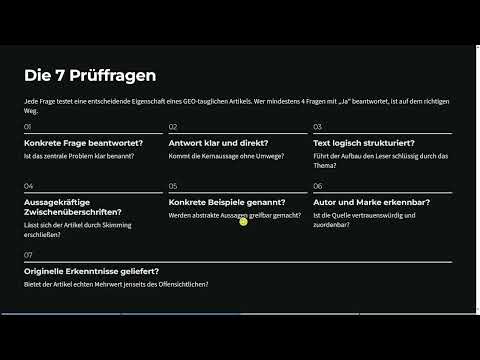
You have written an article, and the question is whether AI search will even cite it. That is exactly what the GEO checklist is for. It summarizes the core principles of the course in seven questions that you can go through in a few minutes before publishing. You don't need a tool for it, just your text and an honest eye.
The video is only loaded from YouTube when you play it – data (including your IP address) is then transmitted to YouTube/Google. More in the privacy policy
Each of the seven questions checks a property that makes a text tangible for AI systems and readers. At the end, you count how many questions you can answer with yes. This guide shows you step by step what to look out for and how to interpret your result.
Key Takeaways
The checklist consists of seven questions, and you should be able to answer at least four of them with yes. More than half is considered a good start. From four onward, your content meets the basic requirements for being cited.
Clarity beats length. The core message must be quickly recognizable, both for the reader and for the AI. Filler sentences and long introductions hurt you.
Structure and subheadings are signposts. Anyone skimming the headings must immediately understand what it is about.
Your own insights determine originality. Your own examples, studies, and methods that are linked to your name or your brand make your text distinctive.
Trustworthy sources and clear authorship strengthen your credibility.
Step-by-Step Guide
Step 1: Is a specific question answered?
Start with the central problem your piece of content addresses. This can be a LinkedIn post, a Reddit text, a blog article, or a YouTube video. Ask yourself whether the problem is clearly named and whether the text actually answers a question.
To do this, read the opening of your text. If a user is searching for the best email marketing tool, they must recognize in the first few lines that your article solves exactly this problem. A long preamble unrelated to the question causes readers to drop off, and the AI cannot reliably match the answer.

Step 2: Is the answer clear and direct?
Check whether your core message comes across without detours. If you write around the core for half an hour, the reader loses patience. Remove filler sentences and get the answer to the point.
It is not about writing texts that are as long as possible. What matters is that the reader and the AI do not have to laboriously piece the information together. A good test: read only the first paragraph. If the answer is in there, you are on the right track.

Step 3: Is the text logically structured?
Each section should build on the previous one. If the order seems arbitrary, the reader loses the thread. At the same time, each section should be understandable on its own, even if someone has not read the previous ones in detail.
Take your text and note in one keyword per paragraph what that section accomplishes. If the keyword list forms a coherent arc, your structure leads the reader logically through the topic. If you break this arc, you should rearrange the sections.
Step 4: Are there meaningful subheadings?
Subheadings are there for skimming. Anyone who flits across the text must immediately know what the respective section is about. Headings like "Case Study" or "Benefits" say too little. A wording like "Benefits for Your Email Marketing" or, even more specifically, "How to Increase Your Open Rate" is better.
Read just the headings of your text one after another. If they form an understandable outline, it works. If they are vague or interchangeable, rewrite them. Comprehensible headings help readers and improve your ranking, while unclear headings make both harder.
Step 5: Are there concrete examples and your own experiences?
Abstract statements quickly seem interchangeable. Therefore, add concrete examples, especially for more complex topics. Your own studies, your own methods, or your own practical cases make the text more personal and credible.
Also link your content to yourself as the author and to your brand or your product. Name, role, and brand are important entities through which AI systems classify a text. If they are missing entirely, the source is harder to attribute. So make sure that the author and brand are recognizable in the text.
Step 6: Are the sources trustworthy?
When you include sources, review them critically. Studies, specialist articles, and official data are reliable. Vague statements like "experts say" or quotes from dubious blogs weaken your text. An incorrectly cited fact can harm you more than no source at all.
Go through your sources once and ask yourself about each one: Who published this, and can I verify the statement? Replace unreliable evidence with solid evidence, and clearly mark your own statements as your own assessment.
Step 7: Is the content original?
Ask yourself whether your text contains new insights or merely repeats what already exists a thousand times over. If you wrote an article with an AI without contributing your own experiences, it lacks exactly what makes it worth citing. A repetition of what users could also gather themselves with an AI offers no added value.
Therefore, add your own observations, figures from your work, or conclusions that only you can draw. This point is often the most difficult, but also the most effective.
Step 8: Evaluate your result
Count how many of the seven questions you were able to answer with yes. With four to seven yes answers, your content is very GEO-friendly and meets the optimal conditions for being cited. The chance increases significantly, even though actual citation can vary depending on niche, topic, and user question.
With two to three yes answers, targeted optimization is worthwhile. With zero to one yes answer, you have hardly any chance of being cited. In that case, you should fundamentally revise the article and not just tinker with details.

Summary – GEO checklist before publication: Seven check questions for citable content
The GEO checklist tests your content using seven questions: concrete question, clear answer, logical structure, meaningful subheadings, concrete examples, trustworthy sources, and originality. With four or more yes answers, you are on a good path. Use the checklist before every publication, and you will quickly recognize where your text still needs improvement.
FAQ
How many questions do I have to answer with yes?At least four out of seven, so more than half. From then on, your content is well positioned.
Does a fulfilled checklist guarantee citation?No. The chance increases significantly, but niche, topic, and the specific user question also influence the result.
Do I have to completely rewrite every article if it scores poorly?With zero to one yes answer, a fundamental revision makes sense. With two to three yes answers, targeted optimization is often enough.
Why do author and brand play a role?Author, brand, and product are entities that AI systems use to classify a text. If they are missing, the source is harder to attribute.
What counts as an original insight?Your own studies, your own examples, your own methods, or conclusions from your practice. Mere repetition of known facts does not count.


