
Ask ChatGPT or Gemini about the best experts on a specialist topic, and the answer usually names people rather than agencies. Many marketers are surprised by this, but the reason is easy to understand: AI systems cite individuals more often than companies. This text shows you why a clearly positioned author profile increases your chances of being mentioned in AI answers, and how to get started with a lean personal branding strategy for GEO (Generative Engine Optimization).
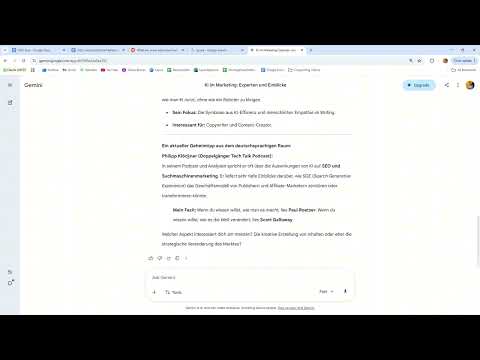
The video is only loaded from YouTube when you play it – data (including your IP address) is then transmitted to YouTube/Google. More in the privacy policy
Key Takeaways
- To AI, people appear more clearly positioned than companies because they have a field of expertise, an opinion, and a perspective.
- A narrowly defined topic area and a specific target audience help AI systems associate you with a particular question.
- Consistency over months and years, recurring statements, and mentions by others strengthen your authority.
- Name, photo, and biography should be identical across all channels.
- If you work as a founder, solo freelancer, or part of a small team, your personal brand is often a bigger GEO lever than your company website.
Step-by-Step Guide
Step 1: Think in terms of people instead of companies
A typical company website promises to help businesses optimize their digital presence. That sounds familiar, but it leaves open what exactly the company stands for. Companies often communicate too broadly because they want to address several target groups at once. A person, on the other hand, can say which field of expertise they represent and what opinion they have on it. AI systems value precisely this clarity. If you are a founder, solo freelancer, or part of a small team, use yourself as the starting point for your visibility.

Step 2: Define a clear topic area
Don't choose a general field like "marketing," but a subtopic, for example "LinkedIn growth for freelancers." A simple test helps you here: if you can say in one sentence what you write about and for whom, your positioning is clear. The sentence "I write about copywriting for B2B freelancers" passes this test. The sentence "I do everything related to marketing" does not.

Step 3: Name a small, specific target audience
Add a clearly defined target audience to your topic area. The topic "LinkedIn growth" becomes strong as soon as it's clear who it is for. A narrow target audience may seem limiting at first glance, but it makes you clearly identifiable to AI systems. The more precisely you describe the question you answer, the easier it is for a model to find you when someone asks exactly that question.
Step 4: Publish consistently over months
Repetition creates recognition. You don't have to design every post the same way. Articles, videos, podcast episodes, and newsletters can have different formats and focuses. However, all of them should roughly point in the same direction, for example toward LinkedIn growth for freelancers. Therefore, plan your core topic as a long-term undertaking over months and years, not as a campaign for a quarter. Building authority takes time, but it pays off in the long run.
Step 5: Encourage mentions by others
Anyone who cites you in articles, podcasts, forums, or on X strengthens your authority. This rarely happens on its own. Guest posts, interviews, well-founded comments in professional discussions, and collaboration with other creators get people talking about you. In addition, there is an effect you can observe with well-known names: they become even better known through frequent citations, and AI systems pick up on exactly such sources. Authority therefore arises from a cycle of your own content and mentions by others.
Step 6: Develop recognizable statements and frameworks
Create terms that are inseparably linked to your name. This can be a framework, a method named after you or your company, a thesis, or a statement that everyone associates with you. This also pays off in an advertising context: with LinkedIn Ads, brand awareness often begins with a person, such as the founder. The face builds trust, and only at a later stage do you lead the target audience to the actual company.
Step 7: Establish a consistent identity on the web
Your presence must look the same on all platforms: the same name, the same photo, and the same biography on your website, LinkedIn, X, and YouTube. Also pay attention to the exact spelling of your name, your brand, and your products. Avoid topic changes that cause confusion. If your website promises "LinkedIn growth for freelancers," but your YouTube channel description reads "Social media for small businesses," it is hard for an AI to classify you clearly.

Step 8: Publish under your name and link your author bios
Even if you work at a company, you can use the visibility of your key people as an advantage. Apple was long associated with Steve Jobs, Tesla with Elon Musk. On a smaller scale, the same applies to any software company with an active founder voice, even in the B2B space. Specifically, this means: Publish content under your own name, if possible, rather than exclusively under the company name. Link author bios on your profiles and keep your biography identical everywhere. These measures seem inconspicuous at first glance, but over the long term they have a major impact on GEO.
Summary – GEO Personal Branding: Building an Author Profile for AI Citations
A clearly positioned author profile is one of the strongest levers if you want to become visible in AI answers. People come across as more distinct than companies, and AI systems can more easily assign them to specific questions. The foundation consists of a narrow subject area, a specific target audience, and long-term, consistent publishing. Complement this foundation with mentions by others, recurring statements, and a unified identity across the entire web. With these steps, you build authority that extends beyond individual campaigns.
FAQ
Why are people cited by AI more often than companies?People come across as more clearly positioned because they represent a field of expertise, an opinion, and a perspective, while companies often communicate too broadly in order to address multiple target audiences at the same time.
What does GEO mean?GEO stands for Generative Engine Optimization. It refers to optimizing content so that AI systems such as ChatGPT or Gemini mention and cite it in their answers.
Do I have to publish under my name instead of the company name?Not necessarily, but if you are creating content anyway, it is worth publishing it under your name and linking author bios on your profiles.
How narrow should my subject area be?It should be narrow enough that an AI can assign you to a specific question, for example "LinkedIn growth for freelancers" rather than "marketing" in general.
How long does it take for authority to develop?Authority builds up over months and years. Consistent content on the same core topic and regular mentions by others are decisive.
Why should my biography be identical everywhere?Identical information about name, brand, and products helps AI systems recognize you unambiguously and attribute your content correctly.


