
Up to this point, you have learned about the building blocks of GEO optimization individually: information content, gain, Definition First, semantic chunks, and structured formats. Now you put them together. Using the question of which CRM suits a small marketing team as an example, I will show you the complete path from a blank document to a finished text. I am deliberately not using AI assistance, so that you can understand at every step why it is structured the way it is. You can then apply the steps to any other topic.
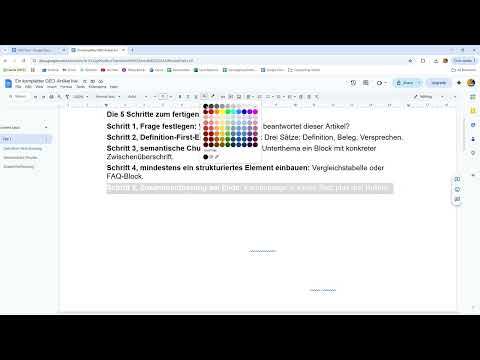
The video is only loaded from YouTube when you play it – data (including your IP address) is then transmitted to YouTube/Google. More in the privacy policy
Key Takeaways
- A GEO article answers exactly one core question. Everything else is secondary.
- The introduction delivers a definition, a piece of evidence, and a promise in three sentences.
- You phrase subheadings as statements or questions, and each section covers exactly one idea.
- A comparison table and a FAQ list make content easy to cite.
- A short summary repeats the core message in one sentence, supplemented by a few bullet points.
Step-by-Step Guide
Step 1: Define the One Core Question
Before you write the first sentence, decide which single question your article answers. Not two, not five, and certainly not fifteen. A GEO article is not a reference work but a focused answer. Secondary terms and side questions may of course appear, but you need a clear overarching topic. For our example, the question is: Which CRM is suitable for a small marketing team of two to five people? It is concrete, narrowly defined, and has a clear target audience. This very precision makes the text clearly attributable for AI systems. Note the core question at the top of the document so that you can orient yourself by it while writing.

Step 2: Start with Definition First
Ideally, the introduction consists of three sentences with a fixed structure. The first sentence is a definition that explains the topic concisely. In the example: A CRM for small marketing teams is a tool that manages contacts, emails, and pipeline in one place, without separate IT administration.
The second sentence provides evidence, ideally in the form of a number. For teams of two to five people, monthly costs typically range between 0 and 50 euros per user. If the number comes from your own comparison or a survey, state that explicitly, as it increases credibility.
The third sentence makes a promise: This article compares the three most widely used options and shows which tool fits which situation. This way, the most important information is already contained in the first roughly 50 words.
Step 3: Divide the Text into Semantic Chunks
Now you break the article down into small, self-contained sections. Each section covers exactly one idea and begins with a concrete subheading. Create these headings first as a framework before you write out the body text. In the example, three central sub-questions emerge: What does a CRM for small teams need to be able to do? Who is HubSpot Free right for, and where are its limits? When is it worth switching from a spreadsheet to a CRM? These are followed by short sections on Pipedrive, which stands out for its easy entry, and on Folk as an option for hybrid teams.
Make sure that every heading is a statement or a question. Pure keywords such as "Features" or "Overview" tell neither readers nor AI much about what is in the section. If many subtopics arise, the article may also have several subheadings. The only important thing is that each section remains cleanly delineated.
Step 4: Incorporate Structured Elements
At least one structured element should appear in the article. Bullet points and numbered lists are the standard for this. I additionally always recommend a comparison table and a FAQ block. A practical approach: First phrase the characteristics as bullet points, for example "HubSpot Free: ideal for teams with growth plans". Then you transfer the information into a table with meaningful categories such as team size, advantages, disadvantages, and costs. AI systems can adopt such a table one to one.
You can place the FAQ in the middle or at the end. The combination of both works particularly well. Plan a few minutes for building the table, because the categories determine how helpful the comparison ultimately is.
Step 5: Conclude with a Citable Summary
Finally comes a summary with the core message in at most two sentences and two to three bullet points. This is not a rigid requirement but a good guideline. A summary that is longer than the actual article misses its purpose.
The core message in the example reads: For marketing teams of two to five people, choosing a CRM is primarily a question of workflow focus, not of feature scope. Below it come the recommendations: HubSpot Free for planned growth, Pipedrive if sales dominates, and Folk if relationships are the focus. Such sentences are often cited directly by AI systems. Therefore, phrase them precisely and independently.

Summary – Building the GEO Article in Five Steps: From a Blank Document to a Citable Text
A GEO article is created in five consecutive steps: define the core question, start with Definition First, structure it into semantic chunks, incorporate structured elements, and close with a citable summary.
- The order of the steps is more important than the chosen topic.
- Each section answers exactly one specific sub-question.
- A table, FAQ, and summary make the text easy for AI systems to cite.
Take a blank document and a topic of your choice, and work through the five steps completely once. Only practical application shows how quickly the structure becomes routine.
FAQ
Does a GEO article always have to answer exactly one core question?As a guideline, that makes sense, because a clear focus makes the text unambiguous for readers and AI systems, but secondary questions may still appear.
How long should the introduction be?Three sentences are enough: a definition, a piece of evidence, and a promise, so that the core message is already within the first roughly 50 words.
Does the summary have to consist of exactly one sentence and three bullet points?No, that is a guideline. What matters is that it remains significantly shorter than the actual article.
Can I also use the process for other topics?Yes, the five steps are topic-independent. The order is what matters.
Do both a table and an FAQ have to be included?At least one structured element is mandatory. However, a comparison table and an FAQ list are explicitly recommended, especially in combination.


