

A ball shoots out of the frame, the player is in the middle of the turn, and your flash is supposed to fire at exactly that moment. This is exactly where artificial light in sports photography quickly reaches its limits. I'll show you how to recognize these limits and push them back with Hi-Sync, using a soccer shoot. Benedikt kicks the ball while I accompany him as a photographer with flash. You'll learn where blur comes from, how to coordinate camera and flash, and how to add extra accents with a rim light.
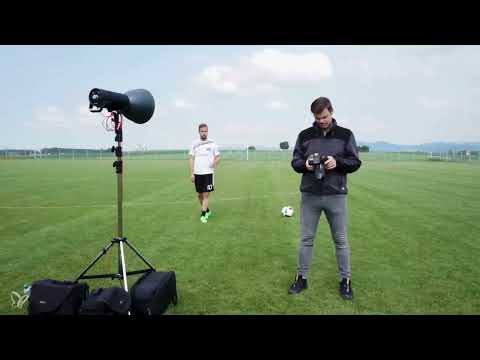
The video is only loaded from YouTube when you play it – data (including your IP address) is then transmitted to YouTube/Google. More in the privacy policy
Key Takeaways
Blur with artificial light usually doesn't come from the camera alone, but from the interplay of flash duration, shutter speed, and the moment at which you release the shutter. A flash can't reliably keep up with burst shooting, so you're better off working in single-shot mode with servo autofocus and a clearly defined trigger moment. Hi-Sync allows you to use shorter shutter speeds than the usual flash sync speed and thus helps you freeze movement. Also pay attention to the distance, position, and angle of the ball, player, and flash, because even small deviations noticeably change exposure and sharpness.
Step 1: Define the Movement Sequence
Before you press the shutter, you should know what is supposed to happen in the picture. Have Benedikt demonstrate different kick variations, such as a shot over the ball with a run-up or a low shot in a particular direction. Make sure he doesn't hit the ball hesitantly but follows through with full dynamism. Try out several variations, because that's how you find out which movement has the strongest effect in your framing.

Step 2: Optimize Kick Direction and Body Posture
The direction of the kick determines how well the movement can be read in the picture. With a purely sideways stance, the kick often looks flat and static. I therefore ask Benedikt to kick the ball past me a bit closer and to show his body rotation more clearly. Especially during the first attempts, I noticed that too little of the rotation was visible. Make sure the player carries the movement through with his upper body, so that the picture doesn't just show a leg movement.

Step 3: Check Ball Height and Ball Position
A ball lying on the ground adds little tension to the movement. So don't just let the ball lie on the ground, but give it a certain height. With every attempt, you should also check whether the ball is in the right spot. If it's too far left or right, the kick shifts out of the frame. Small corrections like a bit further over or a tick closer to the flash help you hit the moment precisely.

Step 4: Set Single Shot and Servo Autofocus
Here lies one of the most important points. Even though you like to shoot in burst mode with sports subjects, you should switch to single shot when using artificial light. The flash can't reliably withstand a burst exposure, and then you get unevenly lit or blurry shots. Instead, set servo autofocus so that the camera tracks the subject during the movement. You then release the shutter deliberately at the moment the player reaches the point you had in mind.

Step 5: Activate Hi-Sync and Adjust Shutter Speed
With the normal flash sync speed, you often can't freeze movement cleanly because the shutter stays open too long. Hi-Sync enables shorter shutter speeds, so that ambient light has less influence on the picture and the flash determines the movement more strongly. Adjust the shutter speed step by step until the picture has the desired sharpness. Make sure the overall exposure is right, because shorter speeds often call for more flash power or a different aperture setting.

Step 6: Place the Compact Flash as a Rim Light
The fill flash used so far delivers even light, but especially with action it often looks flat. A rim light, on the other hand, brings depth and contours into the picture. Place the compact flash to the side, on the other side of the subject, and make sure it stands at the same distance from the player as before. That way you keep the exposure better under control. Afterwards, take a quick test shot to assess the brightness, and correct the direction of the flash if light and shadow don't fit.

Step 7: Mind the Distance to the Flash and the Influence of the Sun
The distance between the ball, the player, and the flash has a big influence on the exposure. If the ball is too close to the flash, it will be overexposed and lose detail. So move it back a bit until the brightness is right. Sunlight can also get in the way. If the sun unexpectedly breaks through, check whether it disrupts the look of your image, and if in doubt, wait a short moment until the lighting situation has settled down again.

Step 8: Vary the Moment of Release
Not every moment of the movement has the same impact. So deliberately shoot at different points in time, sometimes a little earlier, sometimes a little later. The difference in the leg positions is crucial here, because it changes the dynamics of the image considerably. If you notice that the player is too far back or too far forward, simply press the shutter a bit earlier or later. With each series of single frames, you get more choice for your final shot.

Step 9: Create a Sweat Effect with Water
For added drama, you can modify the subject slightly. A spray bottle with fresh water, sprayed over the arm or body shortly before the shot, makes the player look sweaty. The result is very convincing in the video, because it looks like real effort on the pitch. Just make sure the water isn't overdone, otherwise the image looks artificial.

Summary – Hi-Sync in Motion: Photographing Football Action with Artificial Light
Working with artificial light in motion demands patience and good timing. You plan the movement sequence, choose single-frame mode and servo autofocus, use Hi-Sync for shorter shutter speeds, and test the flash as a side light. Even small changes in distance, ball position, or moment of release ultimately make the difference between a blurry snapshot and a dynamic image. It's best to get your own flash, try out the techniques, and have fun doing it.
FAQ
Why does blur often occur with artificial light in motion?The flash only lights up for a very short time, yet the moment of release must match the movement exactly. If shutter speed, flash duration, and release timing don't harmonize, blur or uneven exposures result.
Why should I shoot in single-frame mode instead of burst mode?A flash cannot reliably keep up with a burst exposure. In single-frame mode, you can work toward a specific point and deliberately set each moment of release.
What does Hi-Sync do?Hi-Sync enables shorter shutter speeds than the usual flash sync speed. This lets you freeze fast movements better and reduce ambient light more strongly.
How do I choose the right distance to the flash?If the subject is too close to the flash, it will be overexposed. Test different distances with trial shots until the brightness is right.
When is a side light useful?A side light from the side emphasizes contours and body shapes. It is especially suitable when you want to bring out movement and dynamics more strongly than with an even fill flash.

