
Learning programming for beginners

- 35 lessons in over 3 hours of video training to get you started in programming
- Fundamental aspects: from A for arrays to S for loops and Z for random numbers
- For each chapter: Workbook with exercises (only browser and text editor required for practicing)
- From Jan Brinkmann, a passionate developer who makes you understand program line by line
The starting signal for your journey into the world of programming: Understand the basics, understand what happens in the computer with 0 and 1, and develop your first programs.
35 Videos, 207 minutes
Module #1: Your First Program
Software programming for beginners: 1.1 Welcome
First of all, a very warm welcome to you! I wish you every success and lots of fun with the training!
Software programming for beginners: 1.2 Software: Browser and text editor
Every PC provides everything you need. Nevertheless, with Atom(.io) you will get to know a very powerful tool. The editor supports you in software development.
Software programming for beginners: 1.3 3..2..1..go: your first program
Traditions should be upheld. You don't start with just any example. Instead, you learn about a decades-old tradition: the "Hello World" program.
Software programming for beginners: 1.4 Input, output and processing (the EAV principle)
Do you know the basic steps in every program? They have been a central component since the beginning: input, output and processing. Get to know the EAV commands here.
Software programming for beginners: 1.5 comments
Comments are like the salt in the soup. Without it, the soup is often very bland, too much makes it inedible. Here you will get to know the central idea and syntax.
Software programming for beginners: 1.4 Input, output and processing (the EAV principle)
8 min OpenModule #2: Variables and Memory
Software programming for beginners: 2.1 Data in the working memory
Have you heard? In a computer, everything is 1 and 0. You don't even notice, do you? Find out what happens behind the scenes.
Software programming for beginners: 2.2 The different data types
We can't just store any data. You can use data types to describe different types. Find out why and why not.
Software programming for beginners: 2.3 strings in memory, all 1 and 0 or how?
Okay, numbers as 1 and 0 now make sense. But what about letters? Find out how this problem was also solved.
Software programming for beginners: 2.4 Using variables in code
Now let's move on to programming: variables in code.
Module #3: Time for more dynamic programs
Software programming for beginners: 3.1 Basic arithmetic - aka arithmetic
A computer can calculate. And that's exactly what a programming language can do. Here you will learn how it works.
Software programming for beginners: 3.2 Entering numbers
So far you can only read in characters. For further examples, it would be helpful to enter numerical values. You will also get to know this here.
Software programming for beginners: 3.3 Using comparisons and conditions
As in mathematics, you can perform comparisons. Program code can also be linked to conditions. This central tool is now also included in your portfolio.
Software programming for beginners: 3.4 Using logical operators
A simple comparison is not enough? Then learn how to link and change multiple conditions: with logical operators.
Module #4: Using Arrays
Software programming for beginners: 4.1 Why variables are not enough
Variables are only one part of the equation. Arrays are used, for example, to read in a dynamic number of values.
Software programming for beginners: 4.2 The structure of arrays
Here you will learn about the structure of arrays.
Software programming for beginners: 4.3 Adding and removing elements
The elements in an array can be removed and added. Get to know some of the possibilities.
Software programming for beginners: 4.4 Creating a queue with arrays
So that it doesn't remain theoretical, you can now also see arrays in practical use.
Module #5: Working with loops
Software programming for beginners: 5.1 Loops with while
Repeat logic with loops. Get to know the first variant with the keyword "while".
Software programming for beginners: 5.2 Processing arrays
Loops are incredibly important when processing arrays, for example. Here you will learn how this works.
Software programming for beginners: 5.3 Loops with for
Another construct that is used again and again: the for loop. You will now also get to know it.
Software programming for beginners: 5.4 Excursus: Generating random numbers
You can generate random numbers in most languages. We can use these to develop many other examples. Here you can learn how this works in JavaScript.
Software programming for beginners: 5.5 Loops with do/while
The do/while loop is a foot-controlled loop that is the more elegant choice in some situations. Find out how it works.
Module #6: Recycling - Split Code
Software programming for beginners: 6.1 Creating and calling functions
Without functions, programs would be very static. Here you will learn how to split up the code in a sensible way.
Software programming for beginners: 6.2 Using parameters
How do functions become even more useful? Via parameters. Get to know them in this lesson.
Software programming for beginners: 6.3 Using return values
The last aspect: return values. Incredibly important and a topic in almost every language.
Software programming for beginners: 6.4 Challenge: Getting to know scopes of validity
Functions are also a challenge. Variables that you create in them do not apply anywhere else. Get to know the concept of scopes.
Software programming for beginners: 6.5 Using multiple files
You can split code into several files in almost any language. Learn how to do this here.
Software programming for beginners: 6.4 Challenge: Getting to know scopes of validity
4 min OpenModule #7: Getting to know objects
Software programming for beginners: 7.1 What is object orientation?
Object orientation can fill its own courses with several hundred hours. Here you will get to know the basic idea.
Software programming for beginners: 7.2 Defining objects and properties in JavaScript
How are objects and properties created in JavaScript?
Software programming for beginners: 7.3 Defining methods
Methods are functions in an object-oriented context. You can get to know them here.
Software programming for beginners: 7.4 Constructors
Do you want to initialize objects? The constructor can help.
Software programming for beginners: 7.5 Compiled and interpreted languages
There are two categories of languages in software development: those that are compiled and those that are translated by an interpreter. Here you will learn the difference.
Software programming for beginners: 7.6 What is a programming language?
Programming languages are often discussed. But how do they actually relate to the computer? After all, it is text. Isn't everything actually 1 and 0?
Software programming for beginners: 7.7 How to write source code
In this video, you will once again learn about the basic idea of source code. You will also learn which editors do not work at all, for example.
Software programming for beginners: 7.8 Static vs. dynamic data types
Many languages such as JavaScript, php and the like are dynamic in their handling of data types. Other languages, on the other hand, are rather strict. Why is that? And what are the advantages and disadvantages?
Software programming for beginners: 7.2 Defining objects and properties in JavaScript
3 min OpenYou might also like
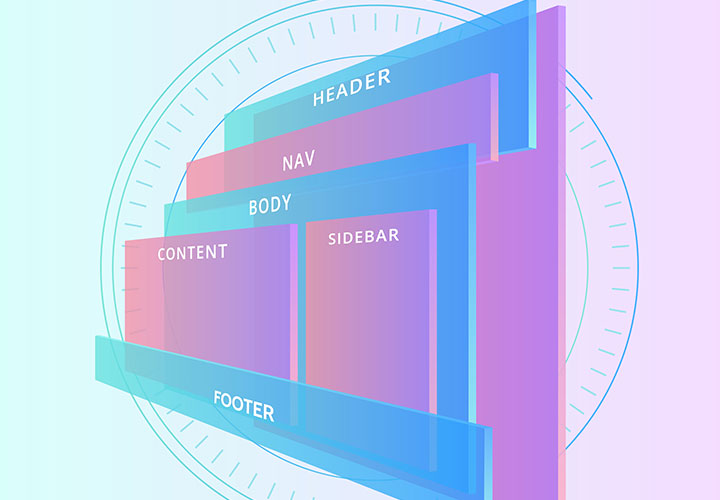
For modern websites & apps
For error-free, fast websites with optimized layouts
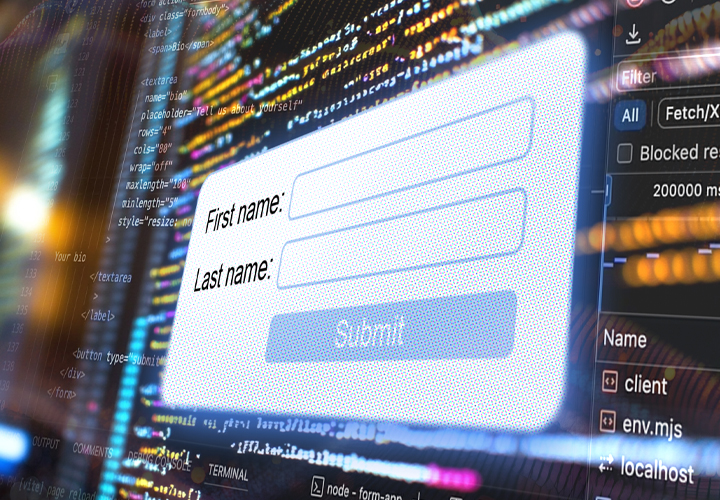
Step by step to your own functional forms

How your websites & apps speak like ChatGPT
Comment now „Learning programming for beginners“