
The world of automation is continuously evolving. While classical automation has been established in many companies for years, AI automation has opened up a new dimension. It is important to understand the differences between these two approaches in order to make processes more efficient and fully exploit the potential of artificial intelligence. In this guide, I will explain the fundamentals and workings of both approaches and show you how to combine them effectively.
The video is only loaded from YouTube when you play it – data (including your IP address) is then transmitted to YouTube/Google. More in the privacy policy
Key insights
Classical automatisations are based on fixed rules and processes, while AI automatisations have the ability to make decisions and learn independently. The combination of both approaches leads to more efficient and flexible workflows.
Step-by-step guide
Classical automation: Understanding the fundamentals
Start with classical automation. This operates according to a clearly defined set of rules. You establish: If A happens, then perform B. A simple example is filling out a form on your website. When a user submits this form, an automatic email should be sent to confirm receipt. Another example could be when an invoice is created in your online shop, which is then automatically saved in Google Drive and your team is informed via Slack or WhatsApp. These processes are reliable because they are well-defined, but they lack flexibility.

The step to AI automation
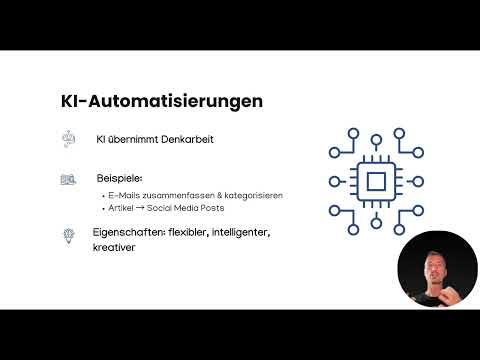
AI automation brings a significant advancement. Here, a fixed rule is not the only crucial factor; artificial intelligence also takes over parts of the thinking process. For example, an AI tool analyzes data and makes decisions. Instead of just forwarding an email, it can summarize messages and categorize them. This shows you only the most important points.
Examples of AI automations
Another example of the capabilities of AI automation is the creation of social media posts. Instead of manually generating content, an AI tool can automatically create posts for various platforms, such as Instagram, TikTok, or LinkedIn. The texts are adapted to the respective target audience, which can save you a lot of time and increase the effectiveness of your social media activities.
The comparison: Checklist vs. smart assistant
To illustrate the differences, one can say that classical automation is like a checklist that is worked through step by step. In contrast, AI automation acts like an assistant that thinks along and offers creative suggestions. This intelligence allows you to go beyond the standard and better adapt processes to the needs of your business.
The power of combining both approaches
The greatest power unfolds when you combine classical and AI automations. This allows you to reliably automate standard tasks while utilizing the intelligence of AI to make your processes more flexible and smarter. By leveraging the strengths of both approaches, you can not only increase efficiency but also develop innovative solutions.

Summary – Classical automations vs. AI automations: A comprehensive comparison
The distinction between classical and AI automation is crucial for optimizing workflows. While classical automation is based on fixed rules, AI automation offers adaptability and intelligence. Combine both approaches to take advantage of both worlds and increase the efficiency of your processes.
FAQ
How do classical automations work?Classical automations are based on fixed rules and execute defined steps when certain conditions are met.
What is the main difference between classical and AI automation?Classical automation follows established rules; AI automation uses machine learning and can make decisions.
How can I implement AI automation in my company?You can select suitable AI tools that meet your specific requirements and integrate them into existing processes.
Which tools can I use for AI automation?There are many tools, including ChatGPT, Zapier, and Integromat, that offer AI functionality.
What are the benefits of combining both types of automation?The combination allows for reliable standard automation as well as the adaptability and intelligence of AI, which increases efficiency.

