
Do you know this feeling? You sit down at your computer in the morning, open a blank document, and wonder what you should write about today. This very problem is one of the biggest stumbling blocks when blogging and sending newsletters. In this guide, I'll show you how to find at least 20 content ideas with a clear approach, schedule them strategically, and thus ensure that your content stays varied and well thought out.
The video is only loaded from YouTube when you play it – data (including your IP address) is then transmitted to YouTube/Google. More in the privacy policy
Key Takeaways
- Spontaneous ideas rarely lead to a well-thought-out series or a coherent content plan.
- Strategic planning with a lead time of several weeks allows you to align content specifically with offers such as courses or e-books.
- Writing and revising should happen at separate times so that you look at your text with some distance.
- Quantity counts at the beginning: first write down all ideas without evaluating them immediately.
- Variety keeps your readers engaged. Mix list posts, opinion pieces, everyday stories, evergreen content, and recommendations.
Step-by-Step Guide
Step 1: Recognize the Blank Document as a Problem
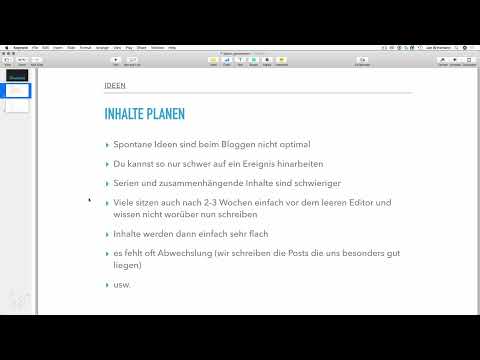
The starting point of any uncoordinated content production is usually the same moment: you open the editor, stare at a blank page, and only then think about what you could write. In doing so, you lose valuable time and risk your topics appearing arbitrary. Keep in mind that this approach may seem spontaneous but rarely leads to success. Make it clear to yourself that at this point you are recognizing the cause of your problem.

Step 2: Work Strategically Toward an Event
The next step is to align your content with a specific goal. Suppose you are releasing a course or an e-book in four weeks. Then, over the coming weeks, you can gradually place content that builds toward this offer. In it, you address problems that your course will later solve, and thus build curiosity. To do this, create a schedule in which you record which post should appear when.

Step 3: Plan Series and Build in Variety
Multi-part article series are hard to implement spontaneously. If you commit to a seven-part series, you quickly find yourself working on a single topic for seven weeks and neglecting other important content. Therefore, plan series deliberately and decide in advance at what rhythm they will appear. Additionally, complement the series with posts in other formats, for example a short story or recommendations. This keeps your offering diverse and your readers keep their enthusiasm for reading.
Step 4: Separate Writing and Revising in Time
A common mistake is to write a text on the day of publication and publish it immediately. It is better to first finish a rough draft without questioning every single word. Afterwards, you set the text aside and gain at least one day, preferably two or three days, of distance. Only then do you revise it soberly. In practice, this separation leads to significantly better content because you review your own text with fresh eyes.
Step 5: Set a Clear Goal for Collecting Ideas
For the exercise, you set a minimum number. With 20 ideas, you have a noticeable supply without overwhelming yourself. If you are confident in your field, you may even manage 50 ideas in an hour. It is important that you write down the goal and set yourself a fixed time frame. That way you don't get lost in brooding and have concrete results in front of you at the end.
Step 6: Write First, Evaluate Later
Write down all the ideas that come to mind and don't discard anything yet. Your inner critic is your biggest enemy in this phase. Often, when reading through later, one idea gives rise to a second, better follow-up idea. So note everything down at first, even if it seems half-baked. The selection comes only in the next step.
Step 7: Plan List Posts and Opinion Pieces
Proven formats are list posts, such as "Five Tips for Working with Freelancers" or "Seven Tips to Get Your Online Shop Ready for the Advent Season in Time". Such titles promise a clear benefit. In addition, you can write opinion pieces. Think about what you have a clear stance on, such as digitalization in the education system or in the working world. Make sure the topic is relevant to your target audience and resonates with them.
Step 8: Turn everyday situations into infotainment
You can find infotainment ideas everywhere. Observe your everyday life: while watching your child's training, you might notice how the team works together and how everyone involved is constantly developing. From there, you can draw a connection to teamwork in a company. You can also take a different perspective at the supermarket checkout. The cashier greets countless customers every day in a friendly way. Then think about what lesson can be drawn from this for your online shop. The main thing is that you find added value that you can connect with your information.
Step 9: Plan evergreen content firmly
If you want to attract visitors via Google in the long term, you need evergreen content. These are topics that remain relevant over a long period and are searched for continuously. One example is book recommendations or basic guides that will still be up to date in a year. Such content brings interested people to your site over a longer period of time. Therefore, deliberately include a fixed share of evergreen posts in your editorial plan.
Step 10: Use movies and series as sources of inspiration
Movies are also an excellent source of ideas if they fit your target group thematically. Let's assume you are an app developer and want to address founders who have an app idea. Movies about company founding in Silicon Valley, for example about Apple, Microsoft or Facebook, give you something to talk about. A comedy about an internship at Google can also serve as a hook for tips about the working world. What matters is that you link the movie to a relevant benefit for your readers.
Step 11: Review and sort ideas and formulate titles
In the last step, you go through your list and sort the ideas by formats, target groups and dates. Check which posts contribute to an offer, which have an evergreen character and which bring variety to your plan. For each idea, formulate a provisional blog intro or a headline. With your list of 20 or more ideas, you then have a solid foundation for the coming weeks.
Summary – Finding blog ideas: Strategically planning 20 content ideas
With a clear approach, you turn the blank document into a well-thought-out editorial plan. Start by collecting all ideas, plan strategically toward a goal and build in variety through different formats. Separate writing and revising in time so that your texts gain in quality. With at least 20 ideas that you sort by formats, you are well prepared.
FAQ
How many ideas should I collect at minimum?At least 20 ideas is a good guideline, more is always better. The more ideas you collect, the greater your choice.
Do I have to evaluate every idea immediately?No. First write everything down and only evaluate afterwards. Often better follow-up ideas emerge from a first idea.
How far in advance should I plan?Plan several weeks in advance if possible. With an offer such as a course or e-book, three to four weeks help to place content in a targeted way.
Why should I separate writing and revising?A text seems fresher after a break with some distance. You can spot weaknesses more easily and optimize your post soberly.
Which formats are suitable for variety?List posts, opinion pieces, infotainment stories, book recommendations and movie recommendations provide varied content.
What is evergreen content?Evergreen content consists of topics that remain relevant over a long period and are searched for permanently. They bring you visitors via search engines in the long term.


