
Many self-employed people can't describe their service cleanly in a single sentence. They say "I'm a WordPress freelancer" or "I develop online shops," and the customer still doesn't understand what benefit they get from it. This is exactly where this guide comes in. You'll learn how to develop a sales message that speaks directly to your target audience, names their problem, and shows how you solve it.
The video is only loaded from YouTube when you play it – data (including your IP address) is then transmitted to YouTube/Google. More in the privacy policy
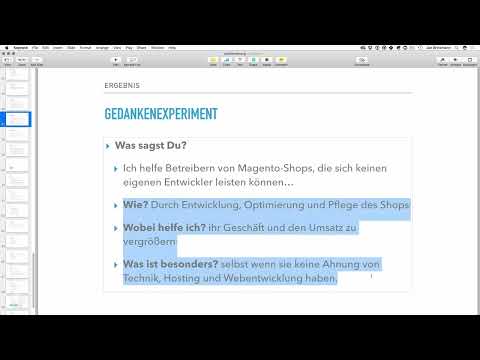
The foundation is a thought experiment by John Carlton. You imagine you're sitting on a train next to someone who is complaining on the phone about a specific problem with their service provider. From this conversation you derive what the person next to you needs, and you build your message from it. The exercise is not a theoretical game, but a practical tool for your website, your contact form, and your sales conversation.
Key Takeaways
A sales message describes the benefit for the customer and not your job title. The formula is: I help a target group achieve a benefit while avoiding a negative case. You build the message from real problems of your target group. Afterwards, you shorten it for your homepage and contact form and distribute individual aspects across your entire website. In the sales conversation, you guide the customer to a decision with a non-binding offer and a sensible bonus.
Step-by-Step Guide
Step 1: Understanding the Thought Experiment
Before you formulate sentences, you need to understand the basic idea. The thought experiment is not meant to deceive customers or invent a situation that never happened. It helps you think about your positioning from the perspective of your target group. You use the exercise as preparation for your sales conversation and as a basis for a concise description of your offering. Note in advance that it's about clarity and not about sales tricks.

Step 2: Working Out the Target Group's Problem
Imagine your conversation partner is complaining about a freelancer who doesn't deliver, doesn't get in touch, and constantly overruns deadlines. Such statements are valuable because they show you exactly where the shoe pinches. Write down the problems verbatim, just as a customer would phrase them. These include frustration over missing feedback, postponed deadlines, or unreachable service providers. The more concretely you describe the problem, the better you can address it later.
Step 3: Applying the Formula
Now you connect the problem with your solution. The template follows a clear logic: You begin with "I help," name your target group, and describe the benefit they can achieve, such as reaching their goal faster, better, or more easily. Then you formulate the negative case, that is, the situation the customer wants to avoid. An example: I help online shop operators grow their business and prevent them from having to constantly deal with service providers. The formula seems abstract at first, but quickly becomes tangible with a concrete example.
Step 4: Walking Through an Example
It's best to work with a specific target group. Take, for example, the operator of a Magento web shop with two to three employees. This merchant can't afford their own developer and therefore works with external service providers to save costs. The negative case for them would be that technology, updates, and further development fall by the wayside and keep them from the actual business. Your benefit is that you take over the development and maintenance of the shop, so that they can concentrate on product selection and supplier communication.
Step 5: Putting the Benefit Ahead of the Job Title
A common mistake is starting with your own title. Anyone who says "WordPress developer" leaves the customer guessing what's in it for them. Instead, phrase your statement around the result. Instead of "I'm a WordPress developer," you'd rather say "I help you grow your business and your revenue." When the question then comes of how you do that, you explain your service, and you answer the question about the benefit right along with it: You can then concentrate on your core business. This order meets the customer where they currently stand.

Step 6: Sharpening the Negative Case in a Targeted Way
The negative case should make the consequences clear to the person you're addressing, without seeming exaggerated. So you name what happens if they change nothing: They lose time, revenue, and nerves. Pay attention to realistic dramatization. If you exaggerate too much, the message seems unbelievable. A note that you can help even if someone has no idea about technology, hosting, or web development significantly lowers the barrier.

Step 7: Putting the message together
Now you put all the building blocks together into a complete message. In the Magento example, it could read: I help operators of Magento online shops who don't want to or can't afford their own developer to grow their business and revenue through the development, optimization, and maintenance of the shop. This version is deliberately long. Its purpose is for you to know exactly what you are offering. You don't have to memorize it.
Step 8: Shortening the message for the website
For the homepage, footer, or contact form, you need a concise version. Shorten the sentence to the essentials: I help operators of Magento shops who can't afford their own developer. This succinct statement can easily be placed as a tagline under the logo or as an introduction on the homepage. A colloquial variant often feels even more personal and suits small service providers better.

Step 9: Distributing the aspects across the website
You don't have to fit the long version completely onto one page. It makes more sense to distribute the individual building blocks across your website. One section describes what exactly you help with, another how you support business and revenue, and an About Me page shows your experience. Blog posts, videos, and stories are also suitable for picking up individual aspects again and again. This way you anchor your positioning sustainably without overloading every text.
Step 10: Leading to a close in the sales conversation
A good message gets the customer into a conversation, but you have to actively shape the close. Offer a non-binding concept or a non-binding quote and make it clear that there is no risk for them. After that, you can work with a sensible scarcity: whoever commissions you by the end of the week gets a bonus such as a self-study course or half a day of training. The bonus should be relevant to your target group and offer real added value. It is important that you do not misuse it as a means of pressure, but as a comprehensible reason for a prompt decision.

Step 11: Trying out the exercise
If you don't yet have any experience with sales conversations, simply try out the formula. People who are already actively looking for a service provider don't need hours of persuasion. If you can credibly convey that you are the right contact person for their problem, the commissioning is often just a formality. You don't have to play a salesperson in the classic sense. Go into conversations openly, use the feedback to check whether your message resonates, and adjust it if necessary. You can make targeted use of further training on sales conversations later.

Summary – Developing a sales message
You develop a sales message by thinking of your offer from the perspective of your target group. The starting point is the specific problem your customer describes. The formula "I help a target group achieve a benefit and avoid the negative case" gives you the structure. Then you shorten the message for your website, distribute the individual aspects across your channels, and lead the sales conversation to a close with a non-binding offer and a suitable bonus. The exercise not only sharpens your positioning but also gives you confidence in conversation.
FAQ
What is the difference between a sales message and a slogan?A sales message describes specifically which problem you solve and what benefit your customer gets. A slogan is usually shorter and more memorable, but often conveys less content.
Do I have to memorize the long version of the message?No. The long version serves to help you understand your offer precisely. For the website and the conversation, a shorter, concise version is enough.
Why shouldn't I start with my job title?A job title doesn't tell the customer what advantage they get. The benefit takes center stage because it meets the customer directly where their problem is.
How realistically may the negative case be portrayed?The negative case should remain plausible. Exaggerations quickly seem unbelievable and damage your credibility.
Where can I place my sales message?Suitable places are the homepage, footer, contact form, About Me page, blog posts, and videos. You can distribute individual aspects across all channels.
How do I close a sales conversation without seeming pushy?Offer a non-binding concept or quote and give a sensible reason for a prompt decision. A relevant bonus can help with this.
What is a suitable bonus for my sales close?A suitable bonus is relevant to your target group and offers real added value, such as a short training session, coaching, or a self-study course.
Do I need experience in sales conversations to carry out the exercise?No. The exercise is especially suitable for beginners because it gives you a clear structure. As you gain practice, you can pursue further targeted training later.


