
In the field of object-oriented programming, understanding references and working with objects plays a crucial role. PHP, as a popular programming language for web development, allows you to effectively utilize the concepts of object orientation. In this text, you will learn how to create and copy objects – and why cloning objects is important.
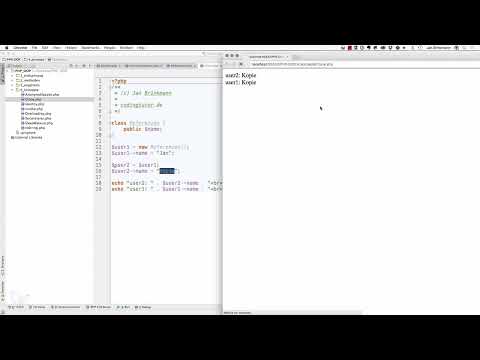
The video is only loaded from YouTube when you play it – data (including your IP address) is then transmitted to YouTube/Google. More in the privacy policy
Key Insights
Duplicating objects in PHP does not happen by simply assigning variables. Instead, a reference is copied that points to the same object. To actually create a new instance of an object, you must use the keyword clone.
Step-by-Step Guide
To understand and apply cloning of objects in PHP, follow these steps:
Step 1: Creating a Class
First, you need to create a class that serves as a template for your object. This can be a simple class with one or more attributes.

Step 2: Instantiating Objects
Create an object based on the defined class. The object will acquire some properties. For example, set the name of the object to "Jan".
Step 3: Copying an Object
However, only the reference of $user1 is passed to $user2. This means both variables point to the same object. If you now change the name of $user2, the name of $user1 will also change.
Step 4: Checking the Values
To verify that both variables point to the same object, you can check the properties in the output of a browser. Change the name in one of the variables and see what happens.

Step 5: Cloning Objects
If you want to create an independent object based on an existing object, you use the keyword clone.
Here, $user2 is now a new instance with its own values, independent of $user1.
Step 6: Verifying Results
Reload the page to determine that $user1 remains unchanged while $user2 has the newly assigned values. This shows that the two class instances are now independent.
Summary - Object-Oriented Web Programming: Cloning Objects
Cloning objects in PHP is an essential part of object-oriented programming. It allows you to duplicate data structures without affecting the original instance. Using the clone keyword ensures that you receive a new instance of the object.
Frequently Asked Questions
How do I copy an object in PHP?You use the keyword clone to create a true copy of an object.
What happens if I simply assign an object?A reference to the original object is created, not a copy.
Can I customize the clone keyword?Yes, you can implement the __clone() method in your class to customize cloning.
How does cloning affect performance?Cloning consumes more memory and may affect performance if many objects are cloned.


