
Whether you're running an ad for the first time or want to improve existing campaigns: at some point you'll ask yourself how big your target audience should be. The short answer is that there is no one-size-fits-all number that works for every product. Still, there are benchmark values you can use to get started sensibly. In this guide, you'll learn how to assess audiences in Ads Manager, which sizes have proven themselves in practice, and why you should always test in the end.
The video is only loaded from YouTube when you play it – data (including your IP address) is then transmitted to YouTube/Google. More in the privacy policy
Key Takeaways
- The exact audience size is less important as long as it is neither extremely small nor extremely large.
- Audiences that are too small quickly become oversaturated, while audiences that are too large can hardly be addressed precisely.
- You can control objective characteristics such as age, place of residence, or interests, but not subjective factors such as mood on a given day or willingness to buy.
- An audience of about 200,000 to 1 million people is considered a common benchmark for product sales in Germany.
- A test with several ad variants shows you which ad actually works.
Step-by-Step Guide
Step 1: Prepare the Campaign
Open Ads Manager and select the Traffic objective in the campaigns section. Then scroll down a bit until you find the appropriate campaign. For this example, you simply name it "Traffic Number 2" so you can easily find it again later.

Step 2: Set the Budget
Set a moderate daily budget. In the example, ten euros per day is used. With a small budget, you can try out audiences without losing much money on a weak ad. Then click "Next" to get to the audience selection.

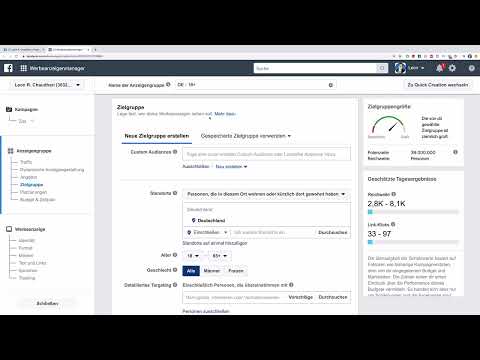
Step 3: Set Up the Audience
Now the crucial question arises: How big should the audience be? Before you enter any numbers, you should know that blanket statements are hardly possible here. However, experienced online marketers largely agree that size is not the main problem as long as it is within a reasonable range.

Step 4: Recognize the Danger of Audiences That Are Too Small
An extremely small audience gives you only a few people to reach. Your budget then flows again and again to the same people. Imagine you show ads to a group of 20,000 people for 100 euros every day. After a short time, these people see your advertising constantly, and they will wonder why the same offer keeps appearing in their feed. This effect is called fatigue and significantly reduces the effectiveness of your ad.

Step 5: Understand the Danger of Audiences That Are Too Large
If the audience is too large, on the other hand, you do reach many people, but none of them in a targeted way. Whether your audience comprises 100,000, 160,000, or 180,000 people doesn't matter much in most cases. What matters is that the ad accurately lands with the people who could actually be interested in your offer.
Step 6: Use Objective Factors
When selecting your audience, you can rely on objective factors. These include age, place of residence, or known interests. One example would be a person who is 22 years old, lives in Germany, and has liked Facebook pages about gummy bears. You can verify such characteristics and select them in a targeted way.
Step 7: Account for Subjective Factors
Besides the objective characteristics, there are subjective factors that you cannot control. Maybe someone is in a bad mood one day and doesn't want to see another sales ad. Another user behaves differently today than yesterday. These influences mean that results can differ from day to day. Therefore, plan for fluctuations from the start.
Step 8: Carry Out a Sample Calculation
Let's assume your audience comprises 180,000 people. In one day, you reach about 4,000 of them and get 80 to 100 link clicks. The next day, it may happen that only 75 to 95 clicks come in because some people are not in the mood to buy right now. This example shows you that individual daily values are only of limited significance. Therefore, always look at a longer period of time.
Step 9: Know the Benchmark for Germany
As a personal rule of thumb, many advertisers use an audience of about 200,000 to 1 million people for nationwide product sales. Others work with values between 100,000 and 2 million. What matters here: this benchmark is not a law. It works well for certain products, but not necessarily for every offer, and certainly not for worldwide shipping.
Step 10: Realistically Assess the Maximum Reach
Suppose your audience comprises just 20,000 people. That is your maximum potential reach. Even if you reach everyone, you won't convince every single person of your product. There are always people who aren't interested, don't budget money for it, or simply don't need the product. So don't expect 20,000 people to turn into 20,000 sales.
Step 11: Choose Larger Audiences for Scaling
If you are successful with an ad, you will want to increase the budget. Larger audiences of about 200,000 to 400,000 people are suitable for this. There you can scale without addressing the same people over and over again. From such an audience, you may be able to win several thousand customers, which is very helpful when planning the coming months.
Step 12: Test Ads Systematically
Blindly putting money into a single ad is risky. Instead, create several variants. They can differ in image, text, or audience. It is best to change only one variable at a time so that you can see exactly what makes the difference. Then you send out all variants at the same time and check which one is the most profitable. Only this ad deserves more budget.
Step 13: Compare Individual Variables Deliberately
When comparing, make sure you don't change too many things at once. If you swap the image, text, and audience all at once, you won't know afterwards which change was responsible for the result. A clean test with individual variables, on the other hand, gives you clear insights that you can build on.
Step 14: Narrow Down the Audience by Location and Age
In the audience tool, you can refine the audience further. Enter additional locations, narrow down the age, or add interests. Let's assume you only roughly know that your customers are between 20 and 40 years old. After some research, you can narrow down this range step by step. However, the more precise you get, the smaller the potential reach becomes.

Step 15: Put Local Ads into Perspective
If you only want to reach people in your area, for example for a local business, you limit the ad to a radius of, say, 10 or 20 kilometers. In this case, an audience of around 20,000 people is perfectly fine, because there are only a limited number of potential customers in your surroundings.
Step 16: Don't Go Into Too Much Detail
It would be a mistake to spend weeks on whether the audience should be 19 to 40 or 20 to 40 years old. Enter your assumptions as precisely as possible, but don't survey every person individually. What matters most anyway is how the ad itself performs. Content, description, and placement also have a major influence on success. The audience is only one part of the overall picture.

Step 17: Get Started Practically with Ads Manager
The best way to start is simply to try things out. Play around with locations and age limits in Ads Manager until you feel comfortable with the interface. Once you have defined the audience, you send out the ad and observe how it performs. This way, over time you develop a feel for which sizes work for your offer.
Summary – Audience Size in Facebook Advertising: Benchmarks, Sample Calculation, and Testing Methods
There is no perfect audience size, but you now have a clear framework for orientation. Avoid audiences that are so small that they become oversaturated, and those that are so large that they remain imprecise. For nationwide product sales in Germany, 200,000 to 1 million people is a proven starting point. Also understand that objective characteristics are controllable, while subjective factors cause fluctuations. Testing remains decisive: compare ads using individual variables, pay attention to long-term trends, and only invest more budget once an ad is actually working profitably.
FAQ
How large should my audience be at minimum for nationwide sales?As a benchmark, about 200,000 to 1 million people in Germany apply, although values between 100,000 and 2 million are also used.
Does an audience of 20,000 people make sense?For local offers with a small radius, it can work. For nationwide sales, it is usually too small because the ads quickly become oversaturated.
Why are my daily results so different?Subjective factors such as mood or the behavior of individual users influence the results. Therefore, always look at a longer period of time.
Should I calculate every age limit exactly before starting?No. Enter your assumptions as precisely as possible, but don't get lost in details. Ad content and placement are often more important.
How much budget should I plan for tests?For large audiences, tests with about 1,000 euros are worthwhile. For small audiences, on the other hand, an extensive test makes little sense.
How do I recognize which ad works?Create several variants, change only one variable at a time, and compare the results. The most profitable ad then receives more budget.


