
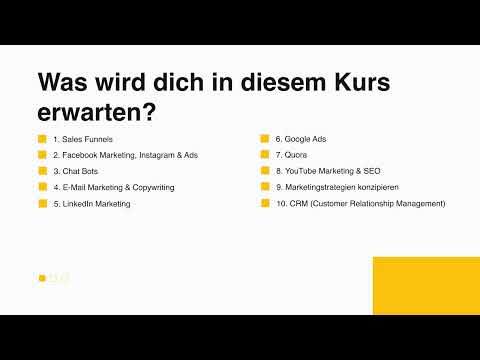
The question of how to win new customers online can rarely be answered with a single trick. Between content marketing, paid advertising, chatbots, and email sequences, there are countless paths, and many companies fail not because of the technology, but because they start without a clear goal. This is exactly where the course "Customer Acquisition on the Internet: Methods & Practical Tips" comes in. This guide shows you which topics await you and in what order you should tackle them.
The video is only loaded from YouTube when you play it – data (including your IP address) is then transmitted to YouTube/Google. More in the privacy policy
Key Takeaways
- Set a specific goal before choosing a method, for example new inquiries, more sales, or greater reach.
- Budget and available time determine whether content marketing or paid advertising suits you better.
- A sales funnel describes the path from unknown prospect to customer and is divided into TOFU, MOFU, and BOFU.
- Landing pages and opt-in pages capture prospects and collect their contact details.
- Every platform, from Facebook and Instagram to LinkedIn and Google to YouTube and Quora, has its own strengths.
- A CRM system helps you retain existing customers and increase their customer lifetime value.
Step-by-Step Guide
Step 1: Clearly Define Your Goal
Before you run any ad, ask yourself a simple question: What exactly do you want to achieve? New inquiries, more sales, and greater reach are three different goals, each requiring different measures. Formulate your goal specifically, such as "20 qualified inquiries per month". This way you avoid randomly trying out different methods without a plan.

Step 2: Choose the Right Method Based on Budget and Time
If you have a lot of time but no large budget, content marketing is usually the better starting point. You create blog articles or videos that attract visitors over the long term. If, on the other hand, you have a relatively large budget and little time, paid ads such as Facebook Ads or Twitter Ads make more sense because they bring reach quickly. Also consider whether you have a sales team or a CRM system, because that determines how many prospects you can handle.
Step 3: Understand the Sales Funnel
A sales funnel describes the path a prospect takes from first contact to purchase. At the beginning, point A, the person does not yet know your brand and your product. At the end, point B, they like your product and have actually bought it. Your task is to guide people step by step from A to B. In doing so, you clarify where the sales process begins, where it ends, and which stages lie in between.

Step 4: Distinguish the Funnel Phases TOFU, MOFU, and BOFU
The funnel is divided into three areas. In the Top of the Funnel (TOFU), it's about attention: people should notice you in the first place. In the Middle of the Funnel (MOFU), you build trust, for example with helpful content, comparisons, or case studies. In the Bottom of the Funnel (BOFU), the purchase decision is made. Each phase needs different content, so you should consider them separately in your planning.
Step 5: Create a Landing Page and Opt-in Page
So that prospects don't get lost in the funnel, you need technical building blocks. A landing page is a standalone page where a single offer takes center stage. An opt-in page specifically collects contact details, usually in exchange for a free guide or video. Setting it up is technically more demanding than a normal website, but it can be implemented quickly with the right tools.
Step 6: Use Facebook and Instagram Strategically
On Facebook and Instagram, you can work with both content marketing and paid advertising. Organic posts build reach slowly. However, if you want to reach many people in a short time, Facebook Ads and Instagram Ads are the right lever. For most companies, building up through content marketing takes significantly longer.
Step 7: Use Chatbots for Quick Answers
A chatbot automatically handles recurring messages. With the tool ManyChat, you create a bot that answers messages, clarifies questions, and messages potential customers. The bot recognizes certain keywords. If someone asks about opening hours, for example, the bot immediately sends the appropriate answer. This way you stay reachable even when you're not online.
Step 8: Master Email Marketing and Copywriting
With MailChimp, you set up a newsletter and work with automated sequences. These sequences accompany prospects along their customer journey. Copywriting is crucial: the subject line decides whether your email is opened at all, and the structure of the text determines whether someone clicks. Practice writing short, clear texts that promise a concrete benefit.
Step 9: Using LinkedIn for B2B Customers
If you do B2B business and want to win many customers online, LinkedIn Marketing, Sales Navigator, and LinkedIn Ads can be very relevant for you. Sales Navigator allows you to filter target individuals by industry, position, and company size. This way, you specifically address the decision-makers who are eligible for your offer.
Step 10: Reaching Search Engines with SEO and Google Ads
If you want people to find you through search engines, you have two options. With SEO, you build organic visibility, which, however, requires patience. Google Ads places ads directly in the search results and ensures quick visibility. In addition, you can place advertising on websites that thematically match your product or your brand.
Step 11: Running Ads on YouTube
YouTube advertising reaches users while they are watching videos or searching for content. You can place ads in the search results and run them on websites that fit your topic. Choose the target audience carefully, because the more precise the targeting, the better the clicks and the cost per contact.
Step 12: Using Quora as an Advertising Platform
Quora is a question-and-answer platform. You can design your ad so that it looks like a question and place it under relevant topics. Those who are interested click and land on your website. The challenge lies in making the ad seem helpful and not like classic advertising.
Step 13: Optimizing Your YouTube Channel and SEO
For many companies, having their own YouTube channel is essential if they want to win customers organically in the long term. Optimization is crucial. Titles, video descriptions, and tags should contain the search terms your target audience is actually searching for. Then your video will be found more often, receive more clicks, and gradually bring you new customers.
Step 14: Designing Marketing Strategies
A single method is not yet a strategy. A strategy combines goal, target audience, channels, and measures into a plan that works over months. You will learn how to turn individual methods into a coherent overall concept and implement it consistently. This topic accompanies you throughout the entire course.
Step 15: Retaining Existing Customers Long-Term with CRM
Finally, it's about customers who have already purchased from you. A CRM system helps you organize contacts into structured processes. You can recognize who already knows you and who has already bought. Important is the Customer Lifetime Value (CLV), that is, the total value a customer generates for you over time. You increase it through retargeting, targeted communication, and suitable new offers, for example.
Summary – Customer Acquisition on the Internet: Methods and Funnel at a Glance
Customer acquisition on the internet succeeds when you first know your goal, adapt your method to your budget and time, and plan the sales funnel consistently. From chatbots and email marketing to Google Ads, LinkedIn, and YouTube, each channel follows its own logic. A CRM system helps you retain existing customers and increase their value. The course provides you with the fundamentals so that you can build your own marketing that is sustainable in the long term.

