
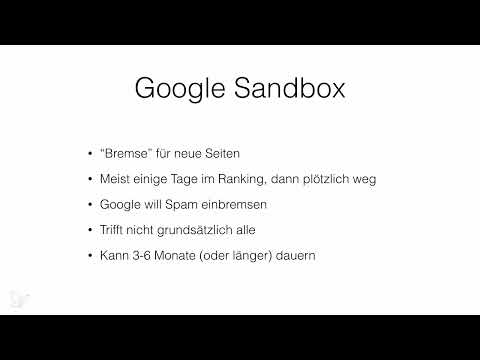
You put a new website online, the first few days look promising, and suddenly everything disappears from the search results. Many people who work in online marketing know this phenomenon, whether with AdSense, affiliate programs, or their own blogs. The so-called Google Sandbox is considered a kind of brake on new sites, meant to prevent newcomers from landing at the very top right away.
The video is only loaded from YouTube when you play it – data (including your IP address) is then transmitted to YouTube/Google. More in the privacy policy
In this guide, I show you how to avoid this trap as much as possible. The advice is based on practical experience with several of my own projects. Google does not officially confirm this mechanism in this form, so you should understand the tips as a proven approach and not as a guaranteed solution.
Key Takeaways
Key Takeaways
- The Sandbox acts like a delay: New sites often need three to six months or longer before their ranking stabilizes.
- A typical warning sign is that a site climbs in the rankings after a few days and then suddenly disappears.
- A start that is too perfect, with full optimization, can trigger the Sandbox rather than prevent it.
- A natural, gradual build-up with content that grows regularly appears more authentic.
- Patience is crucial, because results appear after very different amounts of time for different sites.
Step-by-Step Guide
Step 1: Put the Sandbox in the Right Context
Before you get started, you should understand what you are dealing with. The Google Sandbox is not an official penalty, but a delaying tactic that is presumably part of the algorithm or is controlled manually. Its purpose is to put a kind of brake on new sites so that they don't end up at the very front after just a few weeks. One advantage of this brake is that Google gains time to evaluate sites better. It is important that you accept the Sandbox as a reality and align your strategy accordingly.

Step 2: Recognize the Typical Pattern
The Sandbox often shows itself in a very characteristic way. A new site climbs in the search results within a few days, sometimes even to the first page. Then it suddenly disappears, sometimes down to position 300 or out of the index entirely. If you encounter this pattern, it is a clear sign that the Sandbox has struck. In this case, expect that recovery can take three to six months or longer. The time span is not predictable, and it also doesn't affect all sites equally strongly.
Step 3: Start the Domain Unspectacularly
A surprisingly helpful approach is to deliberately prepare domains unoptimized at first. Register the domain, install WordPress, and set up the basic structure without immediately perfecting every detail. For me, this step was more of a coincidence, because I had several domain ideas and niches in mind and didn't want to launch them all immediately. This relaxed approach in particular helped me later, because the sites grew gradually instead of being trimmed for perfection from the start.
Step 4: Create a Minimal Homepage
Initially create the homepage with little content, such as around 100 words, a clear heading, and a rough indication of what the site is about. That is enough for Google to roughly recognize the topic. You don't need to implement a complete keyword strategy in this phase. It is mainly about making the site look alive and show a clear purpose.
Step 5: Expand the Homepage Gradually
After about a week, you can carefully expand the homepage. Add a few hundred words on the topic and add one to three subheadings. Deliberately hold back and don't yet go into the full on-page program. The goal is growth in small steps, as typically happens with a real blog.
Step 6: Publish the First Articles
Only now do you begin writing the first articles. Here, too, the rule applies: Don't optimize everything down to the last detail yet. One article covers one topic, another covers a further detail, and each can still have gaps. This imperfection often seems more natural to Google than a perfectly styled text that is over-optimized from the start.
Step 7: Stay in Mode and Refine the Site
In my projects, the sites sometimes stayed in this early mode for three to six weeks. That is normal and no reason to panic. Keep refining the site in small steps, for example by adding a logo, better texts, or a clearer structure. Every small improvement is a building block, not a breakthrough. Avoid hectic complete overhauls, because they quickly look unnatural.
Step 8: Linking the Homepage to the Articles
Once several articles are available, you link from the homepage to these posts. This internal linking helps visitors navigate and shows Google which content is important to you. Make sure the linking remains logical and organic, meaning it happens where it actually makes sense for the reader.
Step 9: Be Patient and Wait for the First Results
At some point the first results will come. For me, it took around six weeks until the site had arrived in the rankings and regularly got about 20 visitors per day via Google. This time span varies greatly, so you can't rely on fixed days. What matters is that you stick with it and don't try out new strategies every week.
Step 10: Avoiding the Trap of an Immediate Full Launch
Many beginners are tempted to launch a new site right away with keyword density, optimized headings, perfect word count, and all on-page requirements. This is exactly what can trigger the sandbox. I have seen sites that did not get out of this mode even after a long time, although the competition was rather small. A new attempt with a fresh site, on the other hand, brought results faster. Therefore, it's better to start naturally instead of working through all the checklists at the same time.
Step 11: Building Regularity and Professionalizing
The last step is to gradually develop publishing into regular intervals. Gradually add more content until you have a fixed rhythm, for example three times per week. An editorial calendar helps you keep track. This natural growth looks to Google like the behavior of a real blogger and, in my experience, can help shorten the sandbox or avoid it entirely.
Summary – Avoiding the Google Sandbox: Step-by-Step Guide for New Websites
The Google Sandbox is a delay that slows down new sites, and it cannot be fully controlled. However, you can do a lot to mitigate it. Start with a minimal homepage, expand the content step by step, and publish articles without optimizing everything immediately. Link the homepage and posts sensibly, stay patient, and build a regular publishing rhythm over the long term. If you proceed this way, your site looks natural and gains stability over time.
FAQ
How can I tell that the Google Sandbox has hit my site?A typical sign is that your site rises in the rankings after a few days and then suddenly drops sharply or disappears from the search results entirely.
How long does it take for a site to recover after the sandbox?Recovery can take three to six months or even longer. The exact time span cannot be predicted and depends on the individual site.
Do I have to optimize my new website from the start?No, quite the opposite. Full optimization too early can actually favor the sandbox. It's better to start simple and build out the site step by step.
How much content should the homepage have at the beginning?A short text of about 100 words with a clear heading is enough as a start. After that, you can gradually expand the homepage.
Is the Google Sandbox officially confirmed?The existence of such a delay has been observed many times in practice. Whether it works as a separate mechanism or as part of the algorithm has not been clearly established.
Does regular publishing help against the sandbox?In my experience, yes. A fixed rhythm, such as three times per week, looks natural and can shorten the duration of the sandbox. However, there is no guarantee.


