
Imagine someone sitting at the kitchen table in the evening with ChatGPT, asking whether a solid wood table is worth it compared to a cheaper model. This is exactly the moment your ad should appear. Whether that succeeds is decided by the Context Hint, that is, the text that describes in which conversation your ad may be served. This guide shows you how to write such hints using four patterns based on real purchase conversations. The Eichenwerk case study, a provider of solid wood furniture, serves as the example.
The video is only loaded from YouTube when you play it – data (including your IP address) is then transmitted to YouTube/Google. More in the privacy policy
Key Takeaways
Context Hints describe conversations; they are not keywords. The four patterns Problem, Comparison, Situation and Occasion cover most purchase conversations. Hints that are too narrow don't get served, while those that are too broad burn through your budget. The range therefore belongs in the test design and not in the first campaign, which won't be perfect anyway.
Step 1: Understanding Context Hints as a Conversation Description
The most important change of perspective comes first. A Context Hint is not a search query like "buy solid wood dining table", but the description of a conversation in which someone wants to buy something. So you don't formulate what you sell, but what the user is currently thinking, asking or experiencing. Imagine you are writing for a person who is typing their problem into a chat window right now, and think about which words they would use.

Step 2: The Four Patterns at a Glance
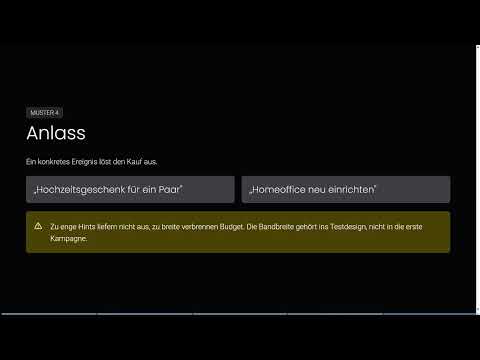
Purchase conversations can be divided into four categories. With the Problem, the user describes a difficulty but doesn't have a solution yet. With the Comparison, they weigh two or more options. With the Situation, they describe a life circumstance without naming the product. With the Occasion, a specific event has triggered the purchase. Each pattern brings its own opportunities, and you should prepare several hints per pattern so that you have a real selection later on.
Step 3: Formulating the Problem Pattern
With the Problem pattern, the user is still looking for a solution. In the case study, one example reads: "Dining room too small for a normal table. Furniture only lasts a few years. What should I do?" The user knows their problem but has no plan. With this pattern, watch out for regulated industries. A health problem, such as irritated eyes, seems suitable at first glance, but is tricky for ads in heavily regulated areas and cannot be sensibly linked to a furniture product anyway.

Step 4: Building the Comparison Pattern
In the Comparison, the user has usually already settled on two options. An example from the case study: "Solid wood or veneer, workshop or furniture store?" The comparison doesn't always have to be spelled out literally. "Expensive versus cheap" is also a comparison, even if the words cheap or inexpensive don't appear at all. This formulation is often the more realistic one, because users rarely name prices as directly as we are used to in search forms.

Step 5: Describing the Situation, Not the Product
The Situation is the pattern in which your product is mentioned the least and yet makes the most sense. The user isn't thinking about a dining table, but about their life circumstances. Examples are "Furnishing my first apartment" or "Moving into an old-building apartment". The table itself doesn't appear in this conversation yet, and that is exactly where the opportunity lies. Emotional life situations are particularly strong because furnishings are easily interchangeable and people feel a lot there, whereas rent, as a fixed cost, hardly triggers any feelings.

Step 6: Capturing the Specific Occasion
The Occasion describes a specific event that triggers the purchase, such as a birthday, a wedding or moving into the first shared apartment. The same rule applies here as everywhere: the more specific the occasion, the better it fits your product. A wedding gift for a couple who already has everything, however, is too broad, because nobody thinks of a solid wood table at a wedding. Moving into your first own apartment with the wish for a proper dining room, on the other hand, fits very well.

Step 7: Assess the Range Correctly
This is where the most common trap lies. Hints that are too narrow don't deliver because your pattern simply doesn't occur in real conversations. Hints that are too broad burn budget because your ad appears in conversations that have nothing to do with your product. "Dining table, which one?" is too broad, because you have to assume scenarios in which a solid wood table is actually being asked about. That is why your first campaign won't be perfect. Go in with honest expectations and use the first phase to find out which hints work. The range therefore belongs in the test design and not in the expectations for the first campaign.
Step 8: Generate Candidates with ChatGPT
You don't have to write all the hints on your own. In a chat, upload a document with your conversation candidates and your product overview, and ask ChatGPT to assign each candidate to exactly one pattern. Then have it show you which patterns are underrepresented, and ask for three new candidates for each of those patterns. Request the output as a table so that you can compare the results quickly. With large documents things can go wrong, so always check the answers.

Step 9: Evaluate the Candidates Critically
The AI delivers suggestions that you have to check yourself. A suitable candidate is, for example, a dining room that is too narrow and where you don't know how much space is sensible. That is a concrete space problem that plausibly leads to searching for a dining table. By contrast, candidates such as a question about furnishing a first shared apartment are too broad, because neither a dining table nor any piece of furniture is mentioned there. The combination of light wood with dark walls is also too broad, because it remains unclear whether it is about the wooden table or about floors and decoration.

Step 10: Recognize Candidates That Are Too Narrow
The Eichenwerk case study shows the classic case of hints that are too narrow. A user has already discovered the provider, wants to order a dining table there, and asks whether the price is justified compared to a carpenter's workshop. The person knows the company and the product; they are only looking for confirmation. An advertisement is then of no use. Only good customer management helps here, such as quick replies to emails or a good question-and-answer function on your own website. Such candidates therefore don't belong in the list for the ad.

Step 11: Enter the Hints in Ads Manager
Enter the selected hints in Ads Manager and make it clear that they are descriptions of conversations and not keywords. You can't evaluate the conversations afterwards, because OpenAI currently doesn't provide conversation reports. Therefore, create several hints per pattern from the start and compare the results later using the campaign figures. Also add the product and offer information so that the AI can understand what you are selling.

Summary – Context Hints for ChatGPT Ads: Four Patterns That Deliver
Context hints describe conversations, not search terms. With the patterns problem, comparison, situation, and occasion, you cover most purchase conversations. Pay attention to the right range: too narrow doesn't deliver, too broad burns budget. Use ChatGPT to collect and categorize candidates, and check every suggestion yourself. The first campaign is for testing, not for perfection.
FAQ
What is the difference between a context hint and a keyword?A keyword is a search term, whereas a context hint describes a conversation in which someone wants to buy something.
Why shouldn't I phrase hints too narrowly?Hints that are too narrow hardly ever match in a real conversation, so the ad doesn't deliver.
What happens with hints that are too broad?The ad appears in conversations that have little to do with your product, and the budget is used up without results.
Why does the range belong in the test design?You can only see in the campaign which hints work, so the first campaign should be understood as a test.
Can I evaluate the conversations afterwards?Not currently, as OpenAI doesn't provide conversation reports.
How many hints should I create per pattern?Create several hints per pattern so that you have a selection later and can compare the results.


