
You open the Ads Manager, see that ad group A has a click-through rate three times as high as B, and want to declare it the winner right away. This is exactly where most wrong decisions happen. In this guide, you go through two ad groups metric by metric. You'll learn what the Ads Manager delivers automatically, what only becomes visible once tracking is set up, and why conversions per euro spent are the only thing you can truly compare reliably.
The video is only loaded from YouTube when you play it – data (including your IP address) is then transmitted to YouTube/Google. More in the privacy policy
Key Takeaways
The click-through rate alone says little about the success of a campaign. Two groups with very different CTRs can mean the economic opposite. Impressions and clicks show reach and interest, but not revenue. Conversions require tracking set up via the OpenAI Pixel and the Conversions API. Without it, you lack the most important metric. There are no industry benchmarks, and Google values cannot sensibly be used as a yardstick. In the end, what is above all reliable is comparing the cost per conversion with your upper limit.
Step-by-Step Guide
Step 1: Getting an Overview of the Metrics
The Ads Manager automatically shows you impressions, clicks, spend, the click-through rate (CTR), the average cost per click (CPC), and the average cost per mille (CPM). In the video, seven metrics are announced. The seventh is the conversion, which you have to set up separately. It is the linchpin of the entire analysis.

Step 2: Understanding the Test Setup
Before you read numbers, you need to know what you are comparing. Group A promotes products and links to the homepage of your regular website. Group B works close to the problem and leads to a specific landing page, which in the best case has a higher conversion rate. Both groups used nearly the same budget: around €5,400 for A and €40 less for B. This comparability in budget is important, because only then can you interpret differences cleanly.

Step 3: Putting Impressions into Perspective
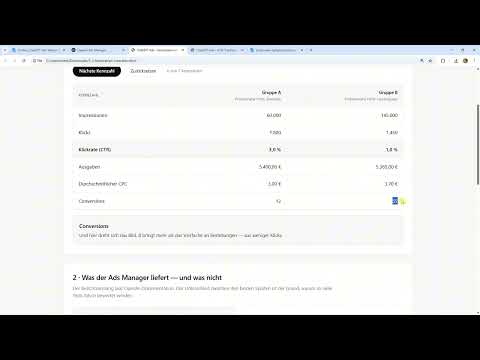
For impressions, Group B is clearly ahead with around 145,000 compared to Group A with about 60,000. This is not automatically an advantage. Problems are a much broader topic of conversation than individual products, which is why B is served more often. Impressions show you reach and visibility, but not yet impact. Treat them as a context value and not as proof of success.
Step 4: Reading the Clicks
In absolute clicks, Group A wins with 1,800 versus 1,450 for B, even though A had significantly fewer impressions. There is a simple logic to this: someone who is already searching for a product or has a product reference in the conversation is more likely to click. Problem-oriented ads, on the other hand, have a stronger effect on brand awareness. You see your logo, but you get a click less often. Both patterns are normal and must be evaluated depending on the goal.

Step 5: The Click-Through Rate and Why It Deceives
Calculate the CTR yourself: 1,800 clicks on 60,000 impressions give three percent, 1,450 clicks on 145,000 impressions give about one percent. Group A therefore clearly looks better. This is exactly where the trap lies, because many people turn off the weaker group based on this number. This also happens in client conversations when reports focus on the click-through rate. Whether the CTR is relevant depends on what your goal was. For the question of whether a campaign pays off, it is not sufficient.
Also, do not compare CTR with Google values. The usage situations are different, and with that comparison you would more likely steer in the wrong direction. There are likewise no reliable industry benchmarks for ChatGPT Ads. Use your own groups as the basis for comparison instead.

Step 6: Calculating Spend and Cost per Click
The spend is nearly identical for both groups. The cost per click results from dividing the spend by the clicks. For Group A, that is about €3 (€5,400 divided by 1,800). For Group B, you arrive at around €3.70 (€5,365 divided by 1,450). Group B therefore has not only the worse click-through rate but also more expensive clicks. However, this alone does not yet determine success.


Step 7: Make Conversions Measurable
Conversion is the first metric you can track really well once you have activated the OpenAI Pixel. For this, you need a connection to your shop if you sell products. However, conversions can also be other goals, for example a newsletter signup or an inquiry. Normally, product sales are the most meaningful variant because you can convert them directly into revenue.

Step 8: Compare Sales and Cost per Conversion
In the example, group A leads with 12 sales, while according to the video B achieves significantly more sales. At the same time, the video states costs per order of €450 for A and just under €890 for B. These figures do not add up mathematically: €5,365 divided by €890 gives about six orders, not 55. This contradiction is a useful lesson for you. Always recalculate your own numbers yourself and check every figure against the raw data. The method stays the same, though: You divide the spend by the conversions and compare the result.

Step 9: Don't Confuse Clicks with Purchases
A click does not mean that someone will buy. Group A links to the homepage, group B to a landing page. Landing pages are built specifically to convert better for ads. A comparison of clicks is therefore only fair to a limited extent. Anyone who looks only at clicks and switches off groups without conversion data often makes the wrong decision. Especially when conversions are not yet being tracked at all, this is a dangerous mistake.

Step 10: Separate Automatic Data from Configured Measurement
Without setup, you automatically see impressions, clicks, click-through rate, spend, CPC and CPM. Conversions, on the other hand, only appear once you integrate the OpenAI Pixel on your website. In addition, you need an attribution in your analytics tool. The connection is made via the Conversions API. Without this step, the most important metric remains empty, and you have to work with substitute metrics that do not give you a complete picture.

Step 11: Work Through a Calculation Example for Your Upper Limit
Assume your campaign has 1,000 impressions, 50 clicks, spend of €500 and 10 conversions. The cost per conversion is €50. If your upper limit is €300, the campaign is clearly viable. If it is €30, it does not pay off. Work through this model for your products before you make decisions. Very important: Set up the OpenAI Pixel as soon as you sell products, otherwise there is nothing you can cleanly compare.


Summary – Reading ChatGPT Ads Metrics: Why the CTR Is Deceptive
You have seen that impressions, clicks, click-through rate and cost per click are available automatically, but say only limited things about the success of a campaign. A high CTR can give you a false impression if the traffic does not result in purchases. The reliable metric is the number of conversions per euro spent, that is, the cost per conversion. For this, you need the OpenAI Pixel, the attribution in the analytics tool and the Conversions API. Compare groups fairly, take the different landing pages into account and do not rely on industry benchmarks or Google values. Finally, work out your upper limit per conversion before you switch off a group.
FAQ
Are there industry benchmarks for the CTR of ChatGPT Ads?No, there are currently no reliable industry benchmarks. Therefore, compare your groups with each other and with your own target values.
Can I compare the CTR of ChatGPT Ads with Google values?This is not advisable. The usage situations differ greatly, and such a comparison easily leads to false conclusions.
Which metrics do I see without further setup?Impressions, clicks, spend, click-through rate, average cost per click and average cost per mille are available automatically.
Why don't I see any conversions in the Ads Manager?Conversions must be tracked separately. For this, you need the OpenAI Pixel on your website, an attribution in the analytics tool and the connection via the Conversions API.
Which metric is most important for the decision?The most reliable are the conversions per euro spent, that is, the cost per conversion. You compare this number with your upper limit.
Why is a high click-through rate alone no proof of success?Clicks only tell you that people reacted to your ad. Whether they buy or make an inquiry is only shown by conversion measurement.


