
Imagine you're standing in an unfamiliar town looking for a good restaurant. You know what you want, but not yet where to find it. This is exactly the point where the question you should ask yourself about ChatGPT Ads comes in: At which stage of the customer journey are people when they know their problem, but not yet the solution? This guide shows you where the channel fits into your budget mix, where to get a test budget from, separately for online shops, local service providers, and B2B offerings. Finally, you'll learn how to stay on top of things when the platform is constantly changing.
The video is only loaded from YouTube when you play it – data (including your IP address) is then transmitted to YouTube/Google. More in the privacy policy
Key Takeaways
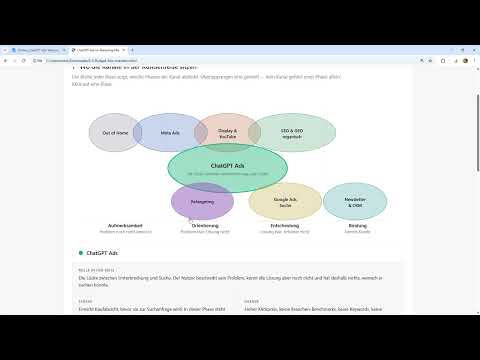
ChatGPT Ads work mainly in the orientation phase, when the problem is clear but the solution is still missing. Out-of-home campaigns, TV advertising, and social media ads are responsible for reach (awareness). Newsletters and good content remain important for customer retention.
For a test, you don't use the entire budget at once, but instead cut around ten percent from existing channels and use it for a fixed test budget. Set an upper limit that you cannot exceed.
For local service providers, part of the print budget can flow into the test, because many people today search for recommendations directly via AI assistants. For B2B offerings, the budget is more likely to come from LinkedIn Ads and Google Ads.
After about three months, you should evaluate the results and decide whether to increase or scale back the budget. Also check the guidelines and the Ads Manager regularly, because the features change continually.
Step-by-Step Guide
Step 1: Break down the customer journey into four phases
Before you shift even a single euro, categorize your target audience. The customer journey can be divided into four stages: awareness, orientation, decision, and retention. In the awareness phase, the customer doesn't know your brand yet and doesn't even know they have a problem. An example: You see a poster for high-protein dog food and remember the name, without currently having a need. For orientation, the customer is further along. They know their problem but are looking for a solution. The decision follows when the solution is settled and only the right provider is still being sought.

Step 2: Deliberately leave awareness to other channels
For the awareness phase, out-of-home campaigns, TV advertising, and social media ads are the obvious choice. Television is expensive, as you'll quickly notice. On Instagram or other platforms, on the other hand, you can target ads specifically, because the platform uses user behavior to assess who might be relevant for your offering. ChatGPT Ads are not the first choice in this early phase, because there people search specifically for something that already concerns them.
Step 3: Cover the orientation phase with ChatGPT Ads
This is where the channel's real added value lies. People describe their problem to an AI assistant and receive rough solution suggestions or directions. Exactly at this moment, your ad can appear. By comparison: With Meta Ads, display advertising, and YouTube ads, you reach people who have also previously searched or consumed content. Retargeting complements this, because you can address the same person multiple times or bring them into the newsletter via an email address. ChatGPT Ads therefore complement these channels; they don't replace them.

Step 4: Don't forget the decision phase
Advertising can also help in the decision phase, for example when the solution is clear and the customer is still looking for a suitable provider. Most people use the classic Google search for this, either via organic results or via paid ads. You need to be present there. That's why Google Ads remains the main channel in this phase for many shops. The classification is clear: ChatGPT Ads belong mainly in orientation, Google Ads mainly in decision.
Step 5: Manage customer retention via newsletter and content
After the purchase, retention matters. Ads are not the right tool for this. You build trust with a newsletter and with good content, for example with helpful guides, tutorials, and offers for existing customers. When you plan the budget for ChatGPT Ads, therefore, don't include retention measures in it.
Step 6: Set the test budget for online shops
Most online shops invest heavily in Google Ads, Meta Ads, and retargeting. That's good, and you don't have to cut any of it completely. For the test, I recommend the following approach: Reduce the budget for Google Ads, especially for search campaigns, a little, and also trim the Meta Ads, because Meta ads are often particularly expensive. You put the money freed up this way into a ChatGPT Ads test budget with a fixed upper limit. In the example, 500 euros per month is mentioned. The exact amount is less important than the fact that you limit the budget and actually carry out the test.

Step 7: Examining local service providers and forgoing print
A restaurant or a hairdresser can save part of the budget for out-of-home advertising, meaning posters or flyers. Before you order print runs, a test with ChatGPT Ads is worthwhile. An example shows why this can work: While on vacation in Albania, the speaker asked an AI for restaurants nearby, gave his location, and named criteria such as style and price. The answer was a sorted list of recommendations. Exactly this behavior can also apply to your service. A flyer in the hotel room would surely have helped too, but AI search is now the more direct route for many people.
Step 8: Funding the B2B budget from several channels
For B2B services such as job placement, real estate, or software projects, the situation looks different. Here, most inquiries come through LinkedIn Ads and Google search. For the test, it is advisable to divert a little from each of these channels, for example from LinkedIn Ads, Google Ads, and retargeting campaigns. The cut does not have to be radical. A share of about ten percent per channel is enough to test ChatGPT Ads without endangering your proven business.

Step 9: Limiting the test and evaluating after three months
A test needs a clear time frame. After about three months, you evaluate the results. If the ads do not bring the desired success, you can increase the budget in the existing channels again. If the test goes well, you let the ChatGPT Ads keep running, perhaps with a somewhat smaller budget than at the start, until you have enough data for a final decision.
Step 10: Staying up to date
The advertising platform will change over the coming months, in some cases even daily. You should therefore regularly check three sources: OpenAI's guidelines on ads, the Help Center, and video tutorials from OpenAI. Most important, however, is the Ads Manager itself. That is where new information, new input fields, and new target group options appear, for example when they become available in the European Economic Area. Set a fixed appointment for this, for example once a month, and look specifically for changes.

Summary – ChatGPT Ads in the Budget Mix: Classification, Test Budget, and Staying Current
ChatGPT Ads belong in the orientation phase of the customer journey, where people know their problem but are still looking for a solution. Awareness is handled by out-of-home advertising, television, and social media. The decision remains with Google Ads. Customer retention is provided by newsletters and content. For the test, you cut the budget per channel by about ten percent, set a fixed upper limit, and evaluate the result after three months. Local service providers can reduce print spending as a test, while B2B providers fund the test from LinkedIn and Google. Check the guidelines and the Ads Manager regularly, because the platform is constantly changing.


