
Imagine you launch a campaign, and the budget drains away without a single conversion. This exact situation often occurs when you operate Google Ads like a pro and simply transfer that knowledge to ChatGPT. The ad is served, the clicks come in, but in the end the results are missing. The reason usually does not lie in the ad itself, but in a mental error that sits at the very beginning.
The video is only loaded from YouTube when you play it – data (including your IP address) is then transmitted to YouTube/Google. More in the privacy policy
Before you set up a campaign, you therefore need to develop a basic understanding of how people use AI assistants. This text guides you step by step through the most important differences between a search query and a conversation and shows you which thought patterns you should abandon.
Key takeaways
Nobody searches for you in ChatGPT. Users discuss a problem, and your brand or your product only appears if it fits into the conversation. There is therefore no keyword booking, no guarantee of delivery in a specific conversation, and no benchmarks that you can carry over from Google Ads. Anyone who treats ChatGPT Ads like Google Ads burns budget.
Step 1: Recognize the Thinking Error
The most common mistake begins with an assumption: you assume that people search in ChatGPT the same way they do in Google. This assumption leads you to build ads following the pattern of a search engine. You then pay for placements that have little connection to your offer, and wonder why no conversions come in.
Keep in mind, therefore, that you are not selling into a search box, but into an ongoing dialogue. This shift in perspective alone prevents many wrong decisions before you even create your first ad.

Step 2: Distinguish Between Search Query and Conversation
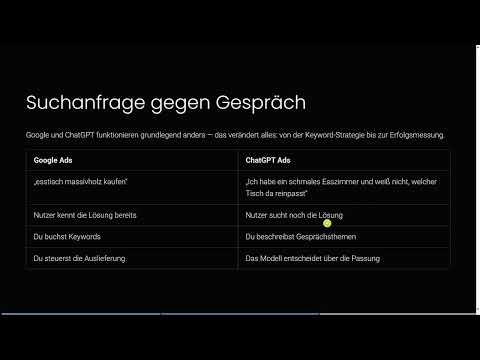
On Google, the user enters a short term, such as "buy solid wood". This input reveals a clear purchase intent, and the user usually already knows the solution. They only want to compare options and prices. This is exactly why keywords work so well there.
In ChatGPT, things look different. The input is often an entire sentence with context, for example: I have a narrow dining room and don't know which table will fit. The user formulates a problem and has no ready-made solution in mind. A conversation therefore consists of a question, a statement, or a situation, not of a search term.

With this distinction, pay attention to the user's state. If they already know what they want, it is more likely a classic search. If they are still looking for a solution, they are in a conversation.
Step 3: Classify User Intent Correctly
Imagine you are on the road in your car and ask your assistant: What is the name of the mountain next to me? On Google, you would probably search for the country, look at images, and click through results. In ChatGPT, you simply ask a question that arises from a concrete situation.
This difference shows you why Google Ads works with keywords that already presuppose a solution. You bid on terms that people search for specifically. With AI assistants, on the other hand, the user often does not know the solution at all. So if you observe how you yourself use AI, you will notice that when looking for a solution, you are more likely to start a conversation.
Step 4: Define Conversation Topics Instead of Keywords
While in Google Ads you bid on keywords, in ChatGPT you describe conversation topics. That sounds abstract at first, but at its core it is simple: you consider which problems people talk about, and determine which solution you offer alongside. The logic is thus thematic rather than word-exact.
The role of the model is important here. It decides based on the context whether your ad fits the conversation. You specify the topics, but the system takes care of matching them to users' concrete questions. Therefore, think in problem areas, not in search terms, and formulate your topics so that they fit real conversation situations.
Step 5: Accept No Keyword Booking and No Delivery Guarantee
Here lies one of the biggest adjustments for switchers. With ChatGPT Ads, there is no keyword booking. So you cannot specify that your ad appears when someone types in exactly a particular term, and you also cannot secure the placement with a higher bid. The topics feed into the model's decision, and the model evaluates the context.
Likewise, there is no delivery guarantee. It is impossible to predict in which specific conversation your ad will appear. This is not a flaw you can fix technically, but a principle of the system. Therefore, don't plan your campaign for precision, but for suitable topics with sufficient relevance.

Step 6: Don't Transfer Benchmarks
Finally, there is a point that is often underestimated in practice: metrics from Google Ads cannot be transferred one-to-one to ChatGPT Ads. Click-through rate, cost per click, and conversion rate arise under completely different conditions in the two worlds. So if you use figures from Google as a benchmark, you are comparing apples with oranges.
Be prepared to build your own reference values. If your boss or a client asks you about metrics, explicitly point out that a direct comparison with Google Ads is not meaningful. This protects you from false expectations and from decisions based on unsuitable figures.
Summary – Understanding ChatGPT Ads: Conversation Instead of Search Query
The central fallacy is treating ChatGPT like a search engine. Users there are not searching for you, but discussing problems for which they often don't yet know a solution. That is why you work not with keywords, but with conversation topics. You have no delivery guarantee and no keyword booking, and you must develop your own benchmarks instead of adopting Google metrics. Once you have understood these differences, you avoid the most expensive mistake when getting started.
FAQ
Why can't I book keywords with ChatGPT Ads?ChatGPT does not work via keywords. You define topics and conversation contexts, and the model matches them to users' questions.
Is there a guarantee that my ad will appear in a specific conversation?No. There is no delivery guarantee. The model decides based on context in which conversations your ad fits.
Can I use my Google Ads metrics as a benchmark for ChatGPT Ads?No. Click-through rate, cost per click, and conversion rate cannot be compared one-to-one. You should build your own reference values.
What is the biggest fallacy when switching from Google Ads?The assumption that users search in ChatGPT the same way they do in Google. As a result, budget is spent on placements that hardly fit your offer.
How can I tell whether a user is searching or having a conversation?If the user already knows what they want, it is more likely a classic search. If they are still looking for a solution, they are in a conversation.


