

Before you start the practical part of the course, it's worth taking a look at the tools you will be working with. This overview shows you which automation platforms and AI applications appear in the course, what they are meant for, and how they work together. You don't need to memorize anything yet, because each tool will be introduced in detail later.
The video is only loaded from YouTube when you play it – data (including your IP address) is then transmitted to YouTube/Google. More in the privacy policy
Key Takeaways
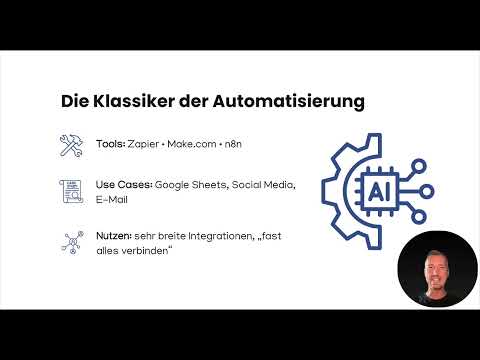
- Zapier, Make, and n8n are the three largest platforms for automation. With them, you can connect almost any applications with each other.
- In addition, there are simpler no-code tools such as IFTTT, Pabbly Connect, and Integrately, which are particularly suitable for beginners.
- AI tools such as ChatGPT, DALL-E, and Stable Diffusion can be integrated into workflows, for example for texts, summaries, or images.
- You don't have to master all the tools right away. In the end, you decide for yourself which platform fits your requirements.
Step-by-Step Guide
Step 1: Getting to Know the Three Major Automation Platforms
The course begins with the classics of automation: Zapier, Make, and n8n. All three are considered the largest platforms in this field. With them, you can connect applications such as Google Sheets, social media channels, or your email inbox with each other. According to the course, over 6,000 individual applications can be addressed through these platforms. For each of these three platforms, the course has its own detailed video with step-by-step explanations.

Step 2: Understanding Cloud, Self-Hosting, and Open Source
Before you decide on a platform, you should know how it is operated. Some solutions work purely in the browser and run entirely in the cloud. Others can be installed on your own server and self-hosted. The platforms also differ in whether they are open source, meaning whether the source code is publicly viewable. These differences play a role later on, for example regarding data protection or costs, and they are explained in more detail in the respective video.
Step 3: Understanding the Structure of the Course
The course builds up step by step. First, you get to know simple processes in which, for example, a new row in a spreadsheet triggers a notification. After that, more complex workflows follow with multiple steps, conditions, and data processing. Finally, you combine classic automations with AI support. So you learn not only how individual tools work, but also how to build processes logically.
Step 4: Comparing the Three Platforms
Zapier, Make, and n8n are suitable for beginners, provided you allow yourself a certain amount of time to get familiar with them. Make is the most visually appealing platform. There, you work with a clear graphical interface in which you build processes via drag-and-drop. n8n, on the other hand, is more technical, but extremely flexible. If you later want to build in your own logic or run the solution on your own server, n8n is often the right choice. In the course, you see both variants in direct comparison.

Step 5: Getting to Know Other No-Code Tools for Getting Started
Besides the three major platforms, there are smaller tools that are more specialized. These include IFTTT, Pabbly Connect, and Integrately. They are particularly suitable for beginners because they are often ready to use with just a few clicks. At the same time, they also give advanced users the opportunity to build smart automations quickly and pragmatically. In the course, they are covered after the main platforms so that you can make your choice in a targeted way.

Step 6: Preparing for the Introduction to AI Automation
The next step leads into the world of artificial intelligence. You learn how to integrate ChatGPT into your processes for text generation and summaries. The course also shows how to have images created automatically with DALL-E or Stable Diffusion. Imagine, for example, that a new blog post is automatically summarized, and a matching cover image is created right along with it. Exactly these kinds of combinations of classic automation and AI are the focus of the second part of the course.


Step 7: Clarify the Prerequisites for the Practical Part
Before you get started, you should know which technical prerequisites you need to bring with you. In the course, this is discussed in detail in the next video. There you will learn what you need for the setup, what to watch out for, and how you can start the practical exercises right away. So set aside some time and be sure to watch this video afterwards.
Summary – Learning Automation: Zapier, Make, and n8n at a Glance
In the course, you will get to know the three major automation platforms Zapier, Make, and n8n, supplemented by simple no-code tools. You will learn how cloud solutions differ from self-hosted variants and how the course builds from simple processes to complex workflows. Finally, you will combine classic automations with AI tools such as ChatGPT and DALL-E. The key point is that you don't have to master everything at once: you try out the tools step by step and in the end choose the platform that fits your goals.
FAQ
Which tools are presented as the main platforms in the course?The three main platforms are Zapier, Make, and n8n. They are considered the largest platforms for automations and can be connected with many applications.
Is the course also suitable for beginners?Yes, after a certain familiarization period, the three major platforms are also suitable for beginners. The course also increases in difficulty step by step.
Which platform is the most visually appealing?Make is considered the most visually appealing platform. n8n, on the other hand, is more technical but very flexible.
Which AI tools are used in the course?In the course, ChatGPT is integrated for text generation and summaries, and DALL-E and Stable Diffusion are integrated for automatic image creation.
Do I have to master all the tools completely right away?No. The course shows you each tool step by step, and in the end you decide for yourself which platform suits you best.
What will I learn in the next video?In the next video, the prerequisites and the setup for the practical part of the course are discussed.

