
Learning to program C# - from data types to object-oriented programming (video tutorial)

- Learn to program C# - ideal for beginners and suitable for anyone who wants to deepen their knowledge
- All the important basics: data types, methods, operators, arrays and loops
- Perfect for beginners: object-oriented programming and databases
- WPF and LINQ: Create a user interface (GUI) and query data from various sources
- 11 hours with trainer Uwe Sawinski - and you simply realize your C# software ideas yourself!
From data types to object-oriented programming - become a C# programming pro in no time with this course!
87 Videos, 667 minutes
Intro to the C# tutorial
C# programming: 1 | What can you expect in the course?
Would you like to learn how to program in C# and need an A-Z course that explains programming using practical examples? Would you like to learn more about object-oriented programming and control structures? Then this complete From Beginner to Expert C# Masterclass is for you.
Download, installation, and update of Visual Studio Community
C# Programming: 2.1 | Download and install Visual Studio Community
Learn how to download and install Microsoft Visual Studio Community.
C# programming: 2.2 | Create first project
In this lesson you will create your first project in C#.
C# programming: 2.3 | Installing components or language packages subsequently
In this lesson, you will learn how to install various required components or language packages in Visual Studio at a later date.
C# programming: 2.4 | Update of modules
In this lesson you will learn how to install module updates from the Visual Studio user interface.
C# programming: 2.5 | Update of Visual Studio
In this lesson, you will learn how to update the Visual Studio program yourself from the user interface.
Introduction to the user interface of Visual Studio
C# programming: 3 | Overview of the Visual Studio interface
In this lesson you will get an overview of the C# Visual Studio user interface.
Introduction to the source code editor, creation of the first program
C# programming: 4.1 | Explanation of the components in the source code editor
Here you will learn how to create source code in C# Visual Studio.
C# programming: 4.2 | Hello world! Our first small program in C#
You will learn how to compile your first source code in C# Visual Studio.
C# programming: 4.3 | Comments in source code
You will get an overview of how you can insert comments in the source code and what they are important for.
C# programming: 4.4 | Enlarge/reduce console (Console) and change background color
In this lesson, you will learn how to change the size and color of the Console output window.
C# programming: 4.4 | Enlarge/reduce console (Console) and change background color
5 min OpenIntroduction to data types and fundamentals
C# programming: 5.1 | What are data types and what types are there?
This lesson gives you an overview of the different data types.
C# programming: 5.2 | Examples of data types part 1 (e.g. integer)
In this lesson, you will learn about different data types using examples, e.g. integer.
C# programming: 5.3 | Examples of data types part 2 (e.g. float, double, decimal)
In this lesson, you will learn about different data types using examples, e.g. float, double and decimal.
C# programming: 5.4 | Examples of data types part 3 (e.g. strings incl. methods and properties)
In this lesson you will get to know the data type strings including methods and properties.
C# programming: 5.5 | Examples of data types part 4 (e.g. string methods such as search, change)
In this lesson, you will learn about and use the string methods Find and Change, among others.
C# programming: 5.6 | Naming, code and layout conventions
In this lesson, you will learn about and apply various naming, code and layout conventions.
C# programming: 5.7 | Data type conversion
Here you will learn how to convert a data type into another data type.
C# programming: 5.8 | Global and local constants
This lesson explains the difference between global and local constants.
C# programming: 5.3 | Examples of data types part 2 (e.g. float, double, decimal)
7 min OpenC# programming: 5.4 | Examples of data types part 3 (e.g. strings incl. methods and properties)
10 min OpenC# programming: 5.5 | Examples of data types part 4 (e.g. string methods such as search, change)
9 min OpenMethods
C# programming: 6.1 | Definition of methods
In this lesson, you will learn what methods are, how to create them and what they are used for.
C# programming: 6.2 | Methods without return value (Void)
In this lesson, you will learn what methods without a return value are.
C# programming: 6.3 | Methods with return value (first part)
In this first lesson on methods with return values, you will learn how to create and use them.
C# programming: 6.4 | Methods with return value (second part)
In this second lesson on methods with return values, the knowledge is deepened.
C# programming: 6.5 | Methods with return value/debugger (third part)
In this third lesson on methods with return values, the knowledge is deepened.
C# programming: 6.6 | Exercise for creating methods
In this exercise, you will be asked to create your own methods.
C# programming: 6.7 | Solution for creating methods
This lesson deals with the task from the last lesson and explains the solution.
Operators
C# programming: 7.1 | Overview of the types of operators
In this lesson, you will learn about the different types of operators.
C# programming: 7.2 | Arithmetic operators
The arithmetic operators are explained here.
C# programming: 7.3 | Comparison operators
This lesson deals with the comparison operators.
C# programming: 7.4 | Logical operators
In this lesson, you will learn about logical operators and how to use them.
C# programming: 7.5 | Assignment operators
In this lesson, you will learn about assignment operators.
C# programming: 7.6 | String concatenation
In this lesson you will learn about string concatenations.
Decisions/control structures
C# programming: 8.1 | Making your first simple decisions in C#
In this lesson you will learn how to deal with decisions within the program code.
C# Programming: 8.2 | If-Else-If-Else-Decisions/Control Structures
You will be introduced to the use of If-Else-If.
C# programming: 8.4 | Nested if-queries (if-statements)
In this lesson, you will learn how to use nested If queries.
C# Programming: 8.5 | Nested If Queries (Part 2)
In the second lesson on nested If queries, the knowledge is deepened further.
C# programming: 8.6 | Shorthand If, Else, If, Else (the ternary conditional operator)
This lesson explains the simplified handling of simple If queries.
C# programming: 8.7 | Switch statement (Switch, Case)
In this lesson, you will learn about the switch instruction and how to use it.
C# programming: 8.6 | Shorthand If, Else, If, Else (the ternary conditional operator)
12 min OpenLoops/Loop Types
C# programming: 9.1 | Overview of the different loops
You will receive an overview of the different types of loops.
C# programming: 9.3 | For loop with a double variable
This lesson deals with the For loop with a double variable.
C# programming: 9.4 | Do-While-Loop incl. Break
The use of the do-while loop including break is explained in this lesson.
C# programming: 9.5 | Solution for the do-while loop task
You will receive a detailed explanation of the solution to the task set.
C# programming: 9.6 | While loop
In this lesson, you will learn how to use a while loop.
C# programming: 9.7 | Break and Continue
This lesson deals specifically with the break and continue options.
Object-oriented programming (OOP)
C# programming: 10.1 | Introduction to object-oriented programming (OOP)
You will gain an overview of OOP (object-oriented programming).
C# programming: 10.3 | The constructor
This lesson explains the constructor and what it is used for.
C# programming: 10.4 | Using multiple constructors in a class
You will learn how to use multiple constructors in a class.
C# programming: 10.5 | Properties/Get- and Set-Properties
In this lesson, you will learn how to use get and set properties.
C# programming: 10.6 | Finalizer/Destructors
In this lesson, you will learn how to use finalizers (formerly known as destructors) using examples.
C# Programming: 10.7 | Inheritance (Part 1)
In the first part of the two lessons on inheritance, you will learn what inheritance means and how to use it. You will also be asked to create a subclass yourself.
C# programming: 10.8 | Inheritance (part 2, solution subclass)
In this lesson you will find the solution to the task Create a subclass.
C# programming: 10.9 | Polymorphism
In the last part of the OOP section, polymorphism is explained using examples.
Arrays
C# Programming: 11.1 | Arrays: Introduction and basics
In this lesson, you will learn about arrays and the basics of using them.
C# programming: 11.2 | Arrays: Practical examples
In this lesson, the use of arrays is explained in more detail using practical examples.
C# programming: 11.3 | ForEach-Loop/Foreach-Loop
You will learn how to use ForEach loops and their advantages.
C# programming: 11.4 | 2-dimensional arrays
In this lesson, the use of 2D arrays is explained using examples.
C# programming: 11.5 | 3-dimensional arrays
In this lesson, the use of 3D arrays is explained using examples.
C# programming: 11.6 | Jagged arrays (branched/jagged arrays)
You will learn the difference between the arrays and the JaggedArray is explicitly discussed here.
C# programming: 11.7 | ArrayList
This lesson explains how to use ArrayList using examples.
Practical examples – advanced C# areas
C# programming: 12.1 | Reading text files
This lesson uses an example to show how to read in text files.
C# programming: 12.2 | Writing text files
This lesson uses an example to show you how to write text files.
C# programming: 12.3 | Delegates
In this lesson, you will learn what delegates are and how they are used.
C# programming: 12.5 | Enumerations (Enums)
Using examples, you will learn what enumerations are.
C# Programming: 12.4 | Lambda Expressions
This lesson explains how to use lambda expressions.
WPF (Windows Presentation Foundation)
C# programming: 13.1 | WPF: Introduction and possible installation
In this lesson, preparations are made for working with WPF and creating GUIs.
C# programming: 13.2 | WPF: New IDE tools
You will get to know the new IDE tools for using WPF.
C# programming: 13.3 | WPF: Textbox
You create the first text box in the WPF environment.
C# programming: 13.4 | WPF: Button/Button-Click-Event/Dependency Properties
In this lesson, the button and the button-click event are explained and applied using examples.
C# programming: 13.5 | WPF: ComboBox/SelectionChanged and Loaded-EventHandler
You will learn how to use ComboBoxes and how to react to changes within the ComboBox.
C# programming: 13.6 | WPF: Tool tip
In this lesson, a useful tool (the tool tip) is used and discussed.
Use of databases in C#
C# programming: 14.1 | Introduction to the use of databases and chapter overview
In this introduction, you will learn why SQLite databases are used and in which environment they are used.
C# programming: 14.2 | Download required packages from the NuGet package manager
This lesson shows how to search for the required packages with the NuGet package manager for the use of SQLite databases and then install them.
C# programming: 14.3 | Establishing a connection to the SQLite database (incl. connection string)
You will learn how to set up and use a connection to an SQLite database.
C# programming: 14.4 | Create database and database table; fill table with initial data
In this lesson you will create your first database with the corresponding database tables.
C# programming: 14.6 | Fill ListBox with data from the SQLite database
In this lesson, the first data is selected from the database and displayed in a ListBox.
C# Programming: 14.7 | Link ListBox with a TextBox and display SQLite data
In this lesson you will learn how to link a TextBox to a ListBox and how to display and filter data in the ListBox.
C# programming: 14.8 | Inserting data into a SQLite database
In this lesson, user input is inserted and saved in the SQLite database.
C# programming: 14.9 | Changing data in a SQLite database
In this lesson you will learn how to change existing data in the SQLite database.
C# programming: 14.10 | Deleting data from a SQLite database
This lesson uses an example to show how to delete data from an SQLite database.
C# programming: 14.1 | Introduction to the use of databases and chapter overview
2 min OpenC# programming: 14.2 | Download required packages from the NuGet package manager
5 min OpenC# programming: 14.3 | Establishing a connection to the SQLite database (incl. connection string)
4 min OpenC# programming: 14.4 | Create database and database table; fill table with initial data
10 min OpenLINQ (Language Integrated Query)
C# programming: 15.1 | What is LINQ? First introduction
You will receive an initial introduction to LINQ and its use.
C# programming: 15.2 | LINQ and array queries
Using examples, you will learn how to use LINQ in conjunction with arrays.
C# programming: 15.3 | LINQ: Filtering and sorting
This lesson is about filtering and sorting using LINQ queries.
C# programming: 15.4 | LINQ: Using classes and lists
You will learn how to handle and use LINQ with the corresponding classes.
C# programming: 15.5 | LINQ: XML files and collections
This lesson shows how LINQ enables and simplifies working with XML files.
C# programming: 15.6 | LINQ: Edit class XElement/XML file from the Internet
Here you will learn how to use the XElement class in relation to XML files.
Examples of use
-
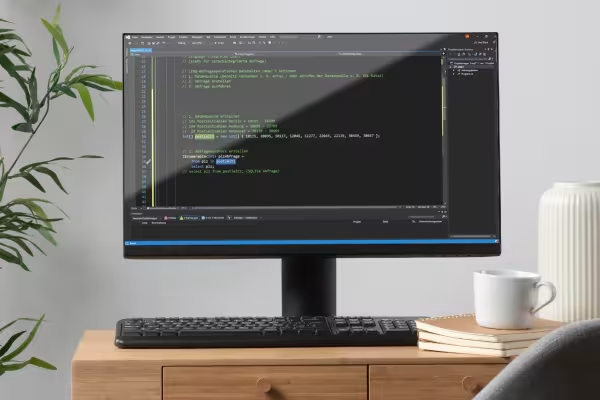 From data types to loops - learn all the important basics of C# programming.
 -
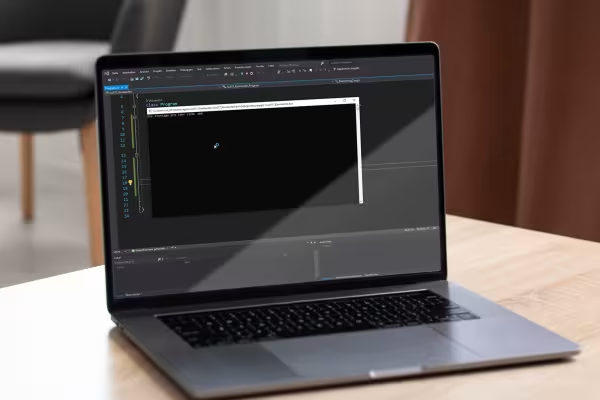 Write your first codes in C#, create a user interface and query databases.
You might also like

How your websites & apps speak like ChatGPT
Step by step to your own functional forms
For error-free, fast websites with optimized layouts
For modern websites & apps
Comment now „Learning to program C# - from data types to object-oriented programming (video tutorial)“